 Lee Vs. McClellan The First Campaign An interesting account of the struggle for western Virginia in 1861. It follows that year's rolls of Generals McClellan and Lee; the former using the successes of the campaign to further his reputation and career, and the latter struggling to straighten out a quagmire and failing to do so |
Union Civil War General
|
|
|
|
General McClellan's Advance Toward Richmond April 1862 May 1862 Kindle Available  Civil War Curiosities: Strange Stories, Oddities, Events, and Coincidences |
A brilliant engineer and highly capable organizer, George B. McClellan just wasn't an army commander. In that position he proved the weakness of West Point in its early years; the academy was simply geared to the production of engineers and company officers for a small, pre-Civil War regular army. The Philadelphia native had entered the academy from the University of Pennsylvania and graduated in 1846 in the second position of his class. Accordingly he was assigned to the engineers. He earned two brevets under Winfield Scott in Mexico and later served at his alma mater.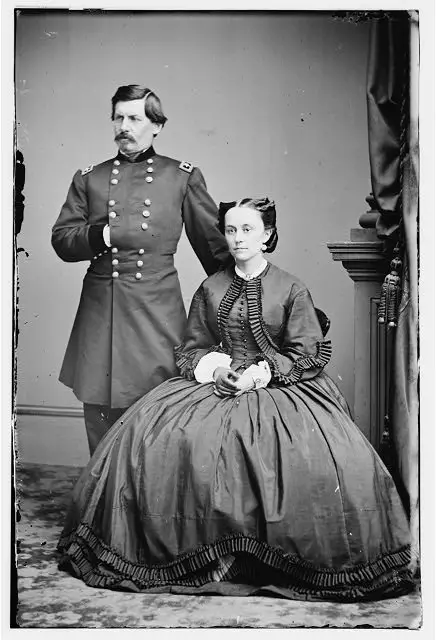 The slow promotions in the regular army prompted him to take a captaincy in the cavalry in the 1855 expansion of the service. He was dispatched to study European armies and filed an extensive report centering on the Crimean War siege operations at Sebastopol. This experience would later influence his decisions on the Virginia Peninsula. During the rest of his year overseas he travelled widely and altered the Prussian and Hungarian cavalry saddles into the "McClellan Saddle" that was used until the army abolished its mounted arm. He resigned his commission on January 16, 1857, and entered railroad engineering. He worked for the Illinois Central-as chief engineer and vice president and just before the Civil War became a division president for the Ohio & Mississippi. Despite his success in the private field he was happy to reenter the military in 1862. The slow promotions in the regular army prompted him to take a captaincy in the cavalry in the 1855 expansion of the service. He was dispatched to study European armies and filed an extensive report centering on the Crimean War siege operations at Sebastopol. This experience would later influence his decisions on the Virginia Peninsula. During the rest of his year overseas he travelled widely and altered the Prussian and Hungarian cavalry saddles into the "McClellan Saddle" that was used until the army abolished its mounted arm. He resigned his commission on January 16, 1857, and entered railroad engineering. He worked for the Illinois Central-as chief engineer and vice president and just before the Civil War became a division president for the Ohio & Mississippi. Despite his success in the private field he was happy to reenter the military in 1862. His assignments included: major general, Ohio Volunteers (April 23, 1861); commanding Ohio Militia (April 23 - May 13, 1861); commanding Army of Occupation, West Virginia, Department of the Ohio and the department (May 13-July 23, 1861); major general, USA (May 14, 1861); commanding Military Division of the Potomac (July 25 - August 15, 1861); commanding Army and Department of the Potomac (August 15, 1861 - November 9, 1862); and commander-in-chief, USA (November 5, 1861 - March 11, 1862). Initially appointed by Ohio's Governor William Dennison, he was soon made second only to Scott by a former attorney for the Illinois Central-Abraham Lincoln. Letting his rapid rise from retired captain to major general go to his head, he issued comical denials of any desire to become a dictator. By then he had won some minor victories in western Virginia, receiving the Thanks of Congress on July 16, 1861, although much of the credit belonged to his subordinates there and in Kentucky. He was called to take charge at Washington after the disaster at Ist Bull Run, but his behavior toward Scott and the civil authorities was unpardonable. Now called "The Young Napoleon," he actively worked for Scott's retirement and was named in his place. His engineering and organizational skills shined bright in the creation of the Army of the Potomac, a mighty machine. But he did not advance and refused to divulge his plans to the civilians over him. He even refused to see the president on one occasion. In December 1861 he was downed by typhoid and this prolonged the delays. By the time he did advance on Manassas, Joseph E. Johnston's army had withdrawn. McClellan then planned an advance on Richmond by way of the Peninsula between the James and York Rivers. It was a good plan despite Lincoln's fears for Washington. But McClellan did not have the ability to direct it. The movement started well but-remembering Sebastopol-he begin siege operations at Yorktown which allowed Johnston to move in reinforcements. When Johnston withdrew McClellan followed, fighting at Williamsburg, to within sight of the Confederate capital. He then stopped. He was constantly overestimating the strength of the enemy facing him. It was these constant delays which prompted Lincoln to suspend him from command of all the armies on March 11, 1862, so that he could concentrate on the Army of the Potomac and Richmond. He survived the Confederate counterattack at Seven Pines, principally through confusion in the Confederate army and the actions of his own subordinates. When Lee attacked him in the Seven Days in late June he failed to take the opportunity to strike at Richmond along the weakly defended south side of the Chickahominy River. Instead he panicked and ordered a dangerous change of base from the York to the James River in the facing of Lee's attacks. Most of the battles fought in the movement were Union successes but the overall outcome of the campaign was negative as a result of McClellan's weaknesses. Safely entrenched at Harrison's Landing he began condemning the War Department, Lincoln, and Stanton, blaming them for the defeat. Finally it was decided in Washington to abandon the campaign and transfer most of McCiellan's men to John Pope's army in northern Virginia. There were charges that McClellan-now called by the press "Mac the Unready" and "The Little Corporal of Unsought Fields"was especially slow in cooperating. With Pope defeated at 2nd Bull Run and his men streaming back to the Washington fortifications, McClellan was restored to active command of his reconstituted army and was welcomed by his men who affectionately called him "Little Mac." In the Maryland Campaign he advanced to confront Lee in the western part of the state and moved uncharacteristically fast when some of his command found a copy of Lee's orders for the movement of his troops. Lee fought several delaying actions along South Mountain in order to reconcentrate his army. His caution returning, McClellan slowed down, and Lee was able to get most of his men in line at Antietam. McClellan attacked piecemeal and his attacks failed to crush Lee who was heavily outnumbered with his back to the Potomac River. Lincoln was extremely upset by the escape of Lee and his army but nonetheless used the "victory" to issue the Emancipation Proclamation. Continuing his dilatory tactics, McClellan resorted to constant demands for more men and called for massive reequipping and fresh mounts for his cavalry. Then for the second time JEB Stuart's cavalry rode completely around the Army of the Potomac, Under orders from the War Department, McClellan relinquished command on November 9, 1862, and repaired to his Trenton, New Jersey, home to await new directives destined never to arrive. The Democratic candidate for president in 1864, he was hampered by the party's plank calling for an end to the war, which was labeled a failure. He himself denounced the plank and was for the rigorous pursuit of victory. At first it appeared that he would defeat Lincoln, but Union victories in the field diminished the public's war weariness. Winning in only three states, he resigned from the army on election day. Active in state politics, he served as New Jersey's governor in the late 1870's and early 1880's. He died on October 29, 1885, at Orange, New Jersey, and is buried in Riverview Cemetery, Trenton. |
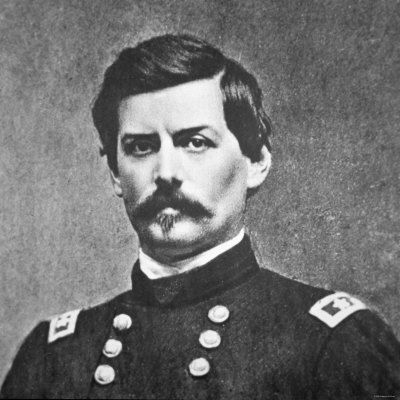
Portrait of General George B. Mcclellan Photographic Print 24 in. x 24 in. Buy at AllPosters.com Framed Mounted |
 Adult Union Officer Uniform |
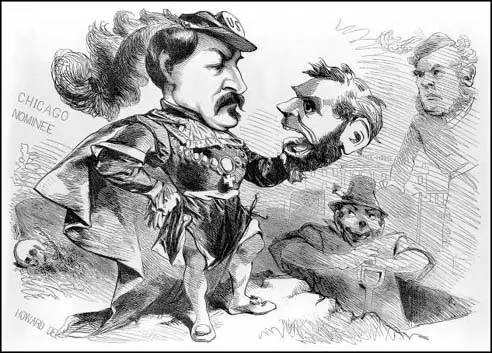 This cartoon of George McClellan holding the skull of Abraham Lincoln was published in the New York World during the presidential campaign of 1864. |
General McClellan's Invasion of Virginia 1862 The Union's invasion of Virginia, in 1862, is explained in a three part video filmed on location in Virginia. The narrative begins at Fort Monroe, in Hampton Road, and ends in Thoroughfare Gap in the Bull Run Mountains as Stonewall Jackson passes through on his way to Manassas Junction. The relationship between George McClellan and President Abraham Lincoln is analyzed and the obstacles it created for McClellan are examined and the decisions he made with regard to them analyzed, with a summing up of his performance as a professional soldier and the place it gives him in American civil war history. Starting at Fort Monroe, in the spring of 1862, General George B. McClellan moved an army of 85,000 men and 20,000 animals 90 miles up the Yorktown Peninsula, past the Confederate defenses at Yorktown and Williamsburg, to the Chickahominy River and the suburbs of Richmond, the Capital of the State of Virginia and the Confederacy. McClellan's campaign is presented with video from the actual locations where the movement occurred. The narrative takes you into the mind of McClellan, showing how he dealt with Lincoln and the problems the relationship created for the success of his mission and offers a comparsion between McClellan's performance in the East and General Grant's in the West. Finally, as General Lee takes command of the Army of Northern Virginia and McClellan is ordered by Lincoln to return his army to the environs of Washington, we follow General Lee as he moves on Pope. |
Lee Vs. McClellan: The First Campaign An interesting account of the struggle for western Virginia in 1861. It follows that year's rolls of Generals McClellan and Lee; the former using the successes of the campaign to further his reputation and career, and the latter struggling to straighten out a quagmire and failing to do so |
 The Civil War Papers Of George B. Mcclellan: Selected Correspondence, 1860-1865 General-in-chief of the entire Union army at one point, he led the Army of the Potomac through the disaster at Antietam Creek, was subsequently dismissed by Lincoln, and then ran against him in the 1864 presidential campaign. This collection of McClellan's candid letters about himself, his motivations, and his intentions |
 George B. McClellan and Civil War History: In the Shadow of Grant and Sherman The complex general who, though gifted with administrative and organizational skills, was unable and unwilling to fight with the splendid army he had created. In this book, Rowland presents a framework in which early Civil War command can be viewed without direct comparison to the final two years of the war |
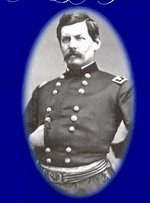 George B. Mcclellan: The Young Napoleon By age 35, General George B. McClellan (1826–1885), designated the "Young Napoleon," was the commander of all the Northern armies. He forged the Army of the Potomac into a formidable battlefield foe, and fought the longest and largest campaign of the time as well as the single bloodiest battle in the nation's history |
Kindle Available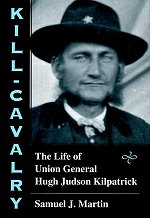 Kill-Cavalry: The Life of Union General Hugh Judson Kilpatrick Nicknamed "Kill-Cavalry" because of the unusually high casualty rate among his men, cavalry commander Hugh Judson Kilpatrick was also the most notorious scoundrel in the Union army. Kilpatrick lied, thieved, and whored his way through the Civil War, yet managed to attain the stars of a major general. |
Kindle Available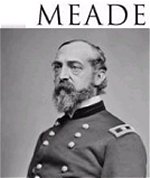 Meade: Victor At Gettysburg Meade took command only hours before his forces stumbled upon Robert E. Lee's Confederates at Gettysburg, Pennsylvania, in 1863. He led his men to victory in one of the most famous battles in history, but Meade was soon embroiled in political battles with fellow generals and Washington politicians |
Kindle Available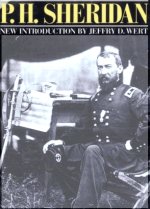 Personal Memoirs of P.H. Sheridan, General United States Army Philip H. Sheridan earned the enmity of many Virginians for laying waste to the Shenandoah Valley. His date and place of birth is uncertain, but he himself claimed to have been born in New York in 1831 |
Kindle Available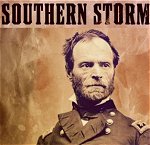 Southern Storm Sherman's March to the Sea The destruction spanned more than sixty miles in width and virtually cut the South in two, disabling the flow of supplies to the Confederate army. He led more than 60,000 Union troops to blaze a path from Atlanta to Savannah, ordering his men to burn crops, kill livestock, and decimate everything that fed the Rebel war machine |
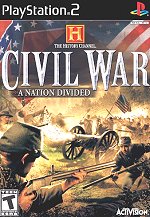 History Channel Civil War A Nation Divided Rally the troops and organize a counterattack -- Your strategic decision and talent as a commander will decide if the Union is preserved or if Dixie wins its independence |
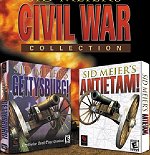 Sid Meier's Civil War Collection Take command of either Confederate or Union troops and command them to attack from the trees, rally around the general, or do any number of other realistic military actions. The AI reacts to your commands as if it was a real Civil War general, and offers infinite replayability. The random-scenario generator provides endless variations on the battles |
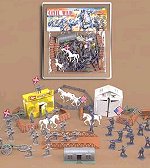 72 Piece Civil War Army Men Play Set 52mm Union and Confederate Figures, Bridge, Horses, Canon
|
 Civil War Soldier 102 Piece Playset
|
Sources:
Library of Congress
Federal Citizens
| Search AmericanCivilWar.com |
| Enter the keywords you are looking for and the site will be searched and all occurrences of your request will be displayed. You can also enter a date format, April 19,1862 or September 1864. |