
Subject: United States Navy Naval DVDs
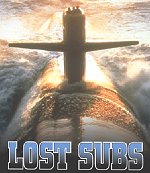 National Geographic - Lost Subs National Geographic's compulsively watchable Lost Subs: Disaster at Sea presents a gripping look at real-life submarine disasters. Four different undersea disasters are examined, from the first tiny problem to the final, tense rescue efforts. A blend of computer animation, contemporary news footage, and stock footage keeps the action moving and gives the viewer an effortless sense of the mechanics involved. In addition to the real-life drama, Lost Subs has a true geek's appreciation for the incredible technology of a sub--at one point a sailor shows that the sonar is sensitive enough to pick up the sound of shrimp feeding. |
DVD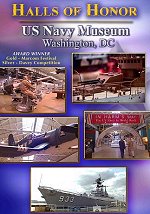 Halls of Honor The U.S. Navy Museum takes you on an informed and entertaining romp through one of North America s oldest and finest military museums. The museum has been in continuous operation at the Washington Navy Yard since the American Civil War |
DVD Raise The Alabama She was known as "the ghost ship." During the Civil War, the CSS Alabama sailed over 75,000 miles and captured more than 60 Union vessels. But her career came to an end in June of 1864 when she was sunk by the USS Kearsarge off the coast of Northern France |  U-Boat War This is a set of 3 documentaries covering the U-boat's impact in WWII, from beginning to end. It is well-written, and supplemented with interviews with American, British, and German survivors (and also historians) as well as a good amount of archival footage. It is really interesting to hear the story from those who were there -- including a number of German U-boat commanders. The breadth of coverage is good, including both German and Allied tactics (and how these tactics changed during the war), as well as technical advances on both sides. Coverage also includes developments in the Allies' ability to read the German naval code. |
|
Raise The Alabama She was known as "the ghost ship." During the Civil War, the CSS Alabama sailed over 75,000 miles and captured more than 60 Union vessels. But her career came to an end in June of 1864 when she was sunk by the USS Kearsarge off the coast of Northern France |
 The Big Aircraft Carrier Kid's-eye tour of the largest ship in the U.S.A Navy invites the viewer into a small airplane on land, takes them on a brief flight, through a landing on the USS Nimitz and through takeoff again. Along the way, there's a tour of the ship--the largest afloat on earth--from hospital to barbershop to library |
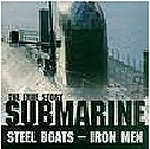 Submarine: Steel Boats - Iron Men This is the only program where the US Navy allowed a film crew to go down with a sub to see what really happens below the waves. As a result, the film presents a never before seen look inside a state of the art nuclear-powered sub on patrol. It shows, in extraordinary detail, the daily ordinary and extraordinary lives of submariners. You will see and hear things that you have never seen before. Steel Boats also shows the training, family life, off-time activities, etc. Viewers visit a "wet trainer" at Sub School to see what these submariners endure when they climb inside one of these remarkable ships. Who are these men, who live confined in a steel tube deep in the ocean for months at a time, surrounded by a hostile environment, in constant danger? |
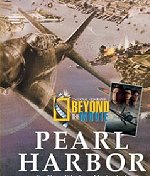 National Geographic Pearl Harbor This National Geographic DVD tells more than just commenting on the recent movie.It sets the record straight.For example,the American volunteers called "The Eagles" that flew against the Luftwaffe in The Battle Of Britain were all civilian volunteers and not military men as portrayed in the Pearl Harbor film.Of these 214 men,109 died going into battle against the Germans. |
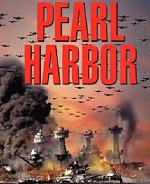
| The History Channel's Pearl Harbor This production provides an in-depth look at the Japanese attack on the American Pacific fleet in Pearl Harbor on the fateful day of December 7, 1941. The documentary begins by providing a background to the eventual conflict in the Pacific, noting how Japan had been waging a war of conquest in China since the early 1930s. As a power struggle with the U.S. loomed on the horizon, the Japanese built a formidable navy marked by an innovative utilization of carrier-based aircraft. Special attention is given to Admiral Yamamoto, who had studied at Harvard and admired America but vigorously planned the assault on America's naval might. The attack on the morning of December 7 is explained tactically, and films shot at Pearl Harbor during the Sunday morning air raid, |
 |
 Civil War Soldier 102 Piece Playset
| Civil War Naval Resources Civil War Ships and Battles Battle of the Monitor U.S. Army Timeline U.S. Navy Seals Young Reader Selections Civil War Summary |
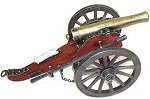 Civil War Cannon Collectible Models and childrens playsets Miniature Collectible Civil War Cannon12 pound Civil War field cannon replica weapon collectible is a detailed 1/12th scale military caisson replica weapon collectible as used throughout the Civil War Childrens Cannon Set. Includes 6 gray cannon with black wheels that measure 4.5 inches long |
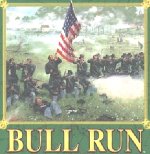 Battleground 7: Bull Run July 21, 1861 The earliest large-scale engagement of the Civil War, the First Battle of Bull Run found J.E. Johnston's outnumbered Rebels fighting a desperate delaying action versus the powerful Union army of Irvin McDowell. It was in this battle that General Thomas J. Jackson earned his famous nickname "Stonewall" |
 Civil War Battles Campaign Atlanta You decide the outcome of a duel between two determined generals in the American Civil War. It's 1864 and the Union forces are ready to make a final drive into the Deep South. General William T. Sherman advances to destroy the Confederate Army of Tennessee & capture the city of Atlanta. Confederate General Joseph E. Johnston planned on using Georgia's difficult terrain to inflict heavy losses |
 Campaign Chickamauga Civil War Battles A defining moment in the Civil War -- one that could have spelled victory for the South if things had been slightly different. At Chickamauga Creek near Chattanooga, TN there was a battle that earned it a new nickname: "River Of Blood." Chattanooga was a vital rail station at the time and had fallen to Union General Rosecrans |
 History Channel Civil War Secret Missions There are about a half-dozen different small arms types, but the Henry is the best for rapid repeating fire and least reloading. The shotgun they give you is useless: you must aim spot-on to affect an enemy, so why not just use the rifle? Grenades are useful at times. |
