|
|
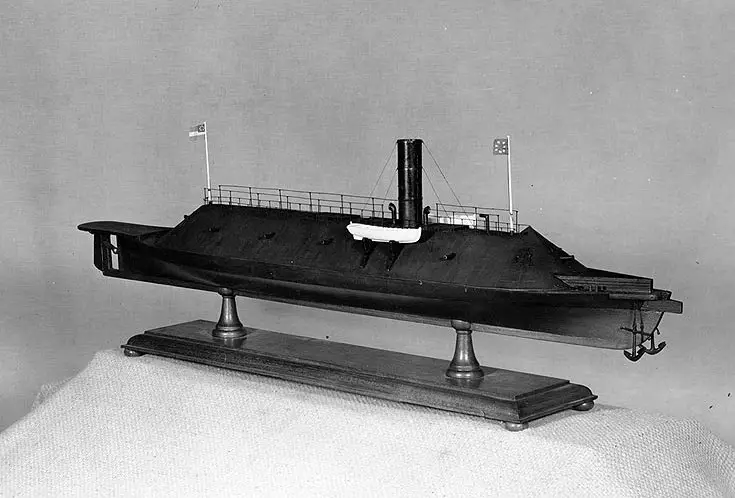
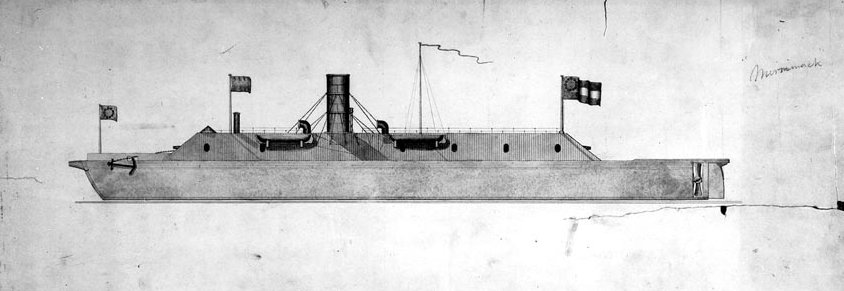
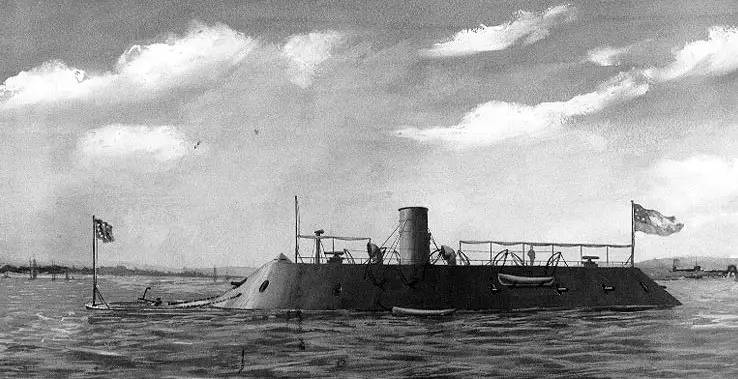
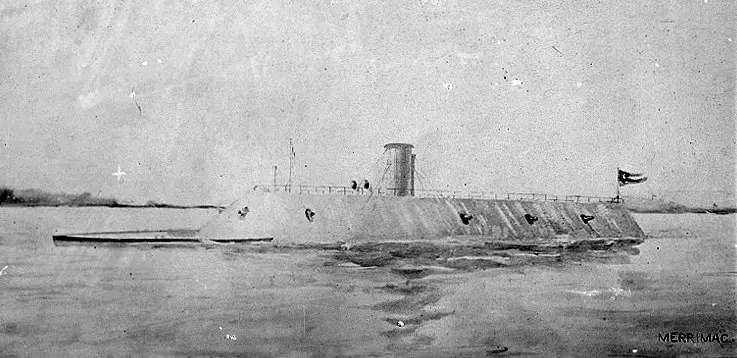
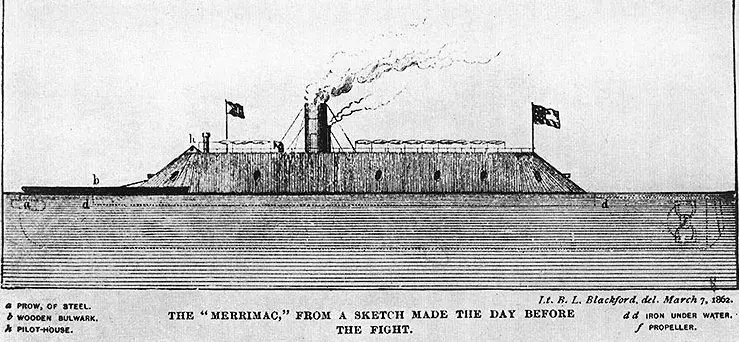
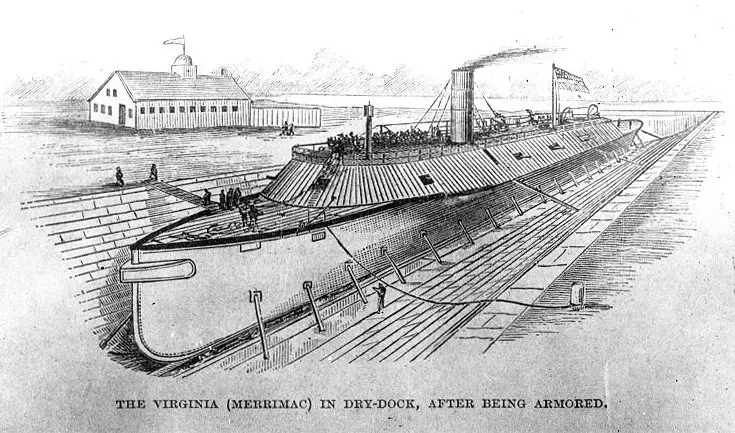
| On 20 April 1861, when Virginia authorities took over the Norfolk Navy Yard after its evacuatuation by Federal forces, they found, among other valuable items, the hulk of the steam frigate USS Merrimack . Though burned to the waterline and sunk, the big ship's lower hull and machinery were intact. During the remainder of 1861 and the first two months of 1862, the Confederate States Navy raised, drydocked and converted her into a casemate ironclad ram, a new warship type that promised to overcome the Union's great superiority in conventional warships. Placed in commission as CSS Virginia in mid-February 1862, the ship's iron armor made her virtually invulnerable to contemporary gunfire. She carried ten guns of her own, a seven-inch pivot-mounted rifle at each end and a broadside battery of two six-inch rifles and six nine-inch smoothbores. Affixed to her bow was an iron ram, allowing the ship herself to be employed as a deadly weapon. Virginia made her first combat sortie on 8 March 1862, steaming down the Elizabeth River from Norfolk and into Hampton Roads. In a historic action that dramatically demonstrated the superiority of armored steam-powered warships over their wooden sailing counterparts, she rammed and sank the big U.S. Navy sloop of war Cumberland and shelled the frigate Congress into submission. In Washington, D.C., many of the Federal Government's senior officials panicked, convinced that Virginia posed a grave threat to Union seapower and coastal cities. They were unaware that her serious operational limitations, caused by her deep draft, weak powerplant and extremely poor seakeeping, essentially restricted her use to deep channels in calm, inland waterways. However, their worries were relieved the next day. When Virginia returned to Hampton Roads to attack the grounded steam frigate USS Minnesota, she found the Union's own pioneer ironclad, USS Monitor, waiting. A second historic battle ensued, with the two opponents firing away, without mortal effect, until the action ended in a tactical draw in the early afternoon of 9 March 1862. Over the next two months, the two ironclads kept each other in check. Virginia , repaired and strengthened at the Norfolk Navy Yard, reentered the Hampton Roads area on 11 April and 8 May, but no further combat with the Monitor resulted. As the Confederates abandoned their positions in the Norfolk area, Virginia was threatened with the loss of her base. After a futile effort to lighten the ship enough to allow her to move up the James River, on 11 May the South's formidible ironclad was destroyed by her crew off Craney Island, some six miles from where she had electrified the World through her battles of 8 and 9 March. CSS Virginia 's wreck was largely removed between 1866 and 1876.
|
 Confederate Phoenix The CSS Virginia The CSS Virginia of the Confederate States Navy destroyed two of the most formidable warships in the U.S. Navy. Suddenly, with this event, every wooden warship in every navy in the world became totally obsolete DVD  Halls of Honor The U.S. Navy Museum takes you on an informed and entertaining romp through one of North America s oldest and finest military museums. The museum has been in continuous operation at the Washington Navy Yard since the American Civil War DVD |
| Colored outboard profile plan, originally in the files of the Bureau of Construction and Repair. Its origin is unknown, but it may be of Civil War vintage. Wash drawing by Clary Ray, 1898 Photograph of a 19th Century artwork. note the incorrect name "Merrimac" on the picture lower right Halftone reproduction of a line engraving, originally published in "Battles and Leaders of the Civil War". Engraving depicting the ship in drydock at the Norfolk Navy Yard, after the installation of her armor, circa early 1862. |
Kindle Available  Confederate Ironclad vs Union Ironclad: Hampton Roads 1862 The Ironclad was a revolutionary weapon of war. Although iron was used for protection in the Far East during the 16th century, it was the 19th century and the American Civil War that heralded the first modern armored self-propelled warships.  Ironclads and Big Guns of the Confederacy : The Journal and Letters of John M. Brooke Information about the Confederate Navy's effort to supply its fledgling forces, the wartime diaries and letters of John M. Brooke tell the neglected story of the Confederate naval ordnance office, its innovations, and its strategic vision. |
| Damaged Dahlgren gun from CSS Virginia Photographed at the Washington Navy Yard, D.C., 27 April 1933. Several other guns, relics of the Civil War and earlier conflicts, are beyond. The gun is inscribed: "One of the Guns of the MERRIMAC in the action with the U.S. Frigates CUMBERLAND and CONGRESS March 8th 1862 when the chase was shot off". The lower inscription reads: "The mutilation of Trunnions &c shows the ineffectual attempts to destroy the Gun, when the U.S. abandoned the Norfolk Navy Yard, April 20th 1861". This gun, presumably one of Virginia 's six IX-inch Dahlgren smoothbore guns, was on exhibit at Dahlgren, Virginia, in 1973. The Parrott gun (second from right in the row behind) is inscribed "Tug Teaser" 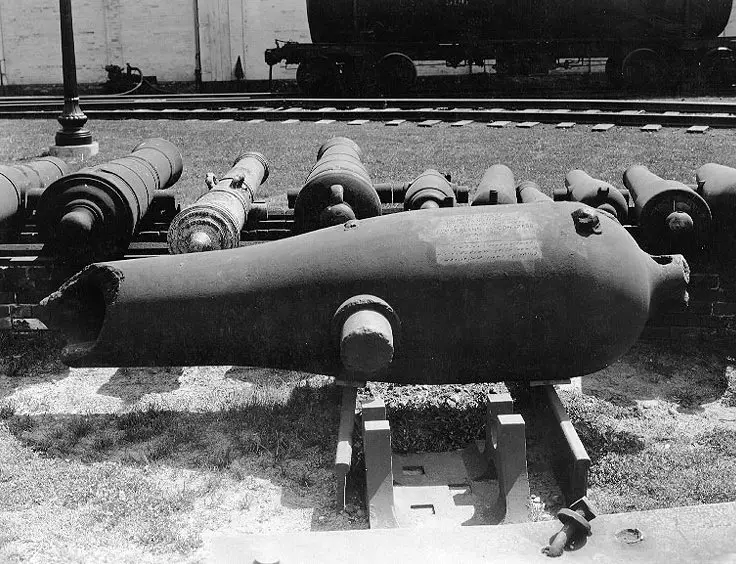 |
 Raise The Alabama She was known as "the ghost ship." During the Civil War, the CSS Alabama sailed over 75,000 miles and captured more than 60 Union vessels. But her career came to an end in June of 1864 when she was sunk by the USS Kearsarge off the coast of Northern France |
 1860 Enfield Civil War Musketoon This piece is a full-size non-firing reproduction of the rifle used in the Civil War. The body is made of European hardwood 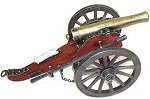 Civil War Cannon Collectible Models and childrens playsets Miniature Collectible Civil War Cannon12 pound Civil War field cannon replica weapon |
Civil War Ships and Battles Civil War Submarines RAM Ships Civil War Naval Timeline American Civil War Exhibits State Battle Maps Civil War Summary Civil War Timeline Women in the Civil War Battles by Campaign |
|
| Kindle Available Confederate Ironclad vs Union Ironclad: Hampton Roads 1862 The Ironclad was a revolutionary weapon of war. Although iron was used for protection in the Far East during the 16th century, it was the 19th century and the American Civil War that heralded the first modern armored self-propelled warships. Release date Nov. 2008 |
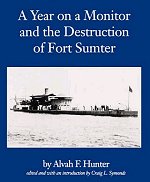 Year on a Monitor and the Destruction of Fort Sumter Personal view of the Civil War Navy. The monitor saw action in several significant naval assaults by the Union's Squadron. It took part in the failed Federal attack on Sumter in April 1863. The "Nahant" also participated in the capture of the Confederate Ram "Atlanta," and in the assault on Fort Wagner |
 Blockaders, Refugees, and Contrabands: Civil War on Florida'S Gulf Coast, 1861-1865 Coastal Florida had a refugee crisis as the war progressed. Escaped slaves ("contrabands") sought out the blockaders. Some joined the U.S. Navy. White men and their families sought to avoid conscription or vengeful neighbors/regulators and eventually sought refuge with the blockaders |
 War, Technology, and Experience aboard the USS Monitor The experience of the men aboard the Monitor and their reactions to the thrills and dangers that accompanied the new machine. The invention surrounded men with iron and threatened their heroism, their self-image as warriors, even their lives |
||||||
 Life in Mr. Lincoln's Navy A tantalizing glimpse into the hardships endured by the naval leadership to build and recruit a fighting force. The seaman endured periods of boredom, punctuated by happy social times and terrifying bouts of battle horror |
Kindle Available Glory in the Name: A Novel of the Confederate Navy From Norfolk to Hampton Roads, from Roanoke Island to the nighttime battle on the river below New Orleans, Glory in the Name tells the story of the Confederate States Navy, and the brave men who carried forward against overwhelming odds |
 Ironclad Down: USS Merrimack-CSS Virginia from Design to Destruction A treasure trove of detailed information about one of history s most famous vessels. Describing Stephen Russell Mallory, John Mercer Brooke, John Luke Porter, et al.--who conceived, designed and built one of the world's first ironclads |
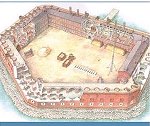 American Civil War Fortifications Coastal Brick and Stone Forts The design, construction and operational history of fortifications, such as Fort Sumter, Fort Morgan and Fort Pulaski. Stone and brick forts stretched from New England to the Florida Keys, and as far as the Mississippi River. A handful of key sites remained in Union hands throughout the war, the remainder had to be won back through bombardment or assault. |
||||||
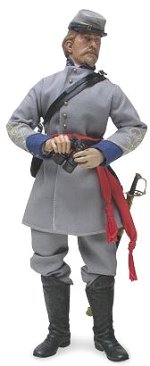 Infantry Officer Army of Northern Virginia 12 inch Figure |
Civil War Cannon Collectible Models and childrens playsets Miniature Collectible Civil War Cannon12 pound Civil War field cannon replica weapon collectible is a detailed 1/12th scale military caisson replica weapon collectible as used throughout the Civil War Childrens Cannon Set. Includes 6 gray cannon with black wheels that measure 4.5 inches long |
 Professor Noggin's Civil War Trivia Game
|
 Civil War Soldier 102 Piece Playset
|
||||||
 72 Piece Civil War Army Men Play Set 52mm Union and Confederate Figures, Bridge, Horses, Canon
|
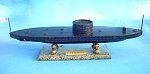 Monitor 21" Civil War Ship Wood Model Fully Assembled
|
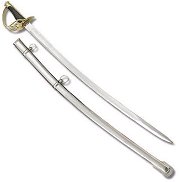 Cavalry Saber This fine replica is 39 inches overall and features a highly polished 33 inch carbon steel blade. Its leather wrapped handle fits the hand perfectly and sports decorative brass accents and a shiny brass pommel. |
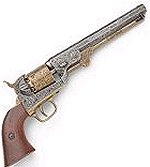 Civil War Model 1851 Naval Pistol Engraved Silver Tone / Gold Tone Finish and Wooden Grips - Replica of Revolver Used by Both USA / Union and CSA / Confederate Forces |
Halls of Honor The U.S. Navy Museum takes you on an informed and entertaining romp through one of North America s oldest and finest military museums. The museum has been in continuous operation at the Washington Navy Yard since the American Civil War |
Raise The Alabama She was known as "the ghost ship." During the Civil War, the CSS Alabama sailed over 75,000 miles and captured more than 60 Union vessels. But her career came to an end in June of 1864 when she was sunk by the USS Kearsarge off the coast of Northern France |
 The Civil War - A Film by Ken Burns Here is the saga of celebrated generals and ordinary soldiers, a heroic and transcendent president and a country that had to divide itself in two in order to become one |
 Civil War Journal The Conflict Begins These four programs from the History Channel series Civil War Journal cover critical aspects of the early days of the war. |
Sources:
U.S. National Park Service
U.S. Library of Congress
US Naval Archives