
Decoding Civil War Soldier Letters

Silas Weaver
Silas Weaver has spent decades exploring historic battlefields, reading primary journals, and tracking down the lesser-known stories of the American Civil War. His lifelong passion for 19th-century history comes through in his engaging accounts of the places, people, and lingering questions of the era. He believes that walking the actual grounds where history happened is the best way to truly connect with the past.
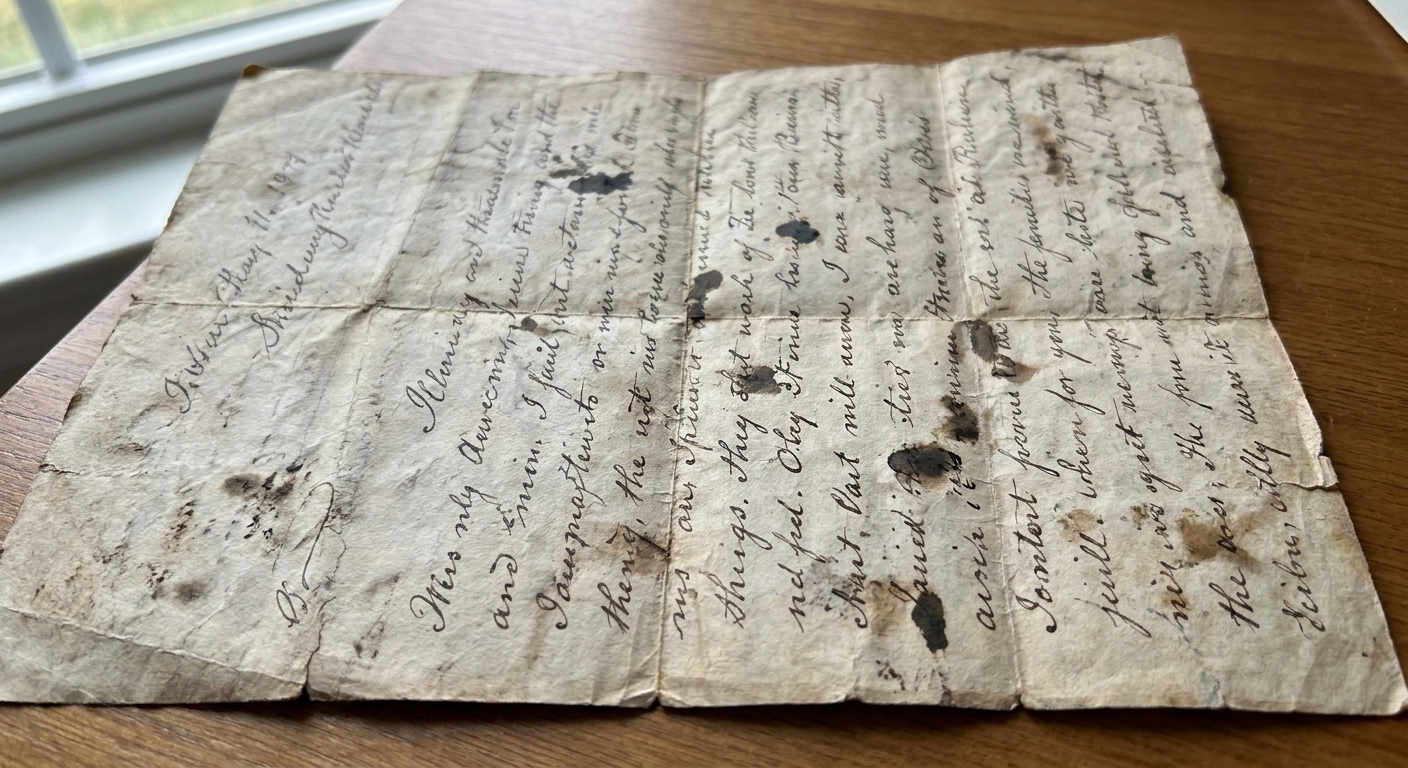
I still remember the first Civil War letter that really stopped me cold. It was a photographed page in a small local archive, brown ink fading into cream paper. The soldier wrote with a steady hand until he didn’t. Midway down, the lines tightened, the spelling went sideways, and a few words looked more like fence rails than letters. I could make out enough to feel the nearness of him, but not enough to understand him. That is the thing about soldier letters. They are honest, immediate, and deeply human, but they speak a dialect of the 1860s. Once you learn that dialect, a “hard march” becomes a specific misery, “skedaddling” turns into gallows humor, and a simple “we drawd 3 days rations” tells you more about hunger than a modern paragraph ever could.
This guide is meant to help you read primary letters the way the families back home learned to read them: with context, patience, and an ear for the soldier’s own shorthand. For broader context on daily life and routines of the era, you can also wander through our Civil War Life guide.
Start with the “envelope clues” inside the letter
Before you decode a single abbreviation, get your bearings. Soldier letters often contain the same kind of information we put on an envelope or email header today, but scattered through the first lines or the closing.
- Date and place: sometimes formal (“Camp near Falmouth, Va.”), sometimes vague (“near the river”), sometimes strategic (“somewhere in Dixie”).
- Unit information: company and regiment might appear as a signature line, a return address, or a casual mention.
- Audience: “Dear Mother,” “My dearest wife,” or “Friend John” matters because the same soldier writes differently to each.
- Situation markers: “on picket,” “in winter quarters,” “after the fight,” “in hospital.” These phrases tell you what sort of day you are reading.
If you have a battlefield in mind, it can help to pair a letter with the geography. I do this constantly on the road. Walking the ground brings meaning to phrases like “the swamp,” “the ridge,” or “the pines.” Our Battles guide and Battlefield Travel guide can help you connect the words to places.
Common abbreviations you will see again and again
Most soldiers learned to save space and time. Paper was precious, candles burned low, and a man might be writing on his knee. Abbreviations are not a code so much as a habit.
Units and ranks
- Co. = Company
- Regt. or Reg. = Regiment
- Brig. = Brigade
- Div. = Division
- Genl. = General
- Col. = Colonel
- Lt. = Lieutenant
- Capt. = Captain
- Sergt. = Sergeant
- Corp. = Corporal
- Adj. = Adjutant
- Q.M. or QM = Quartermaster
- Com. (context matters) = Commissary or Command
Time, directions, and basic shorthand
- inst. = “of this month” (for example, “the 12th inst.” means the 12th of the current month)
- ult. = “of last month”
- prox. = “of next month” (less common, but it appears)
- A.M. = before noon
- P.M. = after noon
- morn., evng., aft. = morning, evening, afternoon
- wd. = would
- abt. = about
- & = and (often used heavily)
- U.S. = United States (also used as shorthand for Federal forces)
- U.S.A. = sometimes appears, often closer to official paperwork than everyday letter writing; many soldiers simply wrote “U.S.” or “U.S. Army” when they wrote it at all
Supplies and pay
- rations: often written out, but you will also see shorthand and phonetic spellings. Some writers shorten it in idiosyncratic ways, and some spell it the way it sounds.
- draw or “drawed/drawd” = issued by the army (rations, clothing, pay)
- ord. = ordnance or orders (context decides which)
- amun. or “amunition” (many spellings) = ammunition
- subs. = subsistence (food allowance or rations in the paperwork sense)
One caution: spelling was flexible. “Regiment” might be “regament.” “Lieutenant” might be “leftenant.” Do not “correct” the soldier in your mind too quickly. Let the letter teach you its own rules.
Slang and soldier talk
Soldiers in both armies borrowed from newspapers, stage humor, politics, and camp life. Some slang is obvious. Some is so period-specific it can sound like nonsense until you have heard it enough.
Movement and combat
- Skedaddle: to run off in a hurry, often used as a joke about retreat or sudden movement. It can be playful or cutting, depending on who is doing the “skedaddling.”
- On the double: move quickly, at a run or fast pace.
- Fall in / fall out: form up for duty, or be dismissed from formation.
- Under fire: literal incoming fire, but also sometimes used to describe any dangerous exposure, like artillery harassment.
- Sharp-shooters (often written as two words): marksmen. Sometimes this means designated skirmishers, sometimes it refers to any accurate enemy fire.
- Shelling: artillery fire. If a soldier writes about “shells bursting over us,” it could mean airbursts from timed fuses, bursts in treetops, or detonations close by. Do not assume it was only ground impacts, or only overhead, without more clues.
Camp life and misery
- Hardtack: the infamous army cracker, often described as “wormy,” “like a brick,” or “fit for building.”
- Fatigue or fatigue duty: work details like digging, hauling, cutting wood, building roads, and fortifying.
- Picket: guard duty forward of the main line. “On picket” usually means little sleep and a lot of listening.
- Detail: a work assignment or temporary duty, not “details” in the modern sense.
- Greenbacks: paper money issued by the United States. Confederate soldiers might mention their own currency with more bitterness as the war went on.
- Quinine: a common medicine, especially in malarial country. It shows up in letters from river valleys and swampy ground, and it often means a man is trying to keep functioning, not that he is truly well.
Food, foraging, and “making do”
- Forage or foraging: gathering food or feed, officially or unofficially. Read carefully. Some men describe it like a necessary chore. Others describe it like a raid.
- Confiscate: often a wink-wink word for taking. Union soldiers especially used it to soften what could be outright theft.
- Mess: a small group that eats together. “Our mess” can tell you who his closest companions were.
Injuries and illness
- Laid up: sick or injured, sometimes in hospital, sometimes just unable to march.
- Down with the diarrhea or flux: intestinal illness. It appears constantly and can be deadly in context.
- Hospital: could mean a large general hospital, a field hospital after a fight, or a regimental hospital setup.
- Slightly wounded: do not take “slight” at face value. Men downplayed injuries to spare families fear.
When you read slang, ask what the soldier is trying to do emotionally. Some slang is comic relief. Some is bravado. Some is a man trying to keep his mother from worrying.
Military terms that trip up modern readers
A lot of confusion comes from ordinary words used in military senses.
- Line: could mean the battle line, the line of march, or the broader “line” of the army’s position.
- Works: fortifications. “The works” might be a trench line, earthworks, or a fortified hilltop.
- Relieved: replaced on duty. “We were relieved at midnight” means another unit took their place.
- Rations for X days: not a promise of comfort, just an accounting. Three days rations might mean three days of hardtack and salt pork, and not much else.
- Reconnoiter (many spellings): scouting, often under threat.
- Skirmish: could mean anything from a sharp exchange to an all-day fight. Some soldiers called major actions “skirmishes” if they were not the “big battle” on the map.
- Paroled: released on promise not to fight until exchanged, especially common in 1861 to 1863. A man might be home and still technically not free to rejoin until exchanged.
- Exchanged: formally swapped as a prisoner. If a letter says “we hope for exchange,” he is speaking of a bureaucratic and political process, not a simple trade.
Handwriting and spelling
If you have ever stared at a word for five minutes and then suddenly seen it clear as day, you already know the trick. Reading 1860s handwriting is less about genius and more about getting your eye accustomed to a particular hand.
Practical steps that work
- Read it aloud. Your ear can catch a word your eye cannot.
- Start with what you know. Names, places, “Dear,” and “Your affectionate son” provide letter-shapes you can compare to unknown words.
- Look for repeated words. “Camp,” “the,” “and,” “we,” “home,” “God,” “health” appear often. Once you identify them, you have a key.
- Expect phonetic spelling. “Rite” for “write,” “enimy” for “enemy,” “sech” for “such.” The sound matters more than the dictionary.
- Assume missing punctuation. Many letters are long rivers of words. Break them into sentences yourself.
If you are transcribing, I like a two-pass method: first pass for meaning, second pass to preserve the writer’s quirks. Keep the original spelling in your transcript, but keep your clarifying notes separate from the text. The goal is to preserve the voice without losing the sense.
Paper quirks you will see
Even when the words are clear, the page itself can fight you. A few common headaches are not handwriting at all, but the physical habits of men writing with limited paper, dim light, and no desk.
- Cross-writing: after filling the page, the writer turns it and writes across the earlier lines at a right angle. It saves paper and destroys modern patience. Read one layer of text at a time.
- Margins and “squeezed” lines: the last paragraph often creeps into margins, curls around a signature, or shrinks as the candle dies.
- Reused paper: you may see ghost-text from an earlier note, a printed form, or a penciled list underneath the ink.
- Ink issues: blotting, fading, and ink that feathers in damp conditions can turn one letter into three possible letters. Context is your friend.
- Tears and missing corners: assume you are reading a survivor. If a sentence stops mid-thought, it might be the paper, not the man.
“Somewhere” and other vagueness
Soldiers often avoided naming exact locations. Sometimes it was censorship. Sometimes it was common sense. Sometimes it was a man protecting his family from worry, or protecting himself from being accused of loose talk.
- Intermittent censorship: some commands instituted mail monitoring at certain times, especially around active operations. It was uneven, and it changed by army, theater, and moment.
- Self-censorship: “I cannot tell you where we are” is often sincere and sometimes a little performative.
- Vague geography: “near Richmond,” “in Virginia,” “down the river” may be the only safe description. In those cases, check the unit’s movements on that date and you can often narrow it down.
When a letter feels cagey, do not assume the writer is ignorant. Often he knows exactly where he is, and chooses not to say.
Religious and sentimental language
Modern readers sometimes skim the faith-heavy lines as filler. I try not to. For many soldiers and families, religious language was the shared vocabulary of fear, hope, and grief.
- “Providence” and “the Lord willing” often signal genuine uncertainty about survival, not mere habit.
- “I feel it my duty” can mean moral conviction, community pressure, or both.
- “Remember me to…” is a social map, showing who mattered back home.
- “If I should not return…” is not rare. Sometimes it is a sober premonition, sometimes it is a man trying to tidy his affairs in words.
If you want a deeper feel for the soldier’s material world that sits behind those emotional lines, take a look at Swords, Revolvers, and Steeds. Weapons and horses show up in letters the way tools show up in a tradesman’s notes: as both pride and burden.
A quick decoding table
| Letter term | Likely meaning in context |
|---|---|
| “We drew” | We were issued rations, clothing, pay, or supplies |
| “On picket” | Guard duty forward of camp, often exposed and sleepless |
| “Detail” | Temporary assigned duty, often labor |
| “The works” | Earthworks, trenches, fortifications |
| “Skirmishing” | Fighting that could range from minor to intense depending on the writer |
| “We advanced” | Moved forward under orders, sometimes into fire |
| “We fell back” | Withdrew, could be orderly or chaotic |
| “I am well” | Often means “well enough to write,” not necessarily healthy |
| “Send me papers” | Newspapers from home, a lifeline for morale and politics |
| “Your obt. servt.” | “Your obedient servant,” a common closing that signals politeness, not intimacy |
When a word means two things
A few terms are notorious for having multiple meanings. Here is how I sort them out.
“Battery”
- Artillery unit: most common usage.
- Guns firing on a position: sometimes a soldier will say “the battery opened on us,” clearly meaning the guns and the men serving them.
“Yankee” and “Reb”
- These can be insults, jokes, or simply shorthand. A Southern soldier might say “the Yankees” with a bitterness that changes from 1861 to 1864. A Union soldier might use “Rebs” like it is a weather report, then later write about a captured enemy with surprising sympathy.
“Contraband”
- Escaped enslaved people who came into Union lines were often referred to as “contrabands,” a term born out of wartime policy. If you see it, read slowly. It is a revealing word, and not a gentle one.
“Freedmen”
- This term appears as the war progresses and in postwar letters. It can signal a changing legal reality, but the tone of the writer matters. The same word can carry respect, paternalism, or hostility.
A simple decoding method
- Transcribe the letter as-is, keeping spelling. In your working notes, mark unclear spots with a question mark or a short note to yourself, rather than forcing a guess.
- Highlight nouns: people, places, units, rivers, towns. Those anchor your interpretation.
- Circle military verbs: marched, advanced, fell back, relieved, drew, detailed, ordered.
- Build a timeline: even a rough one. “Yesterday,” “this morning,” “last Sunday,” “the 14th inst.”
- Check the unit’s known movements on that date. When the letter is vague, the unit history often is not.
- Re-read for tone: Is he boasting, pleading, joking, or trying to reassure? Tone is part of the meaning.
That last step matters more than most people expect. A soldier could write “we had a splendid time” and mean it, or mean the exact opposite with a tired wink. You learn the difference by reading several letters by the same hand.
Light transcription rules
If you plan to share a transcription with family or fellow researchers, consistency helps. I keep it simple.
- Keep original spelling. If you need to clarify, do it in a note outside the text.
- Mark uncertainty with a question mark after your best guess: marchd(?).
- Mark unreadable words plainly: [illegible].
- Use “sic” sparingly. Most of the time, original spelling speaks for itself.
- Expand abbreviations carefully. If you expand, consider doing it in a note, so the original stays intact.
FAQ
Why do so many Civil War letters say “I am well” even during awful campaigns?
Because the letter is partly a balm for the folks at home. Many men led with reassurance before reporting anything else. Also, “well” can mean “alive,” “not in the hospital,” or simply “able to hold a pen.”
How do I handle offensive language in a letter?
Do not sand it down in your mind. It is part of the historical record, and it tells you who the writer was and what his world normalized. When sharing publicly, I favor honest quotation with brief context, especially if readers might be blindsided.
Are abbreviations standardized?
Some are, especially ranks and common terms, but plenty are personal habits. Two soldiers in the same company might shorten words differently.
What is the fastest way to get better at the handwriting?
Read a lot of it, and read one writer at a time. Your brain adjusts to a single hand quickly. Jumping between writers is like switching accents every paragraph.
A final thought from the road
I have read letters in quiet museums, in county libraries that smell like old paper, and in my camper with rain tapping the roof. The more you decode, the more the letters stop being “old documents” and start sounding like voices. Not polished voices, not always educated voices, but voices that worried about boots and coffee, about pay and pride, about the next march and the next letter from home.
If you ever find yourself at a battlefield overlook with a transcribed letter in your lap, you will feel what I felt as a kid near Gettysburg: the past is not gone. It is under your feet, and sometimes it is right there in the ink, waiting for you to learn how to read it.
For more background reading in the same spirit, see more from Silas Weaver.