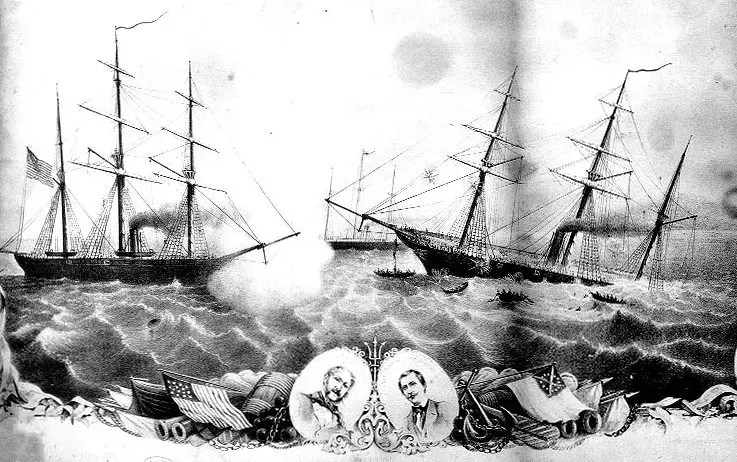
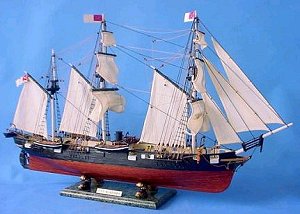
CSS Alabama (1862-1864)CSS Alabama , a 1050-ton screw steam sloop of war, was built at Birkenhead, England, for the Confederate Navy. After leaving England in the guise of a merchant ship, she rendezvoused at sea with supply ships, was outfitted as a combatant and placed in commission on 24 August 1862. Commanded by Captain Raphael Semmes , Alabama cruised in the North Atlantic and West Indies during the rest of 1862, capturing over two-dozen Union merchant ships, of which all but a few were burned. Among those released was the mail steamer Ariel , taken off Cuba on 7 December with hundreds of passengers on board. Alabama began the new year by sinking USS Hatteras near Galveston, Texas, on 11 January 1863. She then moved into the South Atlantic, stopped at Cape Town in August, and went on to the East Indies, seizing nearly 40 more merchantmen during the year, destroying the majority and doing immense damage to the seaborne trade of the United States. The Confederate On 19 June, Alabama sailed out to meet Kearsarge . As Kearsarge turned to meet its opponent, Alabama opened fire. Kearsarge waited patiently until the range had closed to less than 1,000 yards. According to survivors, the two ships steamed on opposite courses moving around in circles as each commander tried to cross the bow of his opponent to deliver a heavy raking fire. The battle quickly turned against Alabama because of the poor quality of its powder and shells, while Kearsarge benefitted from the additional protection of chain cables along its sides. A little more than an hour after the first shot was fired, Alabama was reduced to a sinking wreck, causing Semmes to strike his colors and send a boat to surrender. According to witnesses, Alabama fired 150 rounds at its adversary, while Kearsarge fired 100. When a shell fired by Kearsarge tore open a section at Alabama 's waterline, the water quickly rushed through the cruiser, forcing it to the bottom. While Kearsarge rescued most of Alabama 's survivors, Semmes and 41 others were picked up by the British yacht Deerhound and escaped to England. During its two-year career as a commerce raider, Alabama caused disorder and devastation across the globe for United States merchant shipping. The Confederate cruiser claimed more than 60 prizes valued at nearly $6,000,000. Her wreck was located by the French Navy in the 1980s. |
![]() Wolf of the Deep: Raphael Semmes and the Notorious Confederate Raider CSS Alabama In July 1862, the Confederate captain Raphael Semmes received orders to report to Liverpool, where he would take command of a secret new British-built steam warship. His mission: to prey on Union commercial vessels and undermine the North's ability to continue the war |
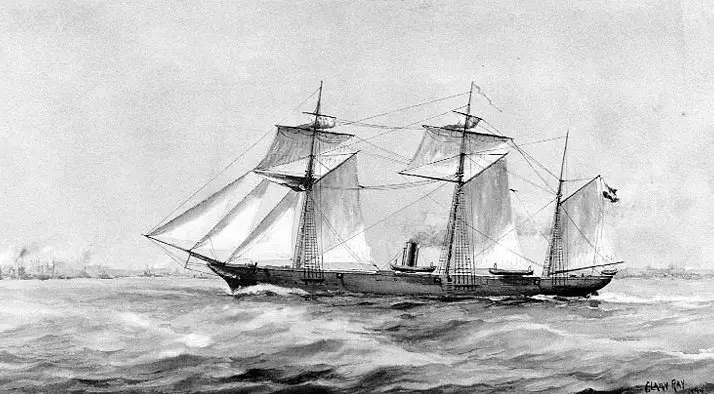
Sepia wash drawing by Clary Ray Navy Art Collection |
![]() Ironclads and Big Guns of the Confederacy : The Journal and Letters of John M. Brooke Information about the Confederate Navy's effort to supply its fledgling forces, the wartime diaries and letters of John M. Brooke tell the neglected story of the Confederate naval ordnance office, its innovations, and its strategic vision. |
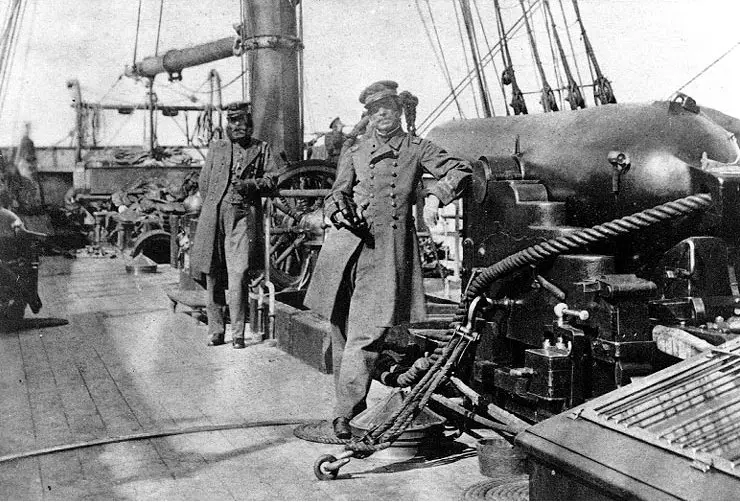
| Captain Raphael Semmes, Alabama 's commanding officer, standing by his ship's 110-pounder rifled gun during her visit to Capetown in August 1863. His executive officer, First Lieutenant John M. Kell, is in the background, standing by the ship's wheel. |
![]() Midshipman in Gray: Selections from Recollections of a Rebel Reefer |
![]() Confederate Ironclad vs Union Ironclad: Hampton Roads 1862 The Ironclad was a revolutionary weapon of war. Although iron was used for protection in the Far East during the 16th century, it was the 19th century and the American Civil War that heralded the first modern armored self-propelled warships. Release date Nov. 2008 |
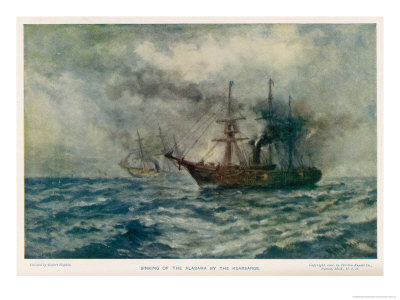
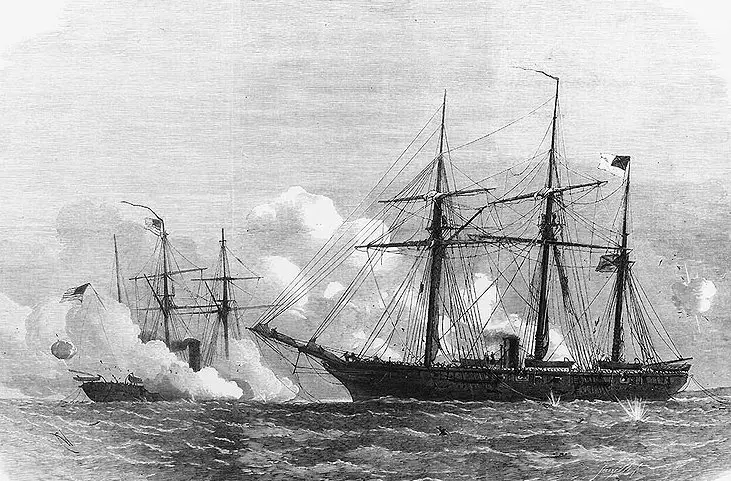
The action between the Ironclad Federal steamer 'Kearsarge' and the Confederate steamer 'Alabama', off Cherbourg, June 19th 1864. |
| |
![]() Confederate Ironclad 1861-65 Every aspect of Confederate ironclads is covered: design, construction, armor, armament, life on board, strategy, tactics, and actual combat actions. |
Civil War Ships and Battles
Civil War Submarines
Civil War Naval Timeline
American Civil War Exhibits
State Battle Maps
Civil War Summary
Civil War Timeline
Women in the Civil War
Battles by Campaign
Civil War Store
![]() Battle on the Bay: The Civil War Struggle for Galveston Civil War history of Galveston is one of the last untold stories from America's bloodiest war, despite the fact that Galveston was a focal point of hostilities throughout the conflict. Galveston emerged as one of the Confederacy's only lifelines to the outside world. |
![]() Year on a Monitor and the Destruction of Fort Sumter Personal view of the Civil War Navy. The monitor saw action in several significant naval assaults by the Union's Squadron. It took part in the failed Federal attack on Sumter in April 1863. The "Nahant" also participated in the capture of the Confederate Ram "Atlanta," and in the assault on Fort Wagner |
![]() Blockaders, Refugees, and Contrabands: Civil War on Florida'S Gulf Coast, 1861-1865 Coastal Florida had a refugee crisis as the war progressed. Escaped slaves ("contrabands") sought out the blockaders. Some joined the U.S. Navy. White men and their families sought to avoid conscription or vengeful neighbors/regulators and eventually sought refuge with the blockaders |
![]() War, Technology, and Experience aboard the USS Monitor The experience of the men aboard the Monitor and their reactions to the thrills and dangers that accompanied the new machine. The invention surrounded men with iron and threatened their heroism, their self-image as warriors, even their lives |
![]() Life in Mr. Lincoln's Navy A tantalizing glimpse into the hardships endured by the naval leadership to build and recruit a fighting force. The seaman endured periods of boredom, punctuated by happy social times and terrifying bouts of battle horror |
![]() Glory in the Name: A Novel of the Confederate Navy From Norfolk to Hampton Roads, from Roanoke Island to the nighttime battle on the river below New Orleans, Glory in the Name tells the story of the Confederate States Navy, and the brave men who carried forward against overwhelming odds |
![]() Ironclad Down: USS Merrimack-CSS Virginia from Design to Destruction A treasure trove of detailed information about one of history s most famous vessels. Describing Stephen Russell Mallory, John Mercer Brooke, John Luke Porter, et al.--who conceived, designed and built one of the world's first ironclads |
![]() The Civil War on Hatteras Island North Carolina New light on the experiences of Civil War soldiers stationed on the Outer Banks. It follows the crucial maritime battles along the Outer Banks and the famous Burnsides Expedition. Aa fascinating history of how one of America's most treasured islands played a significant part in the Civil War |
![]() Naval Strategies of the Civil War: Confederate Innovations and Federal Opportunism Compare and contrast the strategies of the Southern Secretary of the Navy, Mallory, against his rival in the North, Welles. Mallory used technological innovation and the skill of individuals to bolster the South's seapower against the Union Navy's superior numbers |
![]() Confederate Ironclad 1861-65 Every aspect of Confederate ironclads is covered: design, construction, armor, armament, life on board, strategy, tactics, and actual combat actions. |
![]() Reign of Iron: The Story of the First Battling Ironclads, the Monitor and the Merrimack The first ironclad ships to fight each other, the Monitor and the Virginia (Merrimack), were the unique products of American design genius |
![]() Confederate Submarines and Torpedo Vessels 1861-65 Interesting information and many excellent illustrations. It addresses the CSA David class torpedo boats and the Hunley (and its predecessors), as well as Union examples such as the Alligator and the Spuyten Duyvil |
![]() Halls of Honor The U.S. Navy Museum takes you on an informed and entertaining romp through one of North America s oldest and finest military museums. The museum has been in continuous operation at the Washington Navy Yard since the American Civil War |
![]() Raise The Alabama She was known as "the ghost ship." During the Civil War, the CSS Alabama sailed over 75,000 miles and captured more than 60 Union vessels. But her career came to an end in June of 1864 when she was sunk by the USS Kearsarge off the coast of Northern France |
![]() The Civil War - A Film by Ken Burns Here is the saga of celebrated generals and ordinary soldiers, a heroic and transcendent president and a country that had to divide itself in two in order to become one |
![]() Civil War Combat: America's Bloodiest Battles The violent mayhem of the hornet's nest at Shiloh, the valiant charge on the sunken road at Antietam, the carnage in the wheat field at Gettysburg, and the brutal fighting at Cold Harbor |
American Military Gear Recruiter and History
United States Marines gear history and support of Semper Fi Fund
Sources:
U.S. National Park Service
U.S. Library of Congress
US Naval Archives
| Search AmericanCivilWar.com |
Enter the keywords you are looking for and the site will be searched and all occurrences of your request will be displayed. You can also enter a date format, April 19,1862 or September 1864. |
| Books Civil War Womens Subjects Young Readers Military History DVDs Confederate Store Civil War Games Music CDs Reenactors |