|
CSS Virginia vs USS Monitor Civil War Naval Battle
March 9 1862
At dawn the CSS Virginia prepared for renewed combat. The previous day, she had utterly defeated two big Federal warships, USS Congress and USS Cumberland ,
destroying both and killing more than 240 of their crewmen.
Today, March 9, she expected to inflict a similar fate on the grounded steam frigate Minnesota and other enemy ships, probably freeing the lower Chesapeake Bay region of Union seapower and the land forces it supported. Virginia would thus contribute importantly to the Confederacy's military, and perhaps diplomatic, fortunes.
However, as they surveyed the opposite side of Hampton Roads, where the Minnesota and other potential victims awaited their fate, the Confederates realized that things were not going to be so simple. There, looking small and low near the lofty frigate, was a vessel that could only be USS Monitor , the Union Navy's own ironclad, which had
arrived the previous evening after a perilous voyage from New York. Though her crew was exhausted and their ship untested, the Monitor was also preparing for action.
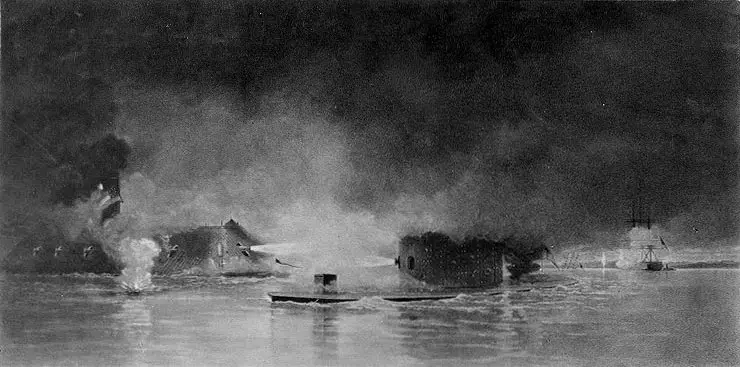
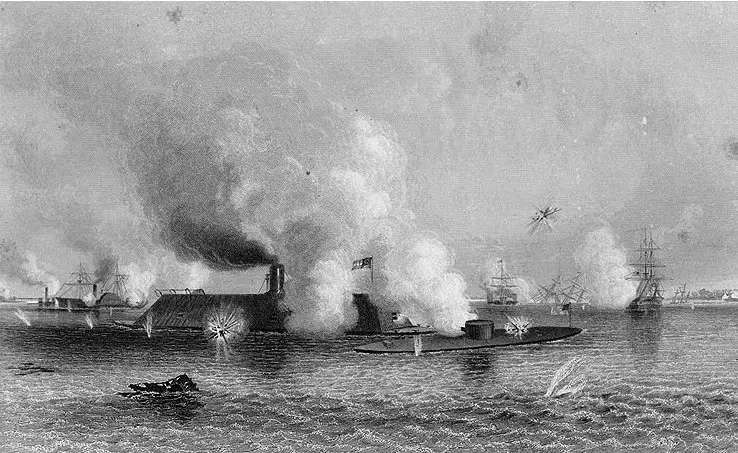
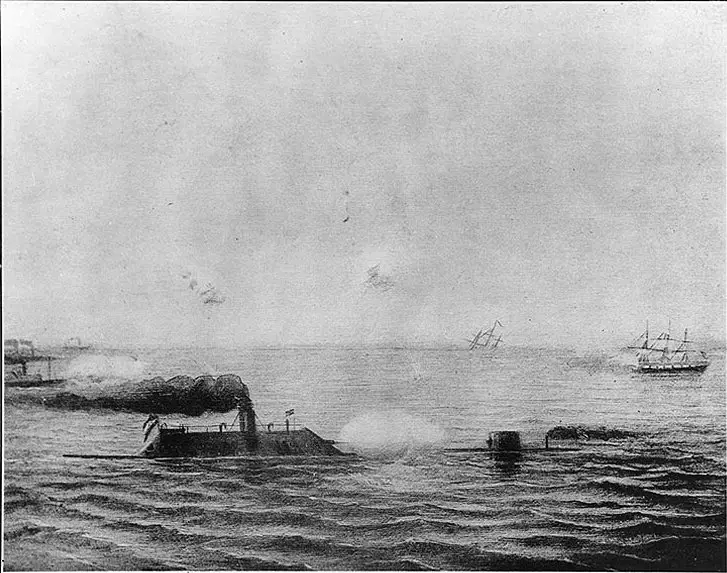
Undeterred, Virginia steamed out into Hampton Roads. Monitor positioned herself to protect the immobile Minnesota , and a general battle began. Both ships hammered away at each other with heavy cannon, and tried to run down and hopefully disable the other, but their iron-armored sides prevented vital
damage. Virginia 's smokestack was shot away, further reducing her already modest mobility, and Monitor 's technological teething troubles hindered the effectiveness of her two eleven-inch guns, the Navy's most powerful weapons. Ammunition supply problems required her to temporarily pull away into shallower water, where the deep-drafted Virginia could not follow, but
she always covered the Minnesota .
Soon after noon, CSS Virginia gunners concentrated their fire on USS Monitor 's pilothouse, a small iron blockhouse near her bow. A shell hit there blinded Lieutenant John L. Worden , the Union ship's Commanding Officer, forcing another withdrawal until he could be relieved at the conn. By the time she was ready to return to the fight, Virginia had turned away toward
Norfolk.
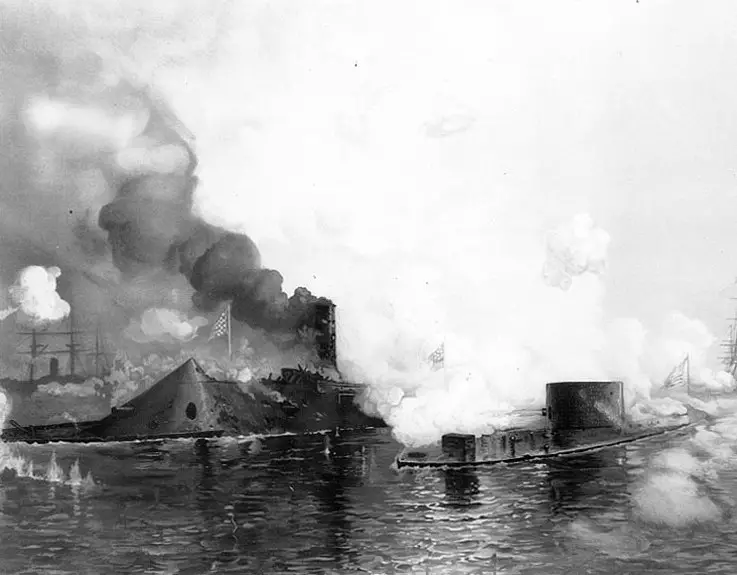
The first battle between ironclad warships had ended in stalemate, a situation that lasted until Virginia 's self-destruction two months later. However, the outcome of combat between armored equals, compared with the previous day's terrible mis-match, symbolized the triumph of industrial age warfare. The value of existing ships of the line and frigates was heavily discounted in
popular and professional opinion. Ironclad construction programs, already underway in America and Europe, accelerated. The resulting armored warship competition would continue into the 1940s, some eight decades in the future.
Kindle Available Naval Strategies of the Civil War: Confederate Innovations and Federal Opportunism Compare and contrast the strategies of the Southern
Secretary of the Navy, Mallory, against his rival in the North, Welles. Mallory used technological innovation and the skill of individuals to bolster the South's seapower against the Union Navy's superior numbers
Confederate Ironclad 1861-65 Every aspect of Confederate ironclads is covered: design, construction, armor, armament, life on board, strategy, tactics, and actual
combat actions.
Lithograph by Closson Blake, after a painting by W.F. Halsall, depicting the two ironclads engaging at close range. Collection of President Franklin D. Roosevelt.
Contemporary print by C. Parsons, New York, after a drawing by J. Davies
Halftone reproduction of an artwork, copyrighted by G.S. Richardson, 1906
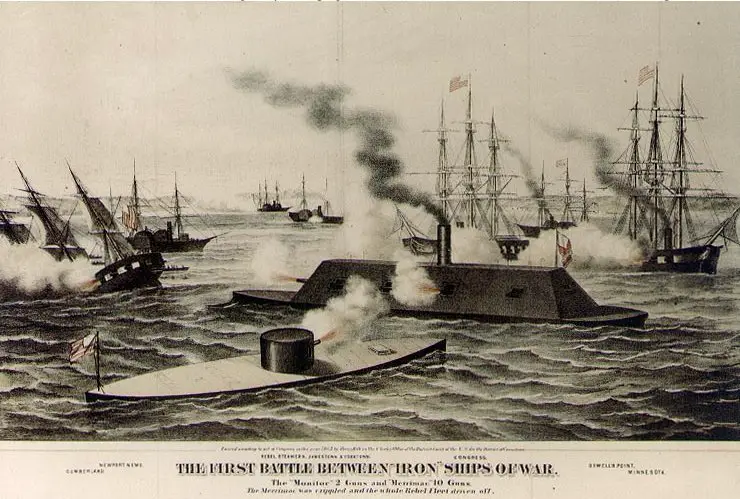
Lithograph published by Henry Bill, 1862 Other ships shown are USS Cumberland (sinking, at left), CSS Jamestown and Yorktown (center distance), USS Congress (right center, behind Virginia ) and USS Minnesota (right). This
artwork is rather inaccurate in historical detail and orientation, showing the other ships generally much closer to the main action than was actually the case and including Cumberland and Congress , both of which had been sunk on the previous day.
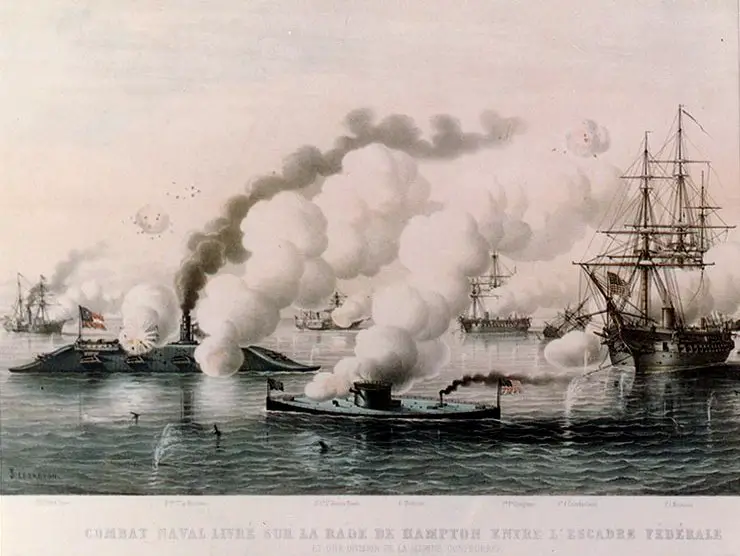
Colored lithograph by LeBreton, after a French officer's sketch, published in Paris, circa 1862
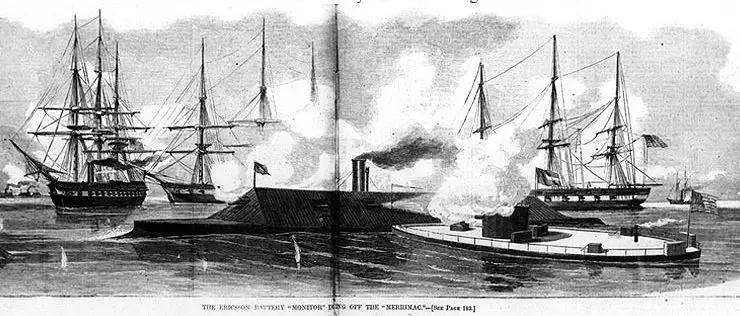
Line engraving published in "Harper's Weekly", January-June 1862 The scene is rather inaccurate in scale and detail, most significantly showing other Federal warships much closer to the action than was actually the case.
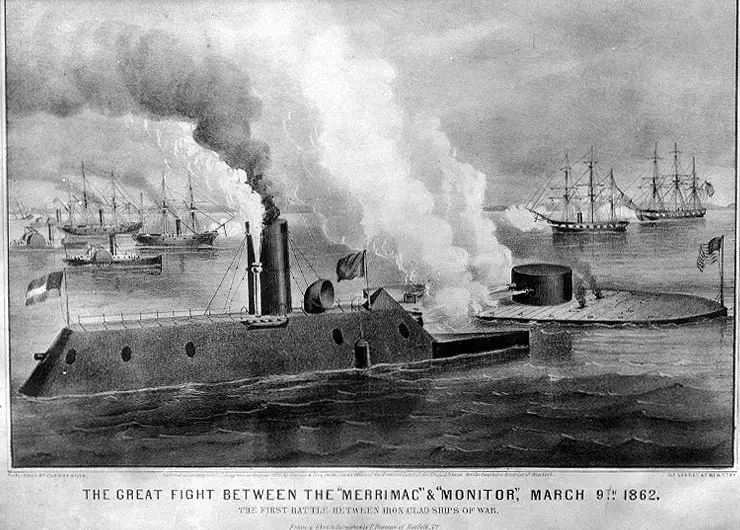
Lithograph by Currier & Ives, New York, 1862, "From a sketch furnished by F. Newman of Norfolk, Va." note the beginning of the use of the name USS Merrimac for the converted USS Merrimack
Confederate Phoenix: The CSS Virginia The CSS Virginia of the Confederate
States Navy destroyed two of the most formidable warships in the U.S. Navy. Suddenly, with this event, every wooden warship in every navy in the world became totally obsolete
Halls of Honor The U.S. Navy Museum takes you on an informed and entertaining romp through one of North America s oldest and finest military museums. The museum
has been in continuous operation at the Washington Navy Yard since the American Civil War DVD
Life in Mr. Lincoln's Navy A tantalizing glimpse into the hardships endured by the naval leadership to build and recruit a fighting force. The seaman endured
periods of boredom, punctuated by happy social times and terrifying bouts of battle horror
Kindle Available
Glory in the Name: A Novel of the Confederate Navy From Norfolk to Hampton Roads, from Roanoke Island to the nighttime battle on the river below
New Orleans, Glory in the Name tells the story of the Confederate States Navy, and the brave men who carried forward against overwhelming odds
Kindle
Available Confederate Ironclad vs Union Ironclad: Hampton Roads 1862 The Ironclad was a revolutionary weapon of war. Although iron was used
for protection in the Far East during the 16th century, it was the 19th century and the American Civil War that heralded the first modern armored self-propelled warships.
Ironclads and Big Guns of the Confederacy : The Journal and Letters of John M. Brooke
Information about the Confederate Navy's effort to supply its fledgling forces, the wartime diaries and letters of John M. Brooke tell the neglected story of the Confederate naval ordnance office, its innovations, and its strategic vision.
Raise The Alabama She was known as "the ghost ship." During the Civil War, the CSS Alabama sailed over 75,000 miles and captured more than 60 Union vessels. But her
career came to an end in June of 1864 when she was sunk by the USS Kearsarge off the coast of Northern France
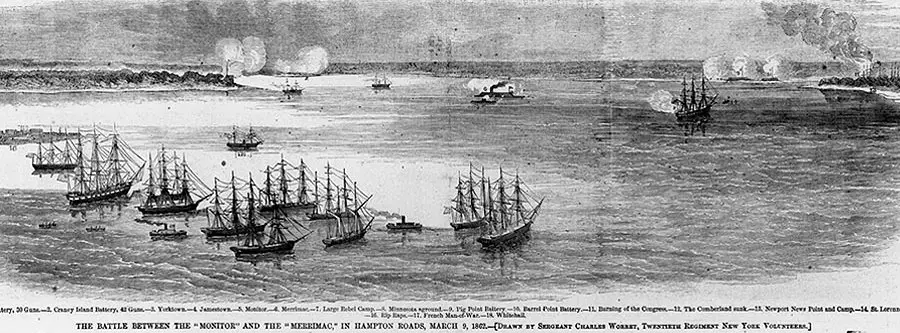
Line engraving published in "Harper's Weekly", January-June 1862, based on a drawing by Sergeant Charles Worret, Twentieth Regiment New York Volunteers. The view looks approximately south, from over Fortress Monroe, and provides a panoramic view of the action, with many elements keyed to text below the picture.
Numbered features, as cited below the view, include: (Note: numbers 1-13 run across the upper part of the view, from left center to right)
1. Sewell's Point Battery, 30 Guns 2. Craney Island Battery, 42 Guns 3. CSS Yorktown 4. CSS Jamestown 5. USS Monitor 6. CSS Virginia ('Merrimac') 7. Large Rebel Camp 8. USS Minnesota
aground 9. Pig Point Battery
10. Barrel Point Battery 11. Burning of the Congress 12. The Cumberland sunk 13. Newport News Point and
Camp 14. St. Lorenze ... (small vessel near Minnesota ) 15. Hampton 16. Rip Raps (at far left) 17. French Man-of-War (left
center) 18. Whitehall
Ships in the left foreground include USS Roanoke with Union transports and storeships.
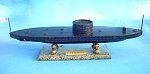
Monitor 21" Civil War Ship Wood Model Fully Assembled
-
Dimensions 21" Long x 5" Wide x 3" High
-
Meticulously painted to the actual Monitor
-
Museum quality model. Fully assembled and ready to display.
-
The model rests perfectly on a polished marble base and 4 arched dolphins
-
Built with rare, high quality rosewood.
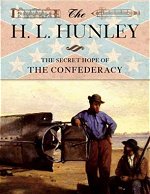
Kindle Available The H. L. Hunley The Secret Hope of the Confederacy On the evening of February 17, 1864,
the Confederacy H. L. Hunley sank the USS Housatonic and became the first submarine in world history to sink an enemy ship. Not until World War I "half a century later” would a submarine again accomplish such a feat. But also perishing that moonlit night, vanishing beneath the cold Atlantic waters off Charleston, South Carolina, was the Hunley
and her entire crew of eight
The Story of the H.L. Hunley During the Civil War, Union forces blockade the
port of Charleston so the Confederate army seeks a way to attrack the Yankee Ships. George Dixon is part of the group of men given the task of creating and building the "fish boat," a submarine. The H.L. Hunley ultimately sets out on its mission to sink Yankee ships, but fails to return, its whereabouts unknown.
Confederate Submarines and Torpedo Vessels 1861-65 Interesting
information and many excellent illustrations. It addresses the CSA David class torpedo boats and the Hunley (and its predecessors), as well as Union examples such as the Alligator and the Spuyten Duyvil
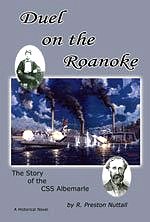
Ironclad of the Roanoke Gilbert Elliott's Albemarle
The story of a Confederate Ironcald that was a powerful force until sunk by a Union Torpedo Boat after its brief stormy life. Ironic in the fact it was built in a Cornfield. Confederate Ingenunity at it finest!
Civil War Musket Wood & Steel Frontier Rifle Designed After The
Original Rifle, This Civil War Musket replica has been designed after the original rifle of its era. Measures approximately 37 inches long. Each is constructed with a solid one-piece wood stock, painted steel barrel and die-cast parts.
Civil War Historic 1000-piece Puzzle The famous faces and fearsome
facts of the Civil War are captured in this 1,000-piece cardboard puzzle for Civil War buffs and serious puzzle fans.
Civil War Cannon Collectible Models and childrens
playsets Miniature Collectible Civil War Cannon12 pound Civil War field cannon replica weapon collectible is a detailed 1/12th scale military caisson replica weapon collectible as used throughout the Civil War Childrens Cannon Set. Includes 6 gray cannon with black wheels that
measure 4.5 inches long  Civil War Soldier 102 Piece Playset
- 25 Union and 25 Confederate Soldier Figures, 18 Horses, 10 Cannon
- 2 Covered Wagons, 2 Tents, 2 Canoes, 2 Flags, 16 Fences
- Size: Figures Stand up to 2-1/8 inches tall
- Scale: 1/32nd, Wagons and Horses slightly smaller
 72 Piece Civil War Army Men Play Set 52mm Union and
Confederate Figures, Bridge, Horses, Canon
- 48 Union and Confederate Soldiers up to 2-1/8 inches tall
- 4 Horses, 4 Sandbag Bunkers, 6 Fence Sections, 3 Cannon, 3 Limber Wagons (Ammo Carts)
- Bridge, Small Barracks, 2 Cardboard buildings
- Scale: About 1/35th
Monitor 21" Civil War Ship Wood Model Fully Assembled
-
Dimensions 21" Long x 5" Wide x 3" High
-
Meticulously painted to the actual Monitor
-
Museum quality model. Fully assembled and ready to display.
-
The model rests perfectly on a polished marble base and 4 arched dolphins
-
Built with rare, high quality rosewood.
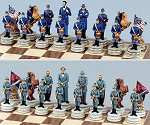
Civil War Chess Set Painted civil war chess set. Dimensions: Chess set pieces:
3-1/4" King's; 1-1/8" bases
 Civil War Union Cavalry: 25 Piece Set
-
13 Union Soldier Figures
-
11 Brown Horses 2-5/8 inches tall
-
1 White Horse Laying Down
-
Scale: Approximately 1/32nd
-
Packaging: Plastic Bag with Header Card
Halls of Honor The U.S. Navy Museum takes you on an informed and entertaining romp
through one of North America s oldest and finest military museums. The museum has been in continuous operation at the Washington Navy Yard since the American Civil War
Raise The Alabama She was known as "the ghost ship." During the Civil War, the CSS
Alabama sailed over 75,000 miles and captured more than 60 Union vessels. But her career came to an end in June of 1864 when she was sunk by the USS Kearsarge off the coast of Northern France
The Civil War - A Film by Ken Burns Here is the saga of celebrated generals and ordinary
soldiers, a heroic and transcendent president and a country that had to divide itself in two in order to become one
More To Explore
|
|