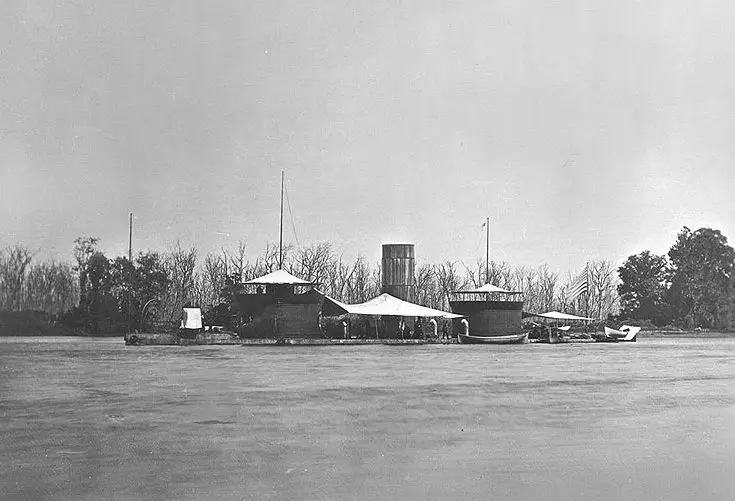
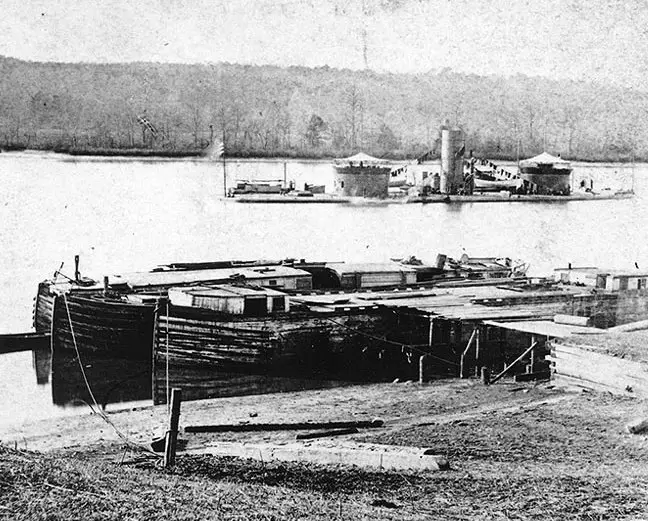
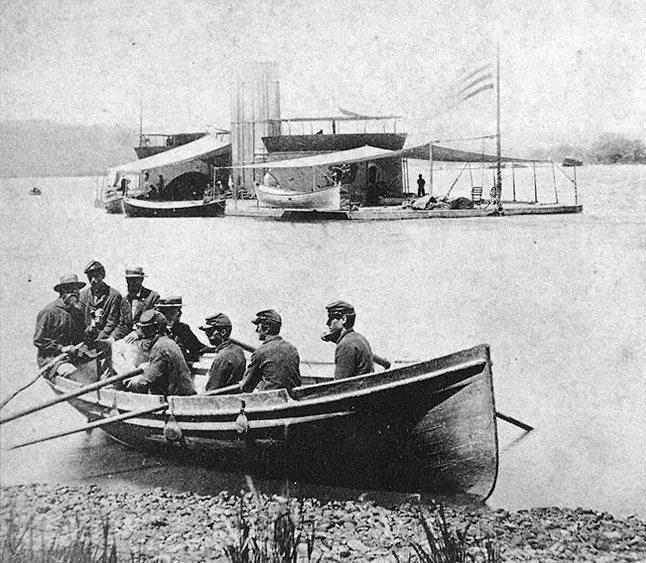
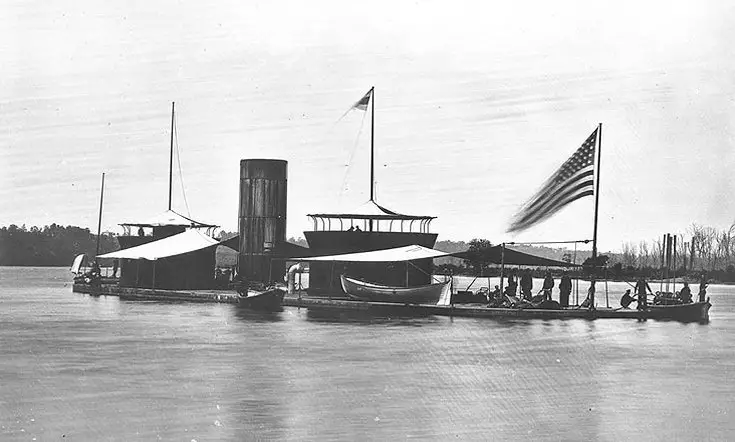
The USS Monitor represented a revolution in warship design. Not only was the vessel fully armored, but she mounted her guns in a revolving turret, which in theory was capable of firing in any direction. Following the first fight between two ironclads at the Battle of Hampton Roads (March 9, 1862) the North was swept by "monitor fever," as everyone from President Lincoln down became convinced that victory in the naval war would be achieved through the creation of a fleet of "monitor" ironclads. The original USS Monitor therefore spawned a host of successors, and gave her name to a new type of warship. On March 14, 1861, Gideon Wells became President Lincoln's Secretary of the Navy. A month later the country was irrevocably plunged into war. When Lincoln approved the "Anaconda Plan," devised by General Winfield Scott, he committed his navy to a course for which it was ill-prepared. The strategy envisaged the encirclement of the Confederacy by both a naval blockade of Southern ports and a drive down the Mississippi River. Scotts' Anaconda would constrict his victim, squeezing the life out of the Confederacy by applying pressure to its borders. When the war was declared in April 1861 the US Navy had just over 90 warships at its disposal, but 48 were either in refit or were unfit for service, and another 28 vessels were deployed overseas. The remaining vessels were clearly insufficient to put into effect any blockade of the Confederate coast, so Welles instituted a huge expansion of the fleet. This included the aquisition and conversion of merchant ships until new purpose-built vessels could be constructed. He also considered the consttruction of armored warships. Both Welles and his Confederate counterpart were aware of the introduction of ironclad warships into the French and British fleets. During 1861 Welles became increasingly convinced that his naval plans would necessarily involve the adoption of a new breed of ironclad warships. Copyright Osprey Publishing USS Onondaga anchor on the James River, Virginia, during the Civil War, circa 1864-65. USS Onondaga Anchored off Aikens Landing in the James River, Virginia, in 1864-1865. Note the barges at the wharf in the foreground. |
Kindle Available Raising the Hunley: The Remarkable History and Recovery of the Lost Confederate Submarine For more than a century the fate of the Hunley remained one of the great unsolved mysteries of the Civil War. Then, on August 8, 2000, with thousands of spectators crowding Charleston Harbor, the Hunley was raised from the bottom of the sea and towed ashore.  Year on a Monitor and the Destruction of Fort Sumter Personal view of the Civil War Navy. The monitor saw action in several significant naval assaults by the Union's Squadron. It took part in the failed Federal attack on Sumter in April 1863. The "Nahant" also participated in the capture of the Confederate Ram "Atlanta," and in the assault on Fort Wagner |
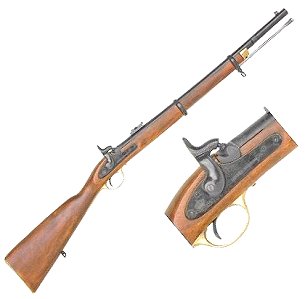 1860 Enfield Civil War Musketoon This piece is a full-size non-firing reproduction of the rifle used in the Civil War. The body is made of European hardwood  Civil War Cannon Collectible Models and childrens playsets Miniature Collectible Civil War Cannon12 pound Civil War field cannon replica weapon |
Civil War Ships and Battles Civil War Submarines RAM Ships Civil War Naval Timeline American Civil War Exhibits State Battle Maps Civil War Summary Civil War Timeline Women in the Civil War Battles by Campaign |
|
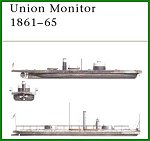 Union Monitor 1861-65 The first seagoing ironclad was the USS Monitor, and its profile has made it one of the most easily recognised warships of all time. Following her inconclusive battle with the Confederate ironclad Virginia on March 9, 1862, the production of Union monitors was accelerated. By the end of the year a powerful squadron of monitor vessels protected the blockading squadrons off the Southern coastline, and were able to challenge Confederate control of her ports and estuaries Kindle Available  Confederate Ironclad vs Union Ironclad: Hampton Roads 1862 The Ironclad was a revolutionary weapon of war. Although iron was used for protection in the Far East during the 16th century, it was the 19th century and the American Civil War that heralded the first modern armored self-propelled warships. |
USS Onondaga in the James River, Virginia, 1864-1865. USS Onondaga on the James River, Virginia, in 1864-65. |
 Life in Mr. Lincoln's Navy A tantalizing glimpse into the hardships endured by the naval leadership to build and recruit a fighting force. The seaman endured periods of boredom, punctuated by happy social times and terrifying bouts of battle horror |
Kindle Available Glory in the Name: A Novel of the Confederate Navy From Norfolk to Hampton Roads, from Roanoke Island to the nighttime battle on the river below New Orleans, Glory in the Name tells the story of the Confederate States Navy, and the brave men who carried forward against overwhelming odds |
 Ironclad Down: USS Merrimack-CSS Virginia from Design to Destruction A treasure trove of detailed information about one of history s most famous vessels. Describing Stephen Russell Mallory, John Mercer Brooke, John Luke Porter, et al.--who conceived, designed and built one of the world's first ironclads |
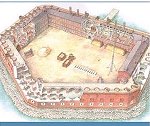 American Civil War Fortifications Coastal Brick and Stone Forts The design, construction and operational history of fortifications, such as Fort Sumter, Fort Morgan and Fort Pulaski. Stone and brick forts stretched from New England to the Florida Keys, and as far as the Mississippi River. A handful of key sites remained in Union hands throughout the war, the remainder had to be won back through bombardment or assault. |
Kindle Available Naval Strategies of the Civil War: Confederate Innovations and Federal Opportunism Compare and contrast the strategies of the Southern Secretary of the Navy, Mallory, against his rival in the North, Welles. Mallory used technological innovation and the skill of individuals to bolster the South's seapower against the Union Navy's superior numbers |
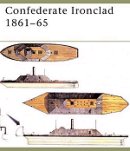 Confederate Ironclad 1861-65 Every aspect of Confederate ironclads is covered: design, construction, armor, armament, life on board, strategy, tactics, and actual combat actions. |
Kindle Available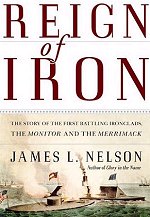 Reign of Iron: The Story of the First Battling Ironclads, the Monitor and the Merrimack The first ironclad ships to fight each other, the Monitor and the Virginia (Merrimack), were the unique products of American design genius |
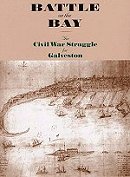 Battle on the Bay: The Civil War Struggle for Galveston Civil War history of Galveston is one of the last untold stories from America's bloodiest war, despite the fact that Galveston was a focal point of hostilities throughout the conflict. Galveston emerged as one of the Confederacy's only lifelines to the outside world. |
 Halls of Honor The U.S. Navy Museum takes you on an informed and entertaining romp through one of North America s oldest and finest military museums. The museum has been in continuous operation at the Washington Navy Yard since the American Civil War |
 Raise The Alabama She was known as "the ghost ship." During the Civil War, the CSS Alabama sailed over 75,000 miles and captured more than 60 Union vessels. But her career came to an end in June of 1864 when she was sunk by the USS Kearsarge off the coast of Northern France |
 The Civil War - A Film by Ken Burns Here is the saga of celebrated generals and ordinary soldiers, a heroic and transcendent president and a country that had to divide itself in two in order to become one |
 Civil War Journal The Conflict Begins These four programs from the History Channel series Civil War Journal cover critical aspects of the early days of the war. |
Sources:
Osprey Publishing
Library of Congress
|
Books Civil War Womens Subjects Young Readers Military History DVDs Confederate Store Civil War Games Music CDs Reenactors |