
Exploring the Trenches of Petersburg

Silas Weaver
Silas Weaver has spent decades exploring historic battlefields, reading primary journals, and tracking down the lesser-known stories of the American Civil War. His lifelong passion for 19th-century history comes through in his engaging accounts of the places, people, and lingering questions of the era. He believes that walking the actual grounds where history happened is the best way to truly connect with the past.
The first time I stood on the old siege lines at Petersburg, the thing that struck me was not a cannon or a monument. It was the ground itself. The earthworks do not feel like scenery. They feel like a decision someone made in a hurry with a shovel, a bayonet, and a fear you can still sense if you slow down and listen.
Petersburg is where the war becomes a long, grinding test of endurance, a siege that ran from June 1864 to April 1865. Not a single dramatic afternoon, but month after month of digging, shelling, watching, and waiting. If you want to understand what the late war meant for the men in the ranks, there are few better places to walk than Petersburg National Battlefield.
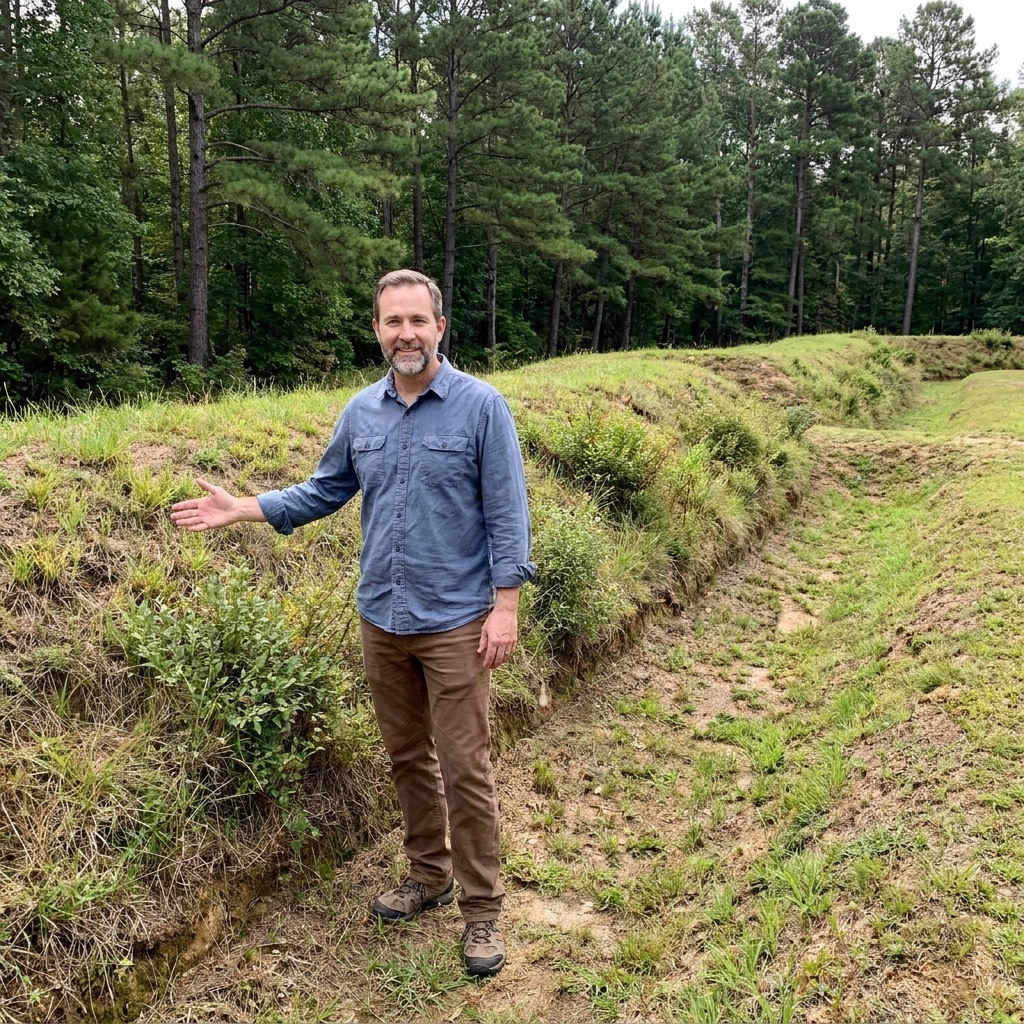
Before you go: what you are looking at
Petersburg’s trenches are easy to underestimate because they are made of dirt. On paper, rifle pits and traverses sound technical. In person, they are intimate. A trench is shoulder-width history. A traverse is a blunt reminder that a straight line gets you killed when artillery starts ranging in.
Quick field guide to earthworks
- Parapet: the raised wall of earth facing the enemy, often reinforced with logs, sandbags, or other materials.
- Ditch: the depression in front of the parapet, meant to slow an assault and provide material for the wall.
- Bombproof: dugouts roofed with logs and earth, built to survive shells and fragments.
- Traverse: a short cross-wall inside a trench to block blast and shrapnel from traveling the full length.
- Redan/redoubt: fort shapes. A redan is typically a V-shaped projection; a redoubt is more enclosed.
If you want a broader approach to walking battlefields and reading terrain, I keep my general habits and planning mindset in our battlefield travel guide.
How the park is laid out
One practical thing to know up front is that Petersburg National Battlefield is not a single, contiguous loop. It is a set of separate units that you connect by car. That matters for time, expectations, and energy.
- Eastern Front: where many visitors begin, with several of the best-preserved siege lines and fortifications.
- The Crater: its own focused stop, tied to one of the siege’s most dramatic and tragic attacks.
- Other units: including areas tied to supply, maneuver, and the wider endgame around Petersburg and Richmond.
In other words, you can absolutely have a great visit, but you will be driving between places. Plan your day around a couple of clusters, not a single long walk that connects everything.
How to tour Petersburg without missing the essentials
Petersburg is not one stop you can knock out in an hour. Think of it as a set of connected experiences: the siege lines and forts, the Crater, and the wider story of how Grant and Lee fought each other into exhaustion.
My best advice is simple: choose your time and your legs. If you only have half a day, focus on one main area and do it slowly. If you have a full day, split it into two sessions with a break in between. Siege history hits harder when you are not rushing.
Two solid visit options
- 2 to 3 hours: The Crater, plus one fort-and-trench stop on the Eastern Front where you can walk a preserved segment and see how the line works.
- 4 to 7 hours: The Crater, multiple Eastern Front fortification stops, and time for ranger talks, exhibits, and slower walking along the works.
For the nuts and bolts of building a day that does not turn into a frantic checklist, see how to plan a Civil War battlefield day.
Visitor basics
If you are new to Petersburg, I like to start where the story is easiest to orient: the main exhibits and the first set of interpretive stops on the Eastern Front. From there, you can decide whether you want a drive-first day with short walks, or a walk-first day where you pick one area and really settle into it.
Most stops are a mix of parking areas, short paths, and longer optional walks. The distances between units are what surprise people, not the walking within a single stop.
Accessibility note
Many key viewpoints can be enjoyed with short, relatively level walks, and some paths are more forgiving than others. If mobility is a concern, build your day around the stops that let you see the shape of the works from close parking and keep the longer trench walks as optional add-ons.
The stops that matter most
You can have a meaningful visit without seeing every marker. These are the places I return to when I need to feel the siege in my bones.
The Crater (July 30, 1864)
The Crater is one of those places you can understand in one glance and still not understand at all. The depression in the ground is the physical proof of an extraordinary plan: a mine tunneled under Confederate lines, packed with powder, and detonated before dawn on July 30, 1864. The blast created a gap. Then the attack collapsed into confusion and catastrophe.
When you walk the paths here, take a moment to picture the sequence: the shockwave, the dust and smoke, the scramble forward, and then the awful funneling effect as men poured into a hole that became a trap. The terrain tells the story if you let your eyes move from the rim down into the bowl and back out toward the lines.

Fort Stedman area (March 25, 1865)
If the Crater shows the terrible potential of innovation, the Fort Stedman sector shows desperation. On March 25, 1865, late in the siege, Lee’s army tried a pre-dawn strike to break the stranglehold. It was bold. It was also the kind of gamble you make when the arithmetic of supplies and manpower is turning against you.
Here, the shapes of the works and the distances between positions help you see how narrow the margin was. In some places at Petersburg, the opposing lines were close enough for constant tension, sniping, and sudden raids. Standing there, you feel how tiring it would be to live on alert day after day.

Forts and connecting trenches
People arrive looking for a single dramatic site. Petersburg’s real power is the network. Forts linked by rifle trenches, angles strengthened by traverses, positions improved and improved again until the ground looks shaped rather than natural.
As you walk, watch for the little details: how a trench bends to avoid enfilade fire, how a raised gun platform would have commanded open ground, how a line uses tree cover or a slight ridge. The men who built these works were learning under pressure, and you can see that learning layered into the soil.
Where the siege becomes human
There is a particular hush that settles over a preserved trench line when you are alone for a moment. You start to notice the practical questions that soldier diaries are full of: Where did they cook? How did they sleep when the artillery started? How did they keep water decent? How long before a man stopped flinching at every crack and thump?
If you want more of that daily-life perspective before or after your trip, our Civil War life guide is a good companion read.
A simple walking approach
When I walk Petersburg, I try to keep one rule: follow the logic of cover. A soldier did not stroll across open ground to admire the view. He moved where the earth protected him.
Try this on any trench segment
- Start behind the parapet and notice what disappears from view. What would you not be able to see? What would you be blind to?
- Find the firing line by looking for where a man could reasonably stand or kneel and shoot over or through the work.
- Look for traverses and imagine a shell bursting in the trench. These small walls are not decoration. They are survival.
- Study the angles. Petersburg is full of bends and corners because straight lines invite deadly side-to-side fire.
- Step back and look at how the line sits on the land. Fortifications are conversations with terrain.
This is the same habit I use everywhere from open-field fights to dense woods battles. If you want a general refresher on reading a battlefield and keeping yourself oriented, see our guide to battles.
Practical tips
Time of day
Early morning and late afternoon light makes earthworks easier to read. Shadows reveal the shape of trenches and parapets. At midday, everything can look flattened.
Footwear and comfort
- Wear shoes with grip. Trenches and slopes can be slick after rain.
- Bring water and a small snack, especially if you plan to walk multiple segments.
- Bug spray matters in warm months. This is Virginia ground, and it does what Virginia ground does.
Bring this for understanding
- Binoculars: useful for reading distant terrain and noticing how lines relate.
- A small notebook: Petersburg rewards questions. Write down what you wonder about, then look it up later.
- Patience: this is a siege landscape. It opens up slowly.
With kids
Trenches can be perfect for young visitors because they are physical and immediate. Let them stand where a soldier might have stood and ask, “What can you see? What can you not see?” If you want more ideas like that, I wrote a whole piece on keeping kids engaged on a battlefield trip.
Respect on the lines
Petersburg is not just an outdoor museum. It is a landscape where thousands suffered, and many died. A few small choices keep the place honorable:
- Stay on established paths where requested. Earthworks erode easily, and footprints add up.
- Do not climb on fragile sections of trench walls.
- Lower your voice when you are close to other visitors who are trying to take it in.
- Leave artifacts where they are. If you see something concerning, report it to park staff.
Why Petersburg matters
Petersburg makes more sense when you remember what it was: a critical railroad and supply hub feeding Richmond and the Confederate armies. The siege is not just a long standoff in the dirt. It is a sustained attempt to cut lifelines.
By spring 1865, those lifelines were snapping. The pressure around Petersburg helped force the evacuation of Richmond and Petersburg, and it pushed the war into its final road, ending days later at Appomattox.
If you are building a Virginia swing, Petersburg pairs naturally with other stops that help explain how the war evolved in that state. Our 3-day Virginia Civil War battlefield road trip can help you stitch multiple sites into one coherent story.
Frequently asked questions
Is Petersburg good for first-time visitors?
Yes, especially if you focus on a few key stops rather than trying to see everything. The earthworks make the tactics visible in a way that open fields sometimes do not.
How much walking is involved?
You can do a mostly drive-and-short-walk visit, but the best understanding comes from walking longer preserved stretches. Plan for at least a couple of miles if you want the trenches to start feeling like a system rather than isolated features.
What should I read beforehand?
Skimming an overview of the Overland Campaign’s transition into the siege will help you understand why the fighting settles into trenches here, and why railroads and supply lines mattered so much. If you want a quick foundation, start with our battles guide and bring your questions to the ground.
One last thought
At Gettysburg, where I grew up wandering as a boy, the story often comes at you in sweeping lines and famous names. Petersburg is different. It is smaller in scale moment to moment and bigger in implication. The war narrows down to a ditch, a parapet, and the stubborn human act of holding on.
Walk slowly. Let the shadows show you the shape of the works. And every so often, step off to the side where you can see a long stretch of line and remember that someone once stood there, staring into the same distance, wondering how many more days the earth would have to do the job that politics and generals could not.