
How to Keep Kids Engaged on a Civil War Battlefield Trip

Silas Weaver
Silas Weaver has spent decades exploring historic battlefields, reading primary journals, and tracking down the lesser-known stories of the American Civil War. His lifelong passion for 19th-century history comes through in his engaging accounts of the places, people, and lingering questions of the era. He believes that walking the actual grounds where history happened is the best way to truly connect with the past.
I learned Civil War ground the same way a lot of kids around Gettysburg did: by roaming. I was not chasing big strategies or famous names. I was chasing places. A tree line where you could hide. A rock you could sit on. A dip in the land that suddenly explained why soldiers hugged that fence instead of walking in the open.
Here’s the secret with kids. You do not “teach a battle” and hope they behave. You help them notice the landscape, then hang a short, human story on what they are seeing. Do that a few times, and a battlefield stops being a long walk with grown-up words. It turns into a real place where real people once stood.
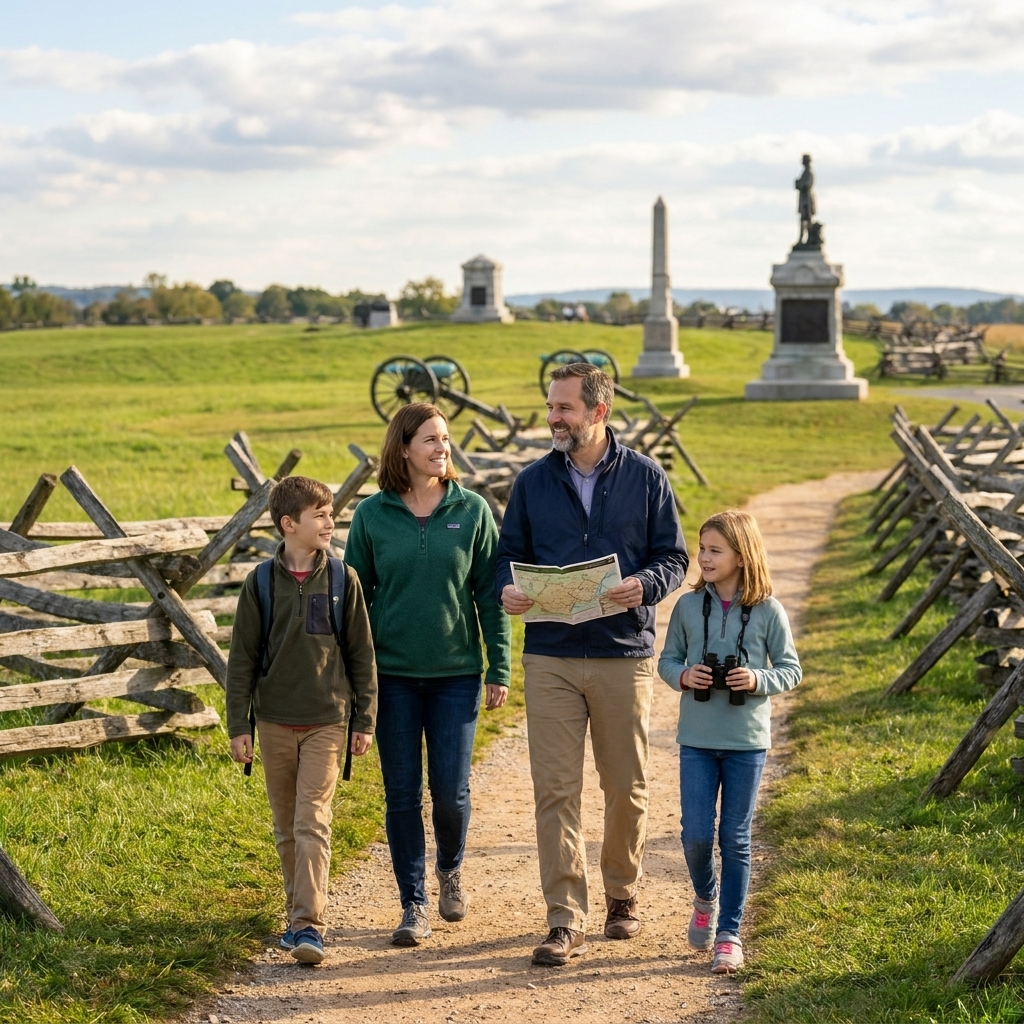
Start with the right day shape
Most family battlefield trips go sideways for one reason: adults try to do too much. Most kids can handle history, heat, and hiking. They cannot handle all three for six straight hours without a plan.
Use the three stops rule
- One big stop where you linger: a visitor center, a famous viewpoint, or a place with a short loop trail.
- One medium stop where you do a simple activity: a scavenger prompt, a map moment, or a short story.
- One quick stop just to stand, look, and reset expectations before you leave.
If you have more time, repeat the pattern. If you have less time, keep the big stop and skip the rest. I have never once regretted doing less ground and enjoying it more.
For a solid itinerary structure, I keep coming back to our own planning guide: Plan a Civil War battlefield day.
Make Junior Ranger your backbone
If the site offers a Junior Ranger program, take it. It is not just busywork. It gives kids a mission, a finish line, and a reason to ask questions before you do.
Use it without homework vibes
- Let your child choose the order of activities when possible. Ownership is half the battle.
- Do it in bursts: 10 minutes of booklet, then 20 minutes of walking or looking.
- Celebrate the swearing-in like it matters, because to a kid, it does.
If you want to preview what many parks offer, the National Park Service keeps an overview here: Become a Junior Ranger (NPS).
Tell a short story, not a lecture
A battlefield has a thousand facts. A child needs one clear thread at a time. I like to tell a two-minute story at each stop. Two minutes forces you to keep it human and simple.
A simple story recipe
- One person: a teen drummer, a tired private, a farm family nearby, a nurse in a crowded building.
- One problem: lost, hungry, scared, confused, ordered forward, ordered to wait.
- One detail you can point to: a fence line, a ridge, a creek, a road, a house.
- One question: “What would you do right now if you were them?”
Kids do not need gore. They need stakes. You can be honest without being graphic. “People were badly hurt here” is true. It also leaves room for a child’s mind to stay safe.
Turn the landscape into a game
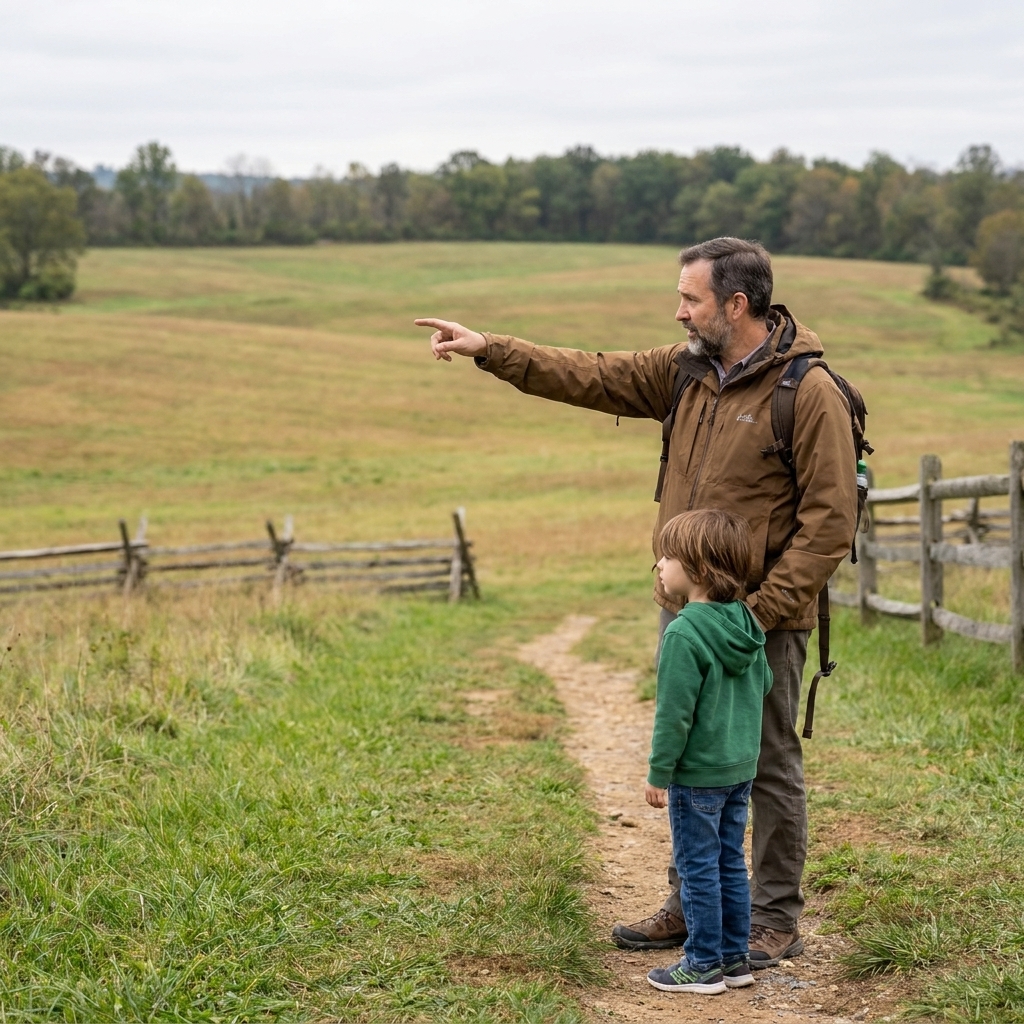
The ground is the best teaching tool you have. Make it a challenge. Let them be the one who figures out why something happened where it did.
Easy prompts
- High ground check: “Where would you stand if you wanted to see farthest?” Walk there and compare.
- Cover vs. concealment: “Which spot hides you, and which spot actually protects you?” (Bushes hide. Rocks and thick earth protect.)
- Best route: “If you had to cross that field, what path would you pick to feel safest?”
- Sound test: Stand still for 20 seconds. “What can you hear today? What do you think you would hear in 1863?”
- Distance guessing: “How many steps to that fence?” Let them guess, then count it out.
Use exhibits with good timing
Interactive exhibits can be a lifesaver, but timing matters. If you start with a long museum when kids are wound up from the car, you are asking for trouble. I like a short exhibit first, then outside, then another short exhibit later.
What to look for inside
- Big maps that show roads, rivers, and ridge lines your kids can later recognize outside.
- Real objects with clear purpose: canteens, knapsacks, hardtack, cartridges, medical tools.
- Audio and short films under 20 minutes. Save the long documentary for another day.
When you head back outdoors, pick one exhibit item and “track it” on the landscape. “Remember the canteen? Now look at this walk. Imagine carrying water the whole way.”
Give them a job
Responsibility keeps attention from drifting. It also keeps you from talking too much, which helps everyone.
Three jobs that work
- Navigator: your child holds the map and tells you the next stop. Even if you already know the route, let them lead.
- Photographer: give them a simple shot list, like “a cannon,” “a fence,” “a view from a hill,” “a monument with an animal on it.”
- Ground detective: they answer one question at each stop: “What is the best hiding place here?” or “What is the worst place to stand?”
If you need help building a kid-friendly route, our overview page is a good place to start: Guide to battlefield travel.
Make it safe and respectful
Battlefields are big outdoor places, not theme parks, and that is part of their power. A few basic habits keep the day smooth and help protect the ground for the next family.
Quick safety checks
- Stay on marked trails and respect closed areas. Old earthworks and steep slopes can crumble, even if they look sturdy.
- Plan for ticks and poison ivy: long socks help, and a quick check in the car before you drive off can save a rough night.
- Hydrate early. Wide-open fields can feel hotter than the forecast says.
Simple stewardship
- No climbing on cannons, markers, or monuments. Kids are not trying to be disrespectful, they just see a great jungle gym.
- Leave what you find. Even a small rock from a wall belongs to the story of the place.
Make the hard parts easier
Most battlefields are wide open. In summer they can feel like griddles. In winter they can feel like a long, windy punishment. Keeping kids engaged often means keeping them comfortable.
Comfort moves
- Front-load the walking in the morning, then use shorter stops after lunch.
- Pick one shaded spot to rest even if it is not the most important place historically.
- Bring a car reset: five minutes of water, a snack, and quiet before the next stop.
- Keep expectations visible: “Two more stops, then we are done.” Kids handle time better in small pieces.
If you are traveling with toddlers, do not be shy about doing a battlefield from the car with short bursts outside. Some days that is the win. And if someone in your group has limited mobility, remember that many major parks have driving loops, accessible overlooks, and short paved paths that still give you real ground and real views.
Talk about the war honestly
Parents sometimes freeze up here, and I understand why. You are standing on ground tied to death and national trauma. The key is plain language and honesty.
Simple phrasing that works
- Why the war happened: “The central cause was slavery. People fought over whether it would continue and expand, and whether the country would stay together.”
- What soldiers faced: “They were often hungry, sick, and scared, and they still had to follow orders.”
- What happened here: “A lot of people were killed or wounded in a short time.”
If your child asks deeper questions, answer them. If they do not, do not force it. Let the place work on them a little at a time.
For family-friendly context on daily life, uniforms, food, and the home front, see our guide to Civil War life.
Pick one hook per kid
I have watched kids light up when they find the piece of the Civil War that belongs to them. Not every kid cares about generals or troop movements. Many care about animals, music, food, tools, or what kids their own age were doing.
Hook ideas
- Signals and messages: flags, bugle calls, couriers on horseback.
- Food: hardtack, coffee, salt pork, what a soldier carried in a haversack.
- Medicine: field hospitals, stretcher bearers, what nurses did.
- Engineering: earthworks, bridges, roads, fortifications.
- Human connections: brothers on different sides, friends turned enemies, neighbors in conflict.
If your child likes the people side of the story, the complicated friendships and rivalries, I would point you to Brothers Divided: pre-war bonds of rival Civil War generals.
A reusable stop plan
Here is a simple pattern I use across battlefields from big parks to small state sites. It keeps kids moving, noticing, and feeling successful.
- Visitor center (20 to 40 minutes): Junior Ranger booklet pickup, bathrooms, one short exhibit, one big map.
- Viewpoint stop (10 minutes): tell a two-minute story and ask one question.
- Short trail or loop (30 to 60 minutes): landscape prompts, photos, and a snack break at the halfway point.
- Final quick stop (5 minutes): “What do you think mattered most here: the hill, the road, or the creek?” Let them choose.
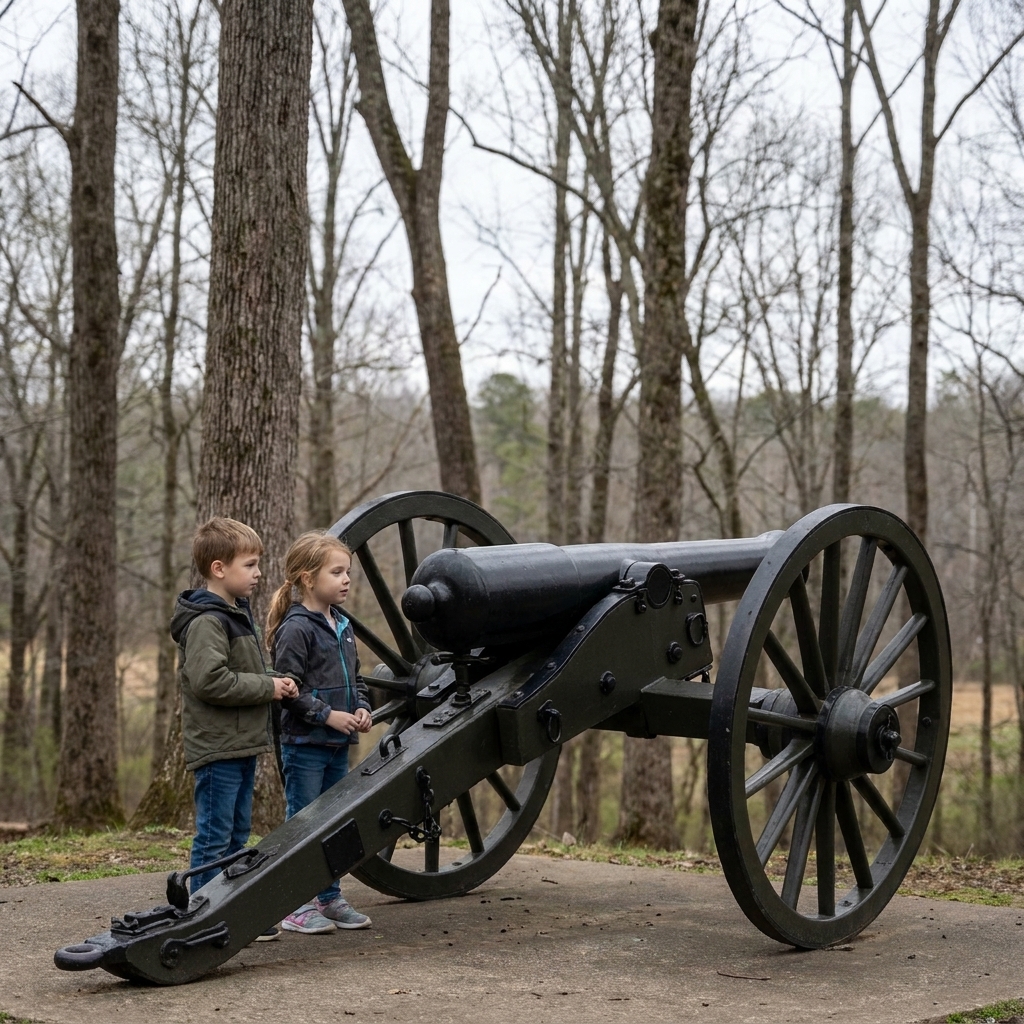
If you want a concrete example built around a specific field, our Chickamauga Battlefield Guide shows how a big, wooded battlefield can still be approachable if you pick your stops carefully.
Quick FAQ
What age is best?
Any age can work if you scale the day. For ages 4 to 7, think short trails and simple stories. For ages 8 to 12, Junior Ranger programs and map moments really click. Teens often enjoy the moral questions and the “why did they choose this?” conversations.
How long should we stay?
For a first visit, I aim for 2 to 4 hours total time on site. You can always come back. Ending while everyone is still doing well is the best trick I know.
How do we handle sensitive topics?
Use plain language, answer what they ask, and do not add details they are not ready for. You can tell the truth about slavery and loss without turning the day into something frightening.
What if my kid says it is boring?
Switch gears fast. Change the job, shorten the stop, or make it a challenge: “Find the best hiding place.” Boredom usually means the pace is adult-paced, not kid-paced.
What I hope they carry home
The best battlefield day with kids is not the one where they memorize dates. It is the one where, weeks later, they remember a hillside, a road, the way the woods suddenly swallowed sound, and the fact that history happened to people who were once as real as they are.
If you ever want to share what worked for your family, you can reach me through our contact page. I am always collecting good ideas from the road.