Union General Joseph Hooker
|
|
|
|
|
During the Battle of Second Bull Run in late August, Hooker's division was attached to Pope's Army of Virginia. In the reorganization of the army at the beginning of the Maryland Campaign in September, Hooker was assigned command of the I Corps, Army of the Potomac, which he led in the Battle of Antietam on 17 September. Soon afterward he was promoted to brigadier general in the Regular Army. At the Battle of Fredericksburg on 13 December, Hooker served as a "grand division" commander of the Army of the Potomac, commanding the III and V Corps. In January 1863 he was assigned command of the Army of the Potomac and led that force to defeat at the Battle of Chancellorsville, 1-4 May 1863. When Lee advanced into Pennsylvania in June, Hooker followed. In late June, after the War Department refused his request for additional troops from the garrison at Harper's Ferry, Hooker asked to be relieved of the army command-his request was immediately accepted. In September Hooker was transferred to the Western Theater, where he commanded the XI and XII Corps (later consolidated into the XX Corps). In July 1864, when one of Hooker's subordinates was promoted over him, Hooker was relieved at his own request. For the remainder of the war he was assigned various departmental commands. Hooker remained on active duty until 1868, when he was retired for disability contracted in the line of duty. |
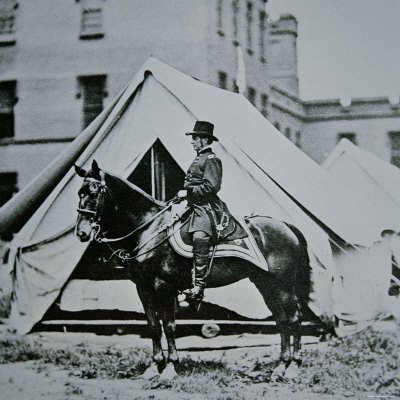
Union General Joseph Hooker Photographic Print 24 in. x 24 in. Buy at AllPosters.com Framed Mounted |
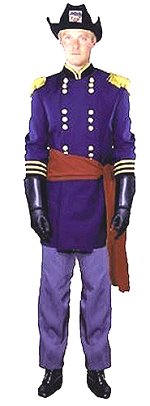 Adult Union Officer Uniform |
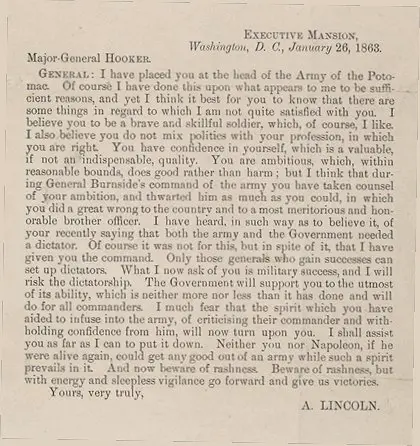
From the Alfred Whital Stern Collection of Lincolniana @ Library of Congress
|
Kindle Available Civil War in the Indian Territory When the war broke out, both sides wanted the Five Civilized Tribes, led by the Cherokees, and each got around half. The Confederacy sent Brigadier General Albert Pike to recruit them, and he did a pretty good job. A strange, brilliant, man, Pike's career as a General is a minor footnote in his long life |
Kindle Available The Maps of First Bull Run: An Atlas of the First Bull Run (Manassas) Campaign, including the Battle of Ball's Bluff, June-October 1861 The Maps of First Bull Run breaks down the entire operation (and related actions) into numerous map sets or "action-sections" enriched with more than fifty full-color original full-page maps. These cartographic originals bore down to the regimental and battery level and include the march to and from the battlefield and virtually every significant event in between. |
Kindle Available One Continuous Fight: The Retreat from Gettysburg and the Pursuit of Lee's Army of Northern Virginia The first detailed military history of Lee's retreat and the Union effort to catch and destroy the wounded Army of Northern Virginia Complimented with 18 original maps, dozens of photos, and a complete driving tour with GPS coordinates of the entire retreat |
Kindle Available Six Years of Hell Harpers Ferry During the Civil War While Harpers Ferry was an important location during the Civil War, in most Civil War books it's a sideshow of something larger. John Brown's raid, Lee's invasions of 1862 & 1863 as well as Early's 1864 raid are all covered in depth |
Kindle Available Mothers of Invention: Women of the Slaveholding South in the American Civil War When Confederate men marched off to battle, southern women struggled with the new responsibilities of directing farms and plantations, providing for families, and supervising increasingly restive slaves |
Kindle Available Civil War Milledgeville: Tales from the Confederate Capital of Georgia In the town of Milledgeville, Georgia--the state capital during the Civil War the actions of local soldiers and citizens alike tell a story that is unique to that locale. The division between combatant and civilian at the local level is not always clear. The often forgotten events and people that have shaped our larger understanding of the Civil War, from a womens riot to a confederate cavalry rescue. |
Kindle Available John Hunt Morgan and His Raiders The "Thunderbolt of the Confederacy" John Hunt Morgan from Tompkinsville, Kentucky to Greeneville, Tennessee. |
Kindle Available Men of Fire: Grant, Forrest, and the Campaign That Decided the Civil War In the winter of 1862, on the border between Kentucky and Tennessee, two extraordinary military leaders faced each other in an epic clash that would transform them both and change the course of American history forever |
Kindle Available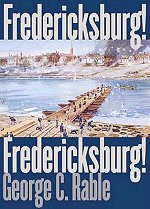 Fredericksburg! Fredericksburg! A stunning defeat for the Union. Confederate Robert E. Lee suffered roughly 5,000 casualties but inflicted nearly 13,000--on his opponent, General Ambrose Burnside. |
Kindle Available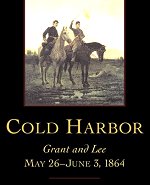 Cold Harbor Grant and Lee May 26-June 3, 1864 The spring 1864 campaignwhich pitted Ulysses S. Grant against Robert E. Lee for the first time in the Civil War |
Kindle Available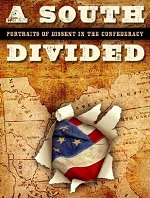 A South Divided: Portraits of Dissent in the Confederacy An account of Southern dissidents in the Civil War, at times labeled as traitors, Tories, deserters, or mossbacks during the war and loyalists, Lincoln loyalists, and Unionists by historians of the war |
Kindle Available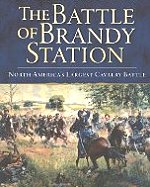 The Battle of Brandy Station North America's Largest Cavalry Battle Just before dawn on June 9, 1863, Union soldiers materialized from a thick fog near the banks of Virginia's Rappahannock River to ambush sleeping Confederates. The ensuing struggle, which lasted throughout the day, was to be known as the Battle of Brandy Station the largest cavalry battle ever fought on North American soil. |
Sources:
Library of Congress
West Point
Federal Citizens
| Search AmericanCivilWar.com |
| Enter the keywords you are looking for and the site will be searched and all occurrences of your request will be displayed. You can also enter a date format, April 19,1862 or September 1864. |

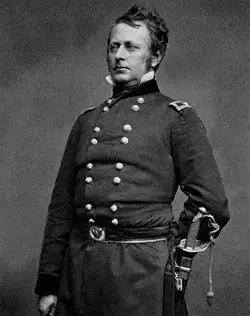 Hooker graduated from West Point in 1837 and served in the Mexican War, rising to the rank of captain of artillery. After a leave of absence from 1851-1853, he resigned his commission to take up farming in California. When the Civil War broke out in 1861, Hooker was made brigadier general of volunteers and commanded troops defending Washington. He was assigned command of a division in the Army of the Potomac during the Peninsula Campaign in early 1862 and promoted to major general of volunteers in May.