AmericanCivilWar.com Original Work - Prelude to Gettysburg: General JEB Staurt's Ride around General Hooker June 1863
|
||||
Kindle Available Flames Beyond Gettysburg The Gettysburg Campaign has been examined in minute detail from nearly every aspect but the key role played by Richard Ewell's Second Corps during the final days in June. Book Review |
American Civil War Battle
|
Kindle Available The Maps of Gettysburg: The Gettysburg Campaign June 3 - July 13, 1863 The Maps of Gettysburg plows new ground in the study of the campaign by breaking down the entire campaign in 140 detailed original maps. Gettysburg Book Titles |
||
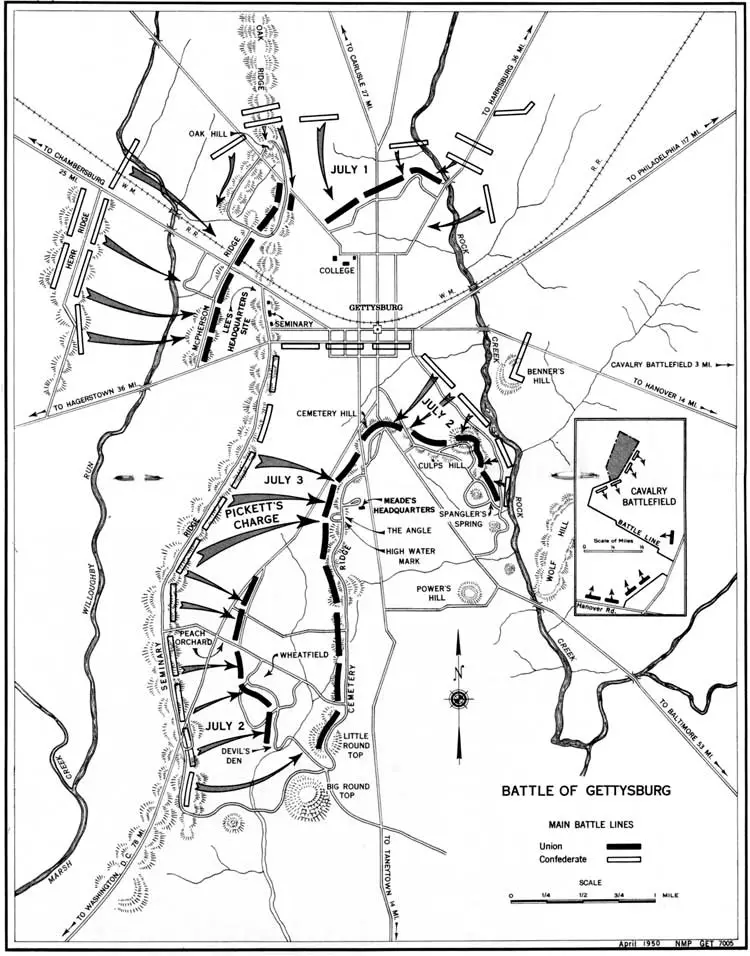
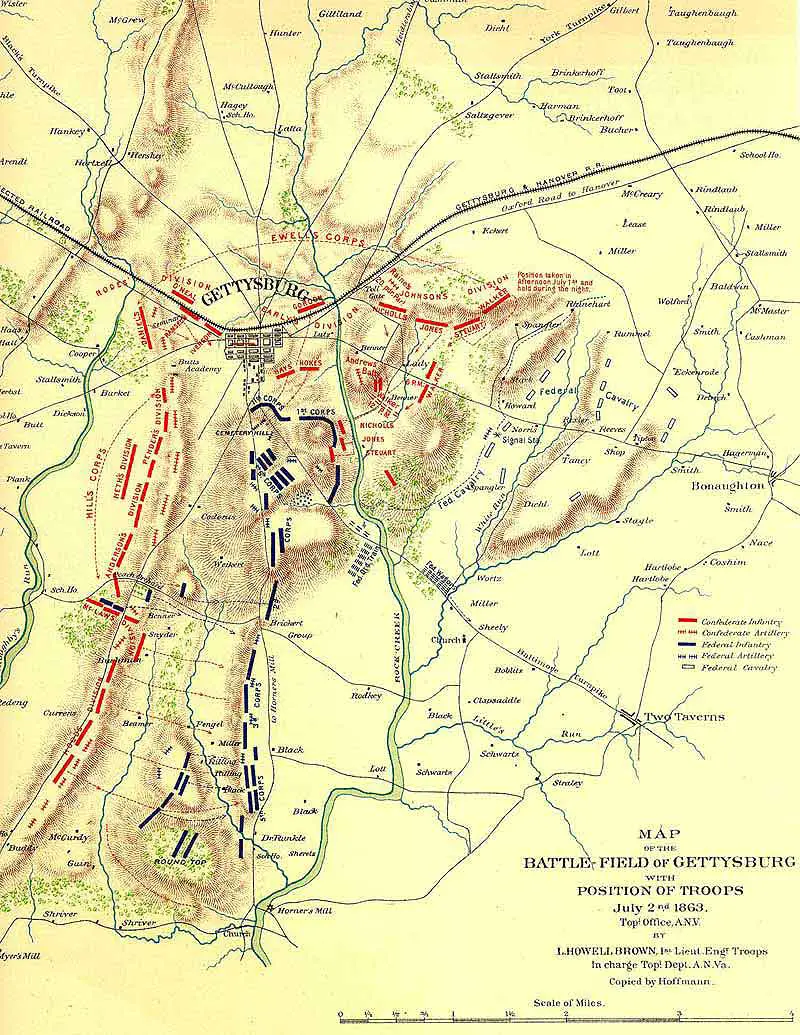
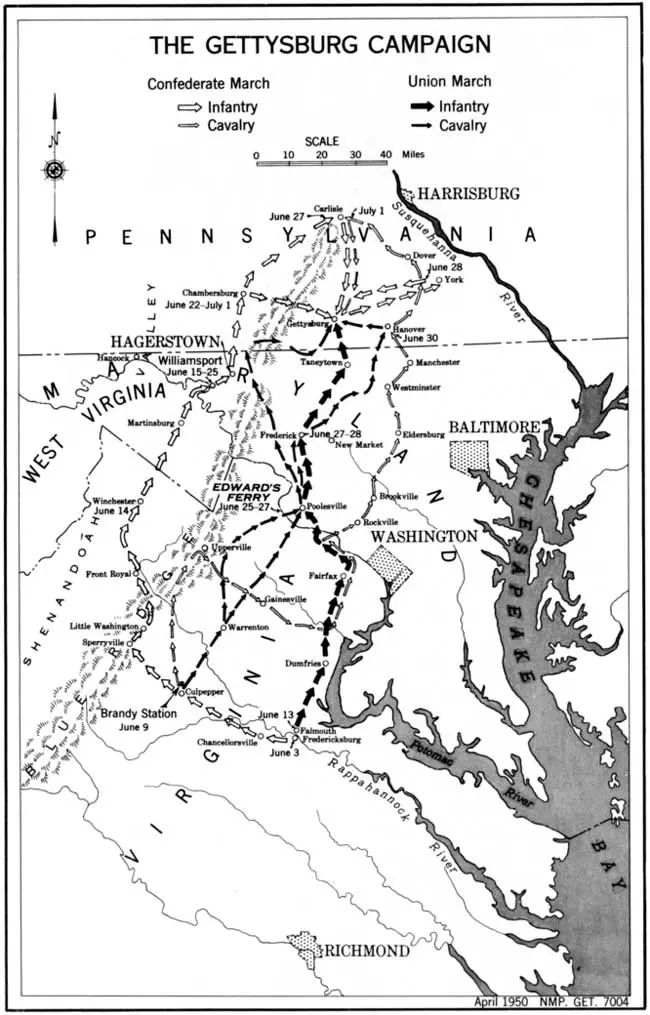
In taking his army north from the Rappahannock, General Lee's objective was to induce the Union Army to disperse across a broad front along the Mason-Dixon line, and then, by maneuver, draw it to a point far from its base of supply where it could be attacked and beaten in detail. In the execution of this operation, the three corps of the Rebel army marched from the vicinity of Culpeper Courthouse into the Shenandoah Valley and across the Potomac at Williamsport and Sheperdstown. Once in the Cumberland Valley, Ewell's corps, leading the invasion, marched to Chambersburg, Pennsylvania. There, CSA General Jubal Early's division turned east and, passing through the South Mountain at the Cashtown Gap, marched past Gettysburg to York while General Ewell, with Rodes's and Johnson's divisions, marched to Carlisle, sending one brigade forward to the Susquehanna in front of Harrisburg. Confederate General A.P. Hill's corps, and General Longstreet's, followed Ewell as far as Chambersburg, arriving there, on June 27, and went into camp. On June 25, when it became clear to its commander, General Joseph Hooker US, that the enemy was crossing the Potomac west of the Blue Ridge, the Union army, scattered about the Manassas plain, marched to Leesburg and crossed the river at Edward's Ferry, moving west to Frederick, Maryland, and into the Middletown Valley to block the anticipated movement of the enemy east through Turner's Gap. Two days later, realizing from reports received that the enemy had reached the Susquehanna River at two points—Harrisburg and Wrightsville—Hooker demanded that President Lincoln give him command of additional forces in order to move north toward the enemy. When Lincoln refused Hooker abruptly resigned and George G. Meade stepped into his place. Meade immediately ordered the army to march, in six columns, northeastward toward the line of Pipe Creek, the 1st, 3rd and 11th corps taking position between Emittsburg and Taneytown, the 2nd, 5th, and 6th corps taking position between Taneytown and Manchester. In the night of June 30, Meade received word from Washington that the enemy forces on the Susquehanna had fallen back and seemed to moving in three directions toward Gettysburg. Meade ordered his army to prepare for a defensive battle behind Pipe Creek and sent John Reynolds, commander of the 1st Corps, supported by the 11th and 3rd Corps, to move toward Gettysburg; with the mission of retarding the anticipated movement of the enemy toward Pipe Creek, if possible, and then fall back. Because Reynolds did not encounter any infantry force approaching, he marched on to Gettysburg and hurriedly formed his corps into a battle line just west of the town, and soon was engaged with A.P. Hill's corps, marching out from the Cashtown Gap |
 PCN Tours Gettysburg Battlewalks: General Meade After Pickett's Charge Did Meade want to fight at Gettysburg? Did Meade want to retreat on the evening of July 2nd? Why didn't Meade counter-assault the Army of Northern Virginia after the Pickett-Pettigrew-Trimble charge? National Park Service addresses these questions DVD |
|
July 1 - Day 1
Learning of Reynolds's death late in the afternoon, Meade had sent Winfield Hancock, commander of the 2nd Corps, to Gettysburg, to take command from Howard. By early evening, receiving a dispatch from Hancock, reporting the condition of things, Meade decided to move the entire army up. Meade arrived on the field about midnight, followed by the arrival of the 5th Corps, the 2nd Corps, and the next day the 6th Corps. Original Work: The First Day at Gettysburg July 1, 1863 |
General JEB Stuart's Ride Around General Hooker: June 1863
|
|
Large Area Map
|
Kindle Available Meade: Victor At Gettysburg Meade took command only hours before his forces stumbled upon Robert E. Lee's Confederates at Gettysburg, Pennsylvania, in 1863. He led his men to victory in one of the most famous battles in history, but Meade was soon embroiled in political battles with fellow generals and Washington politicians  In the Hands of Providence: Joshua L. Chamberlain and the American Civil War The professor-turned-soldier who led the Twentieth Maine Regiment to glory at Gettysburg, earned a battlefield promotion to brigadier general from Ulysses S. Grant at Petersburg, and was wounded six times during the course of the Civil War  Custer Victorious: The Civil War Battles of General George Armstrong Custer Custer was promoted to major general and the helm of the Third Cavalry Division when he was only twenty-four. Urwin describes the Boy General's vital contributions to Union victories from Gettysburg to Appomattox. 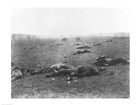 The Harvest of Death, Gettysburg, 1863 Fine-Art Print 24" x 18" |
| Gettysburg Day by Day Summary Gettysburg Address Kids Zone Gettysburg Pennsylvania Battle Map Civil War Exhibits Civil War Maps General Robert E. Lee General Ulysses S. Grant Confederate President Jefferson Davis Ships and Naval Battles |
 Civil War Model 1851 Naval Pistol Engraved Silver Tone / Gold Tone Finish and Wooden Grips - Replica of Revolver Used by Both USA / Union and CSA / Confederate Forces Reenactors Row Supplies Confederate Collectibles Top Book Titles |
Kindle Available Hallowed Ground: A Walk at Gettysburg The events that occurred at Gettysburg are etched into our collective memory, as they served to change the course of the Civil War and with it the course of history. More than any other place in the United States, Gettysburg is indeed hallowed ground. It's no surprise that it is one of the nation's most visited sites (nearly two million annual visitors), attracting tourists, military buffs, and students of American history. |
Kindle Available Sickles at Gettysburg: The Controversial Civil War General Who Committed Murder, Abandoned Little Round Top, and Declared Himself the Hero of Gettysburg No individual who fought at Gettysburg was more controversial, both personally and professionally, than Major General Daniel E. Sickles. By 1863, Sickles was notorious as a disgraced former Congressman who murdered his wife's lover on the streets of Washington and used America's first temporary insanity defense to escape justice |
Kindle Available The Louisiana Tigers in the Gettysburg Campaign, June-July 1863 A sweeping history of the Louisiana Tigers; their predecessors, Wheat's Tigers; the organizational structure and leadership of the brigade in 1863; and the personnel that made up its ranks. Covering the Tigers' movements and battle actions in depth |
 A Vast Sea of Misery: A History and Guide to the Union and Confederate Field Hospitals at Gettysburg, July 1-November 20, 1863 Virtually everything you would want to know about post-battle medical care for Union and Confederate soldiers at Gettysburg can be found in this thorough and highly detailed book. Both Civil War and Medical historians will find this book to be very appealing. It is well-illustrated and full of first-hand accounts of the locations |
 Brigades of Gettysburg: The Union and Confederate Brigades at the Battle of Gettysburg Brigades of Gettysburg fills this void by presenting a complete account of every brigade unit at Gettysburg and providing a fresh perspective of the battle.Using the words of enlisted men and officers, the author-well-known Civil War historian Bradley Gottfried-weaves a fascinating narrative of the role played by every brigade at the famous three-day battle |
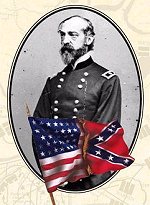 George Gordon Meade and the War in the East To most students of the Civil War, he is merely the man who was lucky enough to benefit from Confederate mistakes at Gettysburg, but whose shortcomings as a commander compelled Abraham Lincoln to bring in Ulysses S. Grant from the West to achieve victory |
Kindle Available Those Damned Black Hats! The Iron Brigade in the Gettysburg Campaign Memorable Battles at South Mountain, Antietam, Chancellorsville, Mine Run, the Overland Campaign, and the grueling fighting around Petersburg. None of these battles compared with the "four long hours" of July 1, 1863, at Gettysburg, where the Iron Brigade was all but wrecked. |
Kindle Available The Gettysburg Gospel: The Lincoln Speech That Nobody Knows Reconstructs what really happened in Gettysburg, Pennsylvania, on November 19, 1863. |
 Horses of Gettysburg Civil War Minutes Filmed in high definition with charging horses, battlefield panoramas and no "talking heads," this cinematic documentary tells the story of the estimated 72,000 horses and mules that fought at the Battle of Gettysburg and uncovers the strategies employed to ensure that the millions of animals in service with the North and South remained healthy and well-trained for action. |
 Gettysburg and Stories of Valor - Civil War Minutes III DVD Box Set This 3-hour documentary captures the scenic beauty of the Gettysburg battlefield, examines rare Civil War artifacts and tells the personal stories of the men who fought in the war. |
 Gettysburg / Gods and Generals The tide of the war changes during three fierce days of combat at Gettysburg [Disc 1] the gripping saga of the tactics command errors and sacrifices behind the bloodiest battle ever fought on U.S. soil. Gods and Generals [Disc 2] reveals the spirited allegiances and fierce combat of earlier Civil War struggles |
 Civil War Journal West Point Classmates - Civil War Enemies Beyond the pages of history and into the personal stories behind the Great Conflict |
 PCN Tours Gettysburg Battlewalks: Lee's Retreat Through Monterey Pass |
PCN Gettysburg Battlewalks: The First Shots |
PCN Tours Gettysburg Battlewalks: The Valley of Death |
PCN Tours Gettysburg Battlewalks: Armistead's Brigade |
PCN Tours Gettysburg Battlewalks: Culp's Hill |
PCN Tours Gettysburg Battlewalks: The Codori Farm |
PCN Tours Gettysburg Battlewalks: Awe-Inspiring Confusion at Devil's Den |
PCN Tours Gettysburg Battlewalks: Maj. General Pender on Seminary Ridge |
PCN Tours Gettysburg Battlewalks: Spangler's Spring |
PCN Tours Gettysburg Battlewalks: Power's Hill |
PCN Tours Gettysburg Battlewalks: Henry Hunt at Cemetery Ridge |
PCN Tours Gettysburg Battlewalks: The Wounded and the Dead |
PCN Tours Gettysburg Battlewalks: Bucktail Brigade |
PCN Tours Gettysburg Battlewalks: Herbst Woods |
PCN Tours Gettysburg Battlewalks: The Wiekert, Trostle, and Klingle Farms |
PCN Tours Gettysburg Battlewalks: The 13th Vermont Infantry |
 The Civil War - A Film by Ken Burns Here is the saga of celebrated generals and ordinary soldiers, a heroic and transcendent president and a country that had to divide itself in two in order to become one |
 PCN Tours Gettysburg Battlewalks: Pickett's Charge - Pettigrew's Perspective The legendary exploits of the Union and Confederate armies come to life with these informative tours of Gettysburg National Park |
PCN Tours Gettysburg Battlewalks: General Meade After Pickett's Charge Did Meade want to fight at Gettysburg? Did Meade want to retreat on the evening of July 2nd? Why didn't Meade counter-assault the Army of Northern Virginia after the Pickett-Pettigrew-Trimble charge? National Park Service addresses these questions |
 History Channel Presents The Civil War From Harper's Ferry, Fort Sumter, and First Bull Run to Shiloh, Antietam, and Gettysburg. The most legendary Civil War battles in brilliant detail. A selection of the soldiers and legendary leaders. |
Sources:
Joe Ryan
Library of Congress
Federal Citizen
| Search AmericanCivilWar.com |
|
| Enter the keywords you are looking for and the site will be searched and all occurrences of your request will be displayed. You can also enter a date format, April 19,1862 or September 1864. |

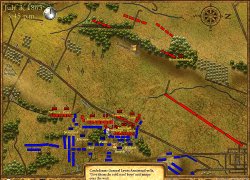
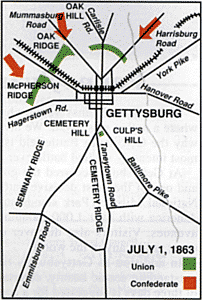 The Confederate 1st Corps and General A.P. Hill's corps grappled along McPherson's Ridge for several hours. Early in the struggle, Reynolds was killed by a sniper's bullet to the brain, and O.O. Howard, commander of the 11th Corps, assumed command. At the time the 11th Corps arrived, two of Ewell's divisions—Rodes and Early—appeared on the right flank of the Union line and attacked. This forced Howard to form a battle line perpendicular to the fighting front of the 1st Corps. The combined rebel pressure against the hinge connecting the two Union lines resulted in Union resistance collapsing and a general retreat commenced, the Union forces running pell-mell through the streets of Gettysburg and up to the heights of Cemetery Hill. The rebel forces under Hill and Ewell pursued, but, worn out and disorganized by the battle, and without fresh forces immediately at hand, the pursuit petered out on the bottom slopes of the hill as night fell.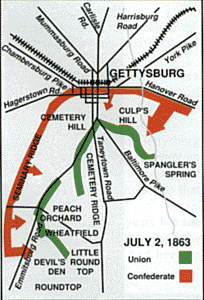
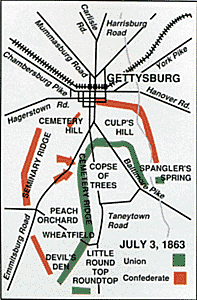
 Fine-Art Print