|
|
|
Jubal Early was born in Franklin County, Virginia on November 3, 1816,the third child of ten. When he was sixteen his mother died and the following year he received an appointment as 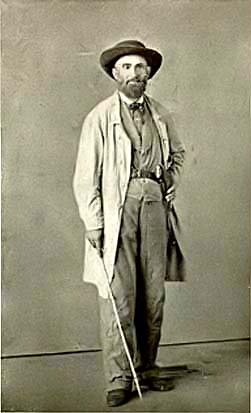 a cadet to West Point. In 1837, he graduated 18th out of a class of 50.
After serving in the army in the Seminole Wars in Florida, Early returned to Virginia where he studied law. After becoming a lawyer in 1840, he served in the Virginia Legislature during the 1841 and 1842 sessions. Though he lost reelection the following year, he received an appointment as prosecuting attorney, which he held until 1851.
In 1844, Early mustered back into the army as a major. During the United States' war with Mexico, Early performed garrison duties, including a two month stint as military governor in Monterrey, Mexico. In April 1848, he once again was mustered out of service and returned home to continue his law practice. a cadet to West Point. In 1837, he graduated 18th out of a class of 50.
After serving in the army in the Seminole Wars in Florida, Early returned to Virginia where he studied law. After becoming a lawyer in 1840, he served in the Virginia Legislature during the 1841 and 1842 sessions. Though he lost reelection the following year, he received an appointment as prosecuting attorney, which he held until 1851.
In 1844, Early mustered back into the army as a major. During the United States' war with Mexico, Early performed garrison duties, including a two month stint as military governor in Monterrey, Mexico. In April 1848, he once again was mustered out of service and returned home to continue his law practice.Always an irascible officer, Jubal A. Early suffered overwhelming defeats in the Shenandoah Valley and went on after the conflict to wage a literary war with a fellow Confederate corps commander. A West Pointer (1837) from Virginia, Early had served one year in the artillery, and later in the Mexican War as a major of volunteers,before taking up law. Also involved in politics, he served in the legislature. Although he voted against secession at the convention, he entered the military where his assignments included: colonel, 24th Virginia (early 1861); commanding 6th Brigade (in 1st Corps from July 20), Army of the Potomac June 20-October 22, 1861); brigadier general, CSA July 21, 1861);commanding brigade, Van Dorn's-D.H. Hill's Division (in Potomac District until March), Department of Northern Virginia (October 22, 1861-May 5, 1862); commanding Eizey's Brigade, Ewell's Division, 2nd Corps, Army of Northern Virginia Uuly 1-September 17, 1862); commanding the division (September 17, 1862-November 1863; ca. December 4-15, 1863; February-May 7; and May 21-27, 1864); major general, CSA (April 2 3 to rank from January 17, 1863); commanding the corps (November-ca. December 4, 1863 and May 27-June 13, 1864); commanding Valley District, Department of Northern Virginia (December 15, 1863 February 1864 and June 13, 1864-March 29, 1865); commanding 3rd Corps, Army of Northern Virginia (May 7-21, 1864); and lieutenant general, CSA (May 31, 1864). Leading a brigade at 1st Bull Run and Williamsburg, he was wounded at the latter. Returning to duty, he was given another command on the day of Malvern Hill. At Cedar Mountain and 2nd Bull Run he directed this unit and continued until he succeeded to division level at Antietam. He went on to Fredericksburg, Chancellorsville, and Gettysburg and commanded the corps in the Mine Run operations. Detached, he commanded in the Shenandoah during the winter of 1863-64. After the Battle of the Wilderness he took over temporary control of Hill's Corps during the operations at Spotsylvania. He directed his division at the North Anna and took over Ewell's Corps before Cold Harbor. A couple of weeks later this command was sent back to the Valley and Early invaded Maryland, fighting 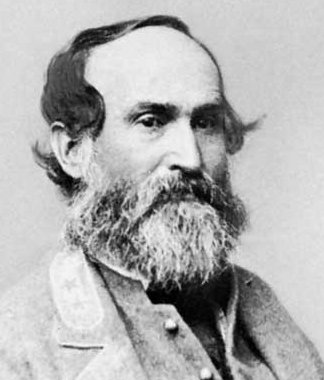 at Monocacy and on the outskirts of Washington. Falling back to Virginia, he dispatched part off his cavalry to burn Chambersburg, Pennsylvania, in retaliation for Union devastation. In September and October he was defeated in a series of disasters at the hands of Sheridan. The reverses at 3rd Winchester, Fisher's Hill, and Cedar Creek ended his power in the Valley and the old 2nd Corps and was recalled to Lee in December. at Monocacy and on the outskirts of Washington. Falling back to Virginia, he dispatched part off his cavalry to burn Chambersburg, Pennsylvania, in retaliation for Union devastation. In September and October he was defeated in a series of disasters at the hands of Sheridan. The reverses at 3rd Winchester, Fisher's Hill, and Cedar Creek ended his power in the Valley and the old 2nd Corps and was recalled to Lee in December. However, Early remained with a small force that was destroyed at Waynesborough the following March. Lee then removed him, explaining that he was forced to by public reaction and the fact that he could not defend his subordinate without revealing how weak the Confederacy was. Early fled to Mexico but soon returned to practice law. He was connected with the Louisiana Lottery and was president of the Southern Historical Society. Becoming a defender of Lee, he feuded with Republican convert James Longstreet until his death. |
 A Memoir of the Last Year of the War for Independence in the Confederate States of America Ranked among the most important generals who fought with Lee's Confederate Army of Northern Virginia. Jubal Early played principal roles at the battles of First Manassas, Chancellorsville, Gettysburg, and most of the other engagements in the Eastern Theater |
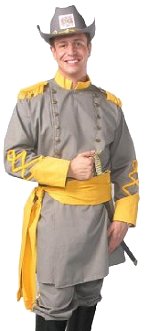 Adult Confederate Officer Uniform |
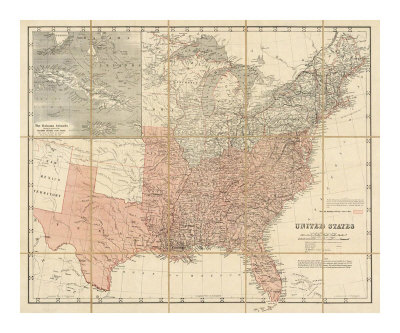 United States, c.1861 40 inches x 33 inches Buy at AllPosters.com Framed |
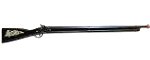 Civil War Musket Wood & Steel Frontier Rifle Designed After The Original Rifle, This Civil War Musket replica has been designed after the original rifle of its era. Measures approximately 37 inches long. Each is constructed with a solid one-piece wood stock, painted steel barrel and die-cast parts. |
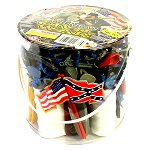 Civil War Soldier 102 Piece Playset
|
 Jubal's Raid: General Early's Famous Attack on Washington in 1864 General Grant was hammering at the gates of Richmond and the Confederacy seemed doomed. In a bold and desperate stroke, General Lee countered by sending General. Early and a force of only twelve thousand men toward Washington, D.C. |
Kindle Available The Illustrated Battle Cry of Freedom The Civil War Era Published in 1988 to universal acclaim, this single-volume treatment of the Civil War quickly became recognized as the new standard in its field. James M. McPherson, who won the Pulitzer Prize for this book, impressively combines a brisk writing style with an admirable thoroughness. He covers the military aspects of the war in all of the necessary detail, and also provides a helpful framework describing the complex economic, political, and social forces behind the conflict. Perhaps more than any other book, this one belongs on the bookshelf of every Civil War buff. |
Kindle Available The Civil War a Narrative This beautifully written trilogy of books on the American Civil War is not only a piece of first-rate history, but also a marvelous work of literature. Shelby Foote brings a skilled novelist's narrative power to this great epic. Many know Foote for his prominent role as a commentator on Ken Burns's PBS series about the Civil War. These three books, however, are his legacy. His southern sympathies are apparent: the first volume opens by introducing Confederate President Jefferson Davis, rather than Abraham Lincoln. But they hardly get in the way of the great story Foote tells. This hefty three volume set should be on the bookshelf of any Civil War buff. |
Kindle Available The Louisiana Tigers in the Gettysburg Campaign, June-July 1863 A sweeping history of the Louisiana Tigers; their predecessors, Wheat's Tigers; the organizational structure and leadership of the brigade in 1863; and the personnel that made up its ranks. Covering the Tigers' movements and battle actions in depth |
Kindle Available Gettysburg-Culp's Hill and Cemetery Hill In this companion to his celebrated earlier book, Gettysburg: The Second Day, Pfanz provides the first definitive account of the fighting between the Army of the Potomac and Robert E. Lee's Army of Northern Virginia at Cemetery Hill and Culp's Hill--two of the most critical engagements fought at Gettysburg. 15 maps. 76 illus. |
Kindle Available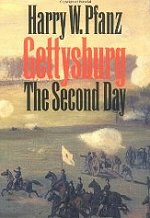 Gettysburg : The Second Day The full dynamics of Longstreet's Charge on the second day, from the suppression of the Union artillery in the Peach Orchard to the attacks and counterattacks around the Wheat Field, Devil's Den, and Little Round Top. The tactics are explained on regimental level. The assault by Anderson's Division on Cemetery Ridge are included |
Kindle Available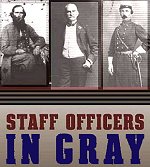 Staff Officers in Gray: A Biographical Register of the Staff Officers in the Army of Northern Virginia Profiles some 2,300 staff officers in Robert E. Lee's famous Army of Northern Virginia. A typical entry includes the officer's full name, the date and place of his birth and death, details of his education and occupation, and a synopsis of his military record. Two appendixes provide a list of more than 3,000 staff officers who served in other armies of the Confederacy and complete rosters of known staff officers of each general |
Kindle Available The Class of 1846: From West Point to Appomattox: Stonewall Jackson, George McClellan, and Their Brothers No single group of men at West Point has been so indelibly written into history as the class of 1846. The names are legendary: Thomas "Stonewall" Jackson, George B. McClellan, Ambrose Powell Hill, Darius Nash Couch, George Edward Pickett, Cadmus Marcellus Wilcox, and George Stoneman |
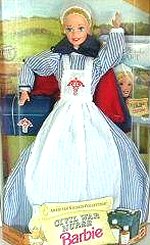 Civil War Nurse Barbie Part of the American Stories Collection. |
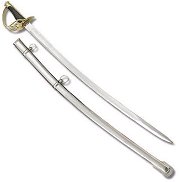 Cavalry Saber This fine replica is 39 inches overall and features a highly polished 33 inch carbon steel blade. Its leather wrapped handle fits the hand perfectly and sports decorative brass accents and a shiny brass pommel. |
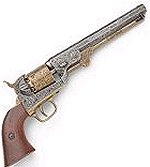 Civil War Model 1851 Naval Pistol Engraved Silver Tone / Gold Tone Finish and Wooden Grips - Replica of Revolver Used by Both USA / Union and CSA / Confederate Forces |
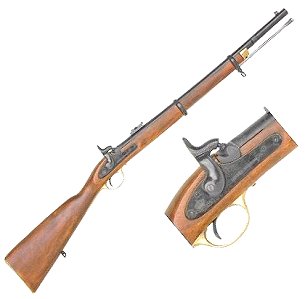 1860 Enfield Civil War Musketoon This piece is a full-size non-firing reproduction of the rifle used in the Civil War. The body is made of European hardwood |
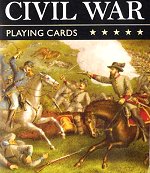 American Civil War Poker Playing Cards Playing Cards commenmorating the AMERICAN CIVIL WAR, featuring great portraits of statesmen, generals and fighting men, as well as graphics scenes of battle in color. Evocative images from the Library of Congress are featured on all 54 cards |
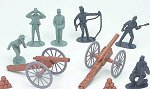 20 piece Civil War Artillery Playset Civil War Artillery Set: 20 piece set includes 12 Artillery Crew Figures in Blue and Gray that stand up to 58mm tall, 4 Parrott Rifle Gun Cannon about 4 inches long, and 4 Cannonball stacks |
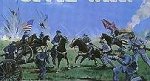 Civil War Figures by IMEX 1/72 Scale. American Civil War Union and Confederate Artillery, Cavalry, and Infantry Set with Base, produced by IMEX. Finely detailed parts are molded in gray (Confederate) and bright blue (Union). |
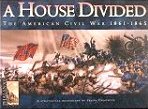 House Divided Board Game
|
