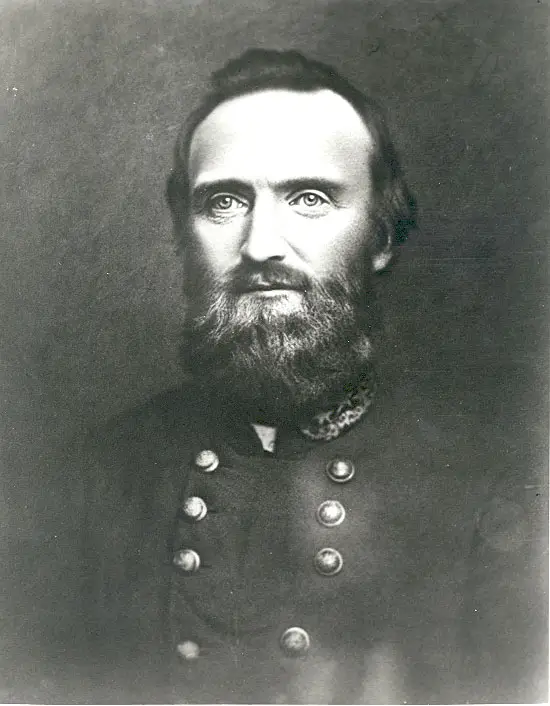
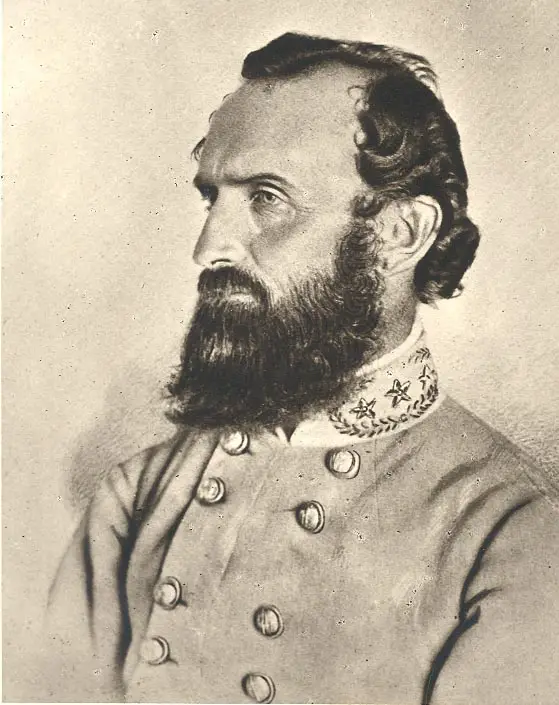
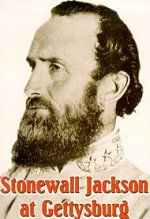
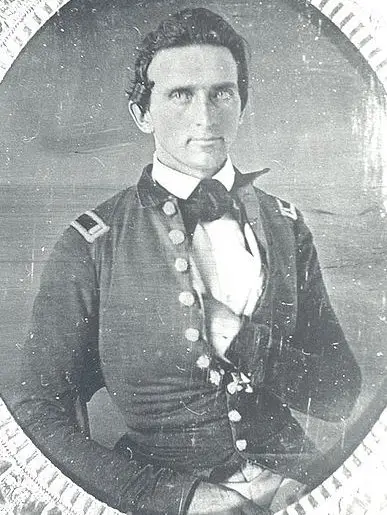
Confederate General Stonewall Jackson
1824-1863
"You may be whatever you resolve to be"


Stonewall Jackson - Biography
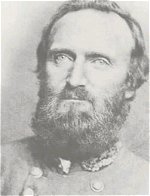
He earned his nickname for bravery at Bull Run. He met his fate in a tragic accident at Chancellorsville. Stonewall Jackson is widely regarded as one of the greatest of the Confederate commanders of the Civil War. An outstanding leader and brilliant tactician he led some of the most stunning campaigns of the war and earned a place in military history.
. DVD
Stonewall Jackson Southern Hero
Thomas Jonathan "Stonewall" Jackson died in an outbuilding on the Chandler plantation in the rural community of Guniea Station. Today, the Jackson Shrine is part of Fredericksburg & Spotsylvania National Military Park.

Born in what is now the state of West Virginia, in the town of Clarksburg, Thomas Jonathan Jackson possessed a strong military background at the outbreak of the Civil War. His training in the U.S. Military Academy at West Point, recognition as a hero in the Mexican War, and his experience as an instructor at the Virginia Military Institute justified Jackson's rank of brigadier general at the first major battle of the Civil War near Manassas, Virginia. Upon that field, General Bernard E. Bee proclaimed, "There is Jackson standing like a stone wall," and a legend as well as a nickname was born.
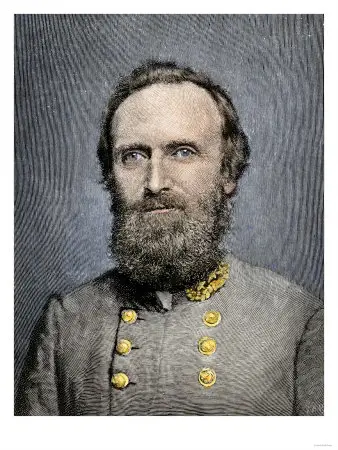
Jackson's military feats had elevated him to near mythical proportions, in both North and South, when in the midst of one of his most brilliant maneuvers, he was mistakenly shot by his own men on the night of May 2, 1863 at the The Battle of Chancellorsville. Confederate army commander Robert E. Lee decided that his indispensable and most capable subordinate should recuperate in a safe place well behind friendly lines. He selected this area, Guinea Station, as the best location for Jackson because of its proximity to the railroad to Richmond and its familiarity to the wounded general.

The "Stonewall" Jackson Shrine is the plantation office building where General Jackson died. The office was one of several outbuildings on Thomas C. Chandler's 740-acre plantation named "Fairfield." This typical frame structure saw use primarily by the men for recreation as well as for work. Chandler kept records in the office and one of his sons once practiced medicine there, but with three of the Chandler boys away serving in the Confederate Army, the building no longer witnessed its ante-bellum level of activity.

The office stood bare, except for a few items in storage, when Jackson's ambulance arrived. Although offered the use of the Chandler house, Jackson's doctor and staff officers chose the quiet and private outbuilding as the best place for Jackson to rest after his long ambulance ride. I all went well, the general would soon board a train at Guinea Station and resume his trip to Richmond and the medical expertise available there.

Today, the office is the only plantation structure remaining. The Chandler house burned at some point after the Civil War, and its shell was dismantled in the early 1900's. Once established as an historic "shrine," the office underwent restorations in the 1920's and the 1960's, and still retains about 45% original fabric. The National Park Service has augmented some of the items used during Jackson's stay with other pieces from the era, along with a few reproductions, to recreate the scene of those tragic last days of his life.


* 1824 January 21
Thomas Jonathan Jackson was born at Clarksburg, [West] Virginia.
Parents: Jonathan Jackson (1790-1826) an attorney, and Julia Beckwith Neale (1798-1831). They were married in September 1817 and had four children: Elizabeth (1819-1826); Warren (1821-1841); Thomas (1824-1863), and Laura Ann (1826-1911).
More Jackson family genealogy


* 1826 March
Jackson's sister Elizabeth (age 6) and his father died of typhoid fever. Julia Jackson gave birth to Laura the day after her husband died. Widowed at age 28, Julia was left with extensive debts and the family was impoverished.


* 1830-1841
Julia Jackson remarried. Her new husband, Blake Woodson, disliked his stepchildren and the family had financial difficulties. A short time after the marriage, Thomas and Laura were sent to live with Jackson relatives in Jackson's Mill [West] Virginia; Warren was sent to Neale relatives. Julia Jackson died, as a result of childbirth complications, on Dec. 4, 1831. She left behind the three Jackson siblings and a newborn son (Thomas's half brother), William Wirt Woodson (1831-1875). Jackson and Laura spent the remaining years of childhood with their paternal uncles. Jackson's brother, Warren, died of tuberculosis in 1841.


* 1842 June-1846 June
Jackson attended the United States Military Academy at West Point. Jackson was not the first choice for his congressional district's appointment, but the top applicant withdrew from the academy after only one day. Jackson graduated in June 1846, standing 17th out of 59 graduates. Jackson began his U.S. Army career as a 2nd Lt., First Artillery Regiment. In 1844, Jackson's beloved sister, Laura, married Jonathan Arnold.


* 1846-1851
United States Army officer. Served in the Mexican War, 1846-1848; stationed at Carlisle Barracks, PA; Ft. Hamilton, NY; Ft. Meade, FL.


* 1851-1861 April

o In the spring of 1851 Jackson was offered and accepted the appointment to teach at the Virginia Military Institute in Lexington, Virginia; he resigned from the army.
Elinor Junkin, Jackson's first wife, died in childbirth
Elinor Junkin Jackson
o Reported for duty at VMI on August 13, 1851. He taught natural and experimental philosophy (related to modern day physics and including physics, astronomy, acoustics, optics, and other scientific courses).
o On August 4, 1853, Jackson married Elinor Junkin (1825-1854), daughter of Dr. George Junkin (President of Washington College) and Julia Miller Junkin.
o Elinor (Ellie) died in childbirth on October 22, 1854. Their child, a son, was stillborn.
o During the summer of 1856 Jackson toured Europe, visiting Belgium, France, Germany, Switzerland, England and Scotland.
o On July 16, 1857, Jackson married for the second time. His wife was Mary Anna Morrison (1831-1915), daughter of Robert Hall Morrison and Mary Graham Morrison. Mary Anna's family resided in North Carolina; her father was the retired President of Davidson College.
o Mary Anna gave birth to a daughter, Mary Graham, on April 30, 1858; the baby died less than a month later, on May 25.
o In November 1859, Jackson was one of the VMI officers who accompanied a contingent of VMI cadets to Harper's Ferry, where they stood guard at the execution of abolitionist John Brown.

* 1861-1863
o April 21, 1861 - the VMI Corps of Cadets was ordered to Richmond to serve as drillmasters for new army recruits. Jackson was placed in command of the cadets.
o April 27, 1861 - Gov. John Letcher ordered Col. Jackson to take command at Harper's Ferry, where he organized the troops that would soon comprise the famous "Stonewall Brigade" (2nd, 4th, 5th, 27th and 33rd Virginia Infantry Regiments; Rockbridge Artillery; all were from the Shenandoah Valley region of Virginia).
o July 1861 - Promoted to Brigadier General. Battle of 1st Manassas, where he acquired the legendary nickname Stonewall. "Look, there stands Jackson like a stone wall."
o October 1861 - Promoted to Major General. Placed in command of the Valley of Virginia (Shenandoah Valley)
o 1862 May & June - Jackson's brilliant Shenandoah Valley Campaign; victories at Front Royal, Winchester, Cross Keys and Port Republic. Following the successful campaign, Jackson was ordered to join Gen. Lee in the Peninsula (Eastern Virginia).
Julia Jackson (1862-1889).
Her mother was Mary Anna Morrison, Jackson's second wife.
From an original image in the VMI Archives Photograph collection Julia Jackson (1862-1889)
o 1862 June 15-July 1 - Seven Days Battles. Jackson displayed ineffective leadership which stood in stark contrast to the brilliance of the Shenandoah Valley campaign; the reasons for this uncharacteristic military failure is still debated among Jackson scholars. Returned to the Valley.
o 1862 June-September. Battles of Cedar Mountain, Clark's Mt., 2nd Manassas (July 21), Antietam (September 17).
o 1862 October - Lee reorganized his army into two corps. Jackson was promoted to Lt. General and given command of the new Second Corps. Jackson was now in charge of half of Lee's Army of Northern Virginia.
o 1862 November - Jackson's daughter, Julia Laura, was born.
o 1862 December 13 - Battle of Fredericksburg
o 1862 December-1863 March - In quarters at Moss Neck, 10 miles south of Fredericksburg. The estate was owned by the Corbin family, who offered their home as winter headquarters.
o 1863 April - in camp at Hamilton's Crossing
o 1863 May 1 - Battle of Chancellorsville begins.
o 1863 May 2, 9:00 p.m. - While reconnoitering with members of his staff, Jackson was accidentally fired upon by his own troops. The 18th North Carolina Infantry Regiment was responsible for the "friendly fire" incident. Jackson was struck by three .57 caliber bullets. He was taken to a field hospital near the battlefield, where his left arm was amputated.
o 1863 May 4 - Jackson was moved to a field hospital at the home of Thomas and Mary Chandler, near Guiney Station, approximately 30 miles from the battlefield.
o 1863 May 10 - Jackson died at 3:15 p.m. His last words were "Let us cross over the river and rest under the shade of the trees."
o 1863 May 15. Jackson's funeral took place in Lexington, Virginia, the town that was Jackson's home during his years as Professor at VMI.

Postscript
o Mary Anna Morrison Jackson never remarried. She was known as the "Widow of the Confederacy" and lived until 1915.
o The close relationship between Jackson and his sister, Laura Jackson Arnold, was destroyed during the war. Laura was an outspoken Unionist who became estranged from her brother and other members of her family. Federal troops occupied her hometown of Beverly [West] Virginia during most of the war, and Mrs. Arnold cared for Federal wounded in her home. See the Johnson Family Papers for a letter mentioning Laura's wartime reputation.
o Julia Jackson was less than one year old when her father died. She married William E. Christian in 1885; she died of typhoid fever in 1889, at age 26. Her children were Julia Jackson Christian (1887-1991), who married Edmund R. Preston; and Thomas Jonathan Jackson Christian (1888-1952), who married three times. Both of Jackson's grandchildren had several children; thus there are many living descendants of Stonewall Jackson.


Southern Historical Society Papers.
Vol. XIV. Richmond, Va., January-December. 1886.
Death of Stonewall Jackson


Still Standing: The Stonewall Jackson Story
The life of Stonewall Jackson from his orphaned childhood, to the Sunday School class he taught for African Americans that has resulted in a lasting impact today, to the pivotal role he played as a General in the Civil War
confederate general Stonewall Jackson

First Battle at Bull Run
Confederate General Robert E. Lee
Confederate President Jefferson Davis
Civil War Submarines
Kids Zone Battle of Gettysburg
Kids Zone Underground Railroad
Civil War Exhibits
Civil War Summary
Civil War Women
State Battle Maps

American Civil War DVD Titles

Lincoln and Lee at Antietam: The Cost of Freedom
Lincoln and Lee at Antietam covers the entire struggle of the Antietam Campaign. The political concept about why Lincoln needed a Union victory and Lee's need to take the war north were covered as well as the battle.

Rebel Sabres / The Battle of Brandy Station 1863
Through dramatic reconstructions and eye-witness accounts, this documentary explores the 1863 Battle Of Brandy Station.

Shiloh: The War is Civil No More

Civil War: A Concise History
The best collection of Civil War visuals ever assembled in one 75-minute program. A breathtaking and first-hand account of the war. Great DVD Bonuses
Stones River Tennessee
Stones River National Battlefield
Stones River was one of the hardest fought battles of the Civil War with casualties of 27 percent on the Confederate side and 29 percent on the Union side

Battle of Stones River: The Fight for Murfreesboro
At dawn on December 31, 1862 the two armies clashed in a deadly struggle along the banks of Stones River.
Chickamauga Civil War DVD
The Battle of Chickamauga
Special Widescreen Edition

Chickamauga one of the fiercest engagements of the American Civil War. Over a period of two days, more than 100,000 men struggled for control of the south's transportation hub, Chattanooga.

Struggle For Vicksburg
Photography of the park with authentic battlefield illustrations and life-like paintings. Vicksburg's wartime role in the bloody and brutal conflict.

Civil War Terror
Tales of hidden conspiracies of terror that specifically targeted the civilian populations. Engineers of chemical weapons, new-fangled explosives and biological warfare competed

Civil War Journal, West Point Classmates - Civil War Enemies, Robert E. Lee
Beyond the pages of history and into the personal stories behind the Great Conflict

The Last Days of the Civil War - April 1865: The Month That Saved America, Civil War Combat:
The Tragedy At Cold Harbor
The remarkable succession of events leading from the fall of Richmond to Appomattox.

The Last Days of the Civil War - Biography: Abraham Lincoln & Robert E. Lee, Civil War Journal: Jefferson Davis
In-depth profiles that series--illuminate the personalities at the heart of the conflict: Abraham Lincoln, Jefferson Davis, and Robert E. Lee

In Search Of History - Quantrill's Raiders

Long Road Back to Kentucky:
The 1862 Confederate Invasion

The often-overlooked Western campaign of the war with a specific emphasis on Kentucky's involvement in the American Civil War.

History's Mysteries: Family Feud:
The Hatfields And McCoys

Millions of dollars worth of timber and coal rich land were at stake, the courts were involved and once the national press got wind of what was happening, the backwoods folk found that their fight was being followed nationwide

The Civil War - A Film by Ken Burns
Here is the saga of celebrated generals and ordinary soldiers, a heroic and transcendent president and a country that had to divide itself in two in order to become one

Gettysburg and Stories of Valor - Civil War Minutes III DVD Box Set
This 3-hour documentary captures the scenic beauty of the Gettysburg battlefield, examines rare Civil War artifacts and tells the personal stories of the men who fought in the war.

Still Standing: The Stonewall Jackson Story
The life of Stonewall Jackson from his orphaned childhood, to the Sunday School class he taught for African Americans that has resulted in a lasting impact today, to the pivotal role he played as a General in the Civil War.

Stonewall Jackson - Biography
He earned his nickname for bravery at Bull Run. He met his fate in a tragic accident at Chancellorsville. Stonewall Jackson is widely regarded as one of the greatest of the Confederate commanders of the Civil War. An outstanding leader and brilliant tactician he led some of the most stunning campaigns of the war and earned a place in military history.

Rebel Sabres / The Battle of Brandy Station 1863
Through dramatic reconstructions and eye-witness accounts, this documentary explores the 1863 Battle Of Brandy Station.
The Smoothbore Volley That Doomed the Confederacy: The Death of Stonewall Jackson and Other Chapters on the Army of Northern Virginia
No military unit in all the annals of American history exceeds in reputation Robert E. Lee's illustrious Army of Northern Virginia. In ten chapters based on exhaustive research, esteemed Civil War scholar Robert K. Krick gives eloquent examination to aspects of the army ranging from biographical sketches and the best and worst books on the subject, to Confederate troop strengths and locating soldier records. He begins with two key events: Thomas J. "Stonewall" Jackson's mortal wounding at Chancellorsville; and Jackson's most famous quarrel with a subordinate, which resulted in the unsuccessful court martial of General Richard B. Garnett.

Krick continues with chapters on James Longstreet's failure at Knoxville and the prickly relationship between Jubal A. Early and the undisciplined Valley Cavalry. His piece on Robert E. Rodes is the first complete portrait of Lee's best division commander, whose wife methodically burned all of his letters sent home, forever preventing a full-scale biography. Krick, however, has uncovered a wide array of unpublished material on Rodes to sketch him in fresh perspective. Another essay considers the life and career of Colonel R. Welby Carter-a rogue who was cashiered by a court martial after the Battle of Tom's Brook-a character quite different from Rodes. Krick also examines Maxcy Gregg in the only article written on this politician-general.

The Smoothbore Volley That Doomed the Confederacy gleams with Krick's usual superior research, skilled writing, and sound analysis and sheds new light on one of the most popular Civil War subjects. It is sure to become an integral part of the historiography of the Army of Northern Virginia.


Stonewall Jackson and the American Civil War
First in the Historical American Biographies series, this story of one of the South's most talented generals begins with his famous Battle of Bull Run, then flashes back to highlights in his life. It concludes with details of his later battles and death. Pflueger tells the story of this fascinating character in a readable style, but she avoids analysis of Jackson, which can lead to gaps. She describes first how his students despised him for his stiffness, then recounts, several chapters later, how his men loved him, without accounting for his change or the reason for the men's regard. Nevertheless, this provides a solid basis for research, and may find fans among Civil War enthusiasts as well. (maps, b&w photos, not seen, chronology, notes, further reading, glossary, index)
Robertson has put together an exhaustive account of the life of Stonewall Jackson from his early years as an orphan until his death after being accidentally shot by his own troops. Robertson describes Jackson as "a man of arms surrounded by the tenets of faith," and so he was. He was a devout, reticent man who surrendered himself to the will of God. Even the deaths of his first wife and his children and his own agonizingly slow death didn't shake his faith. Yet he was also a great military strategist and stern disciplinarian who inspired great loyalty in his troops. Lee considered him his best general and was shaken by his death. Extensively researched and well written


Books
Civil War
Womens Subjects
Young Readers
Gettysburg
Native Americans
Military History


Confederate Store
Civil War DVDs
Civil War VHS
Civil War Games
Civil War Music
Civil War Posters

Military Toys
Military Video Games
Military History DVDs
Military Magazines
US Military Gear
 
Web AmericanCivilWar.com
Volcano-Pictures.INFO
Source:
U.S. National Park Service
VMI