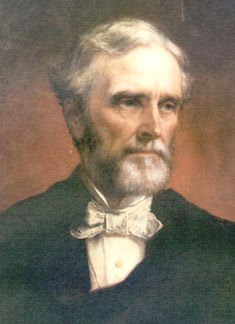
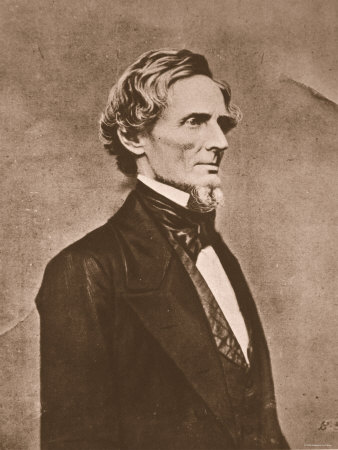
Jefferson Davis 1808-1889
President of the Confederate States of America

We feel that our cause is just and holy; we protest solemnly in the face of mankind that we desire peace at any sacrifice save that of honour and independence; we ask no conquest, no aggrandizement, no concession of any kind from the States with which we were lately confederated; all we ask is to be let alone; that those who never held power over us shall not now attempt our subjugation by arms.

'President Jefferson Davis - 29 April 1861'
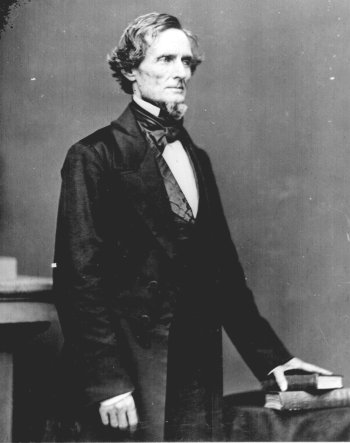
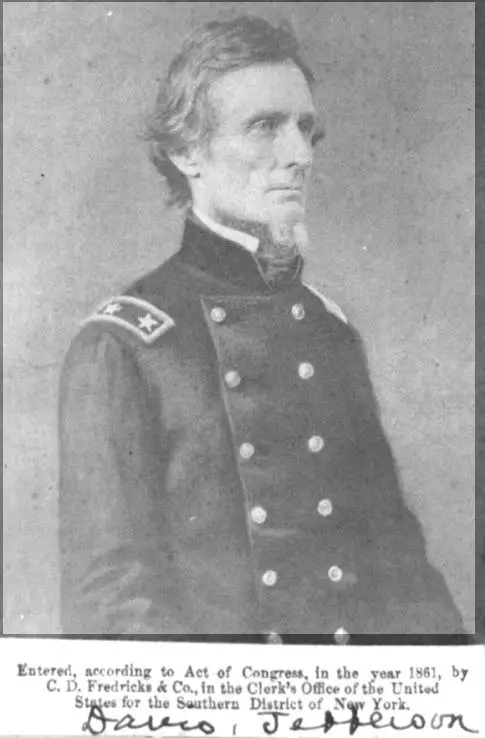
Confederate President Jefferson Daviis
Click for larger image

The Rise and Fall of the Confederate Government
Whether we agree with Jefferson Davis or not, knowledge of his point of view is essential to understanding the causes of the Civil War. The forward by McPherson helps to give balance and explanation.
Jefferson Davis was born on June 3, 1808, in Christian (now Todd) County, Kentucky,Jefferson Davis Confederate President and educated at Transylvania University, Lexington, Kentucky.

Military History

    U.S. Military Academy Graduated 1828.
    Afterwards was in the frountier service.
    Health forced him to resign from the army in 1835
    Fought in the Mexican War at Monterrey and Buena Vista
    Wounded at Buena Vista

Political History

    US senator from Mississippi from 1835 to 1845.
    US Congressman from 1845 to 1846
    US Congressman from 1857 to 1861
    Withdrew from the Senate in 1861 when Mississippi seceded.
    On February 18, 1861, the provisional Congress of the Confederate States made him provisional president .
    He was elected to the office by popular vote the same year for a 6-year term and was inaugurated in Richmond, Virginia, the capital of the Confederacy, on February 22, 1862.
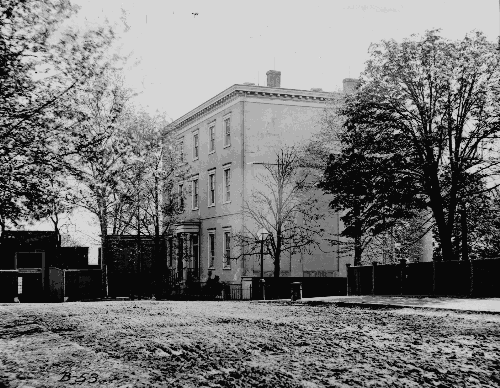
Confederate Capital
Confederate Capital Building


During the War

Davis failed to raise sufficient money to fight the American Civil War and could not obtain recognition and help for the Confederacy from foreign governments. He was in constant conflict with extreme exponents of the doctrine of states' rights, and his attempts to have high military officers appointed by the president were opposed by the governors of the states. The judges of state courts constantly interfered in military matters through judicial decisions.

Davis was nevertheless responsible for the raising of the formidable Confederate armies, the notable appointment of General Robert E. Lee as commander of the Army of Virginia, and the encouragement of industrial enterprise throughout the South. His zeal, energy, and faith in the cause of the South were a source of much of the tenacity with which the Confederacy fought the Civil War. Even in 1865 Davis still hoped the South would be able to achieve its independence, but at last he realized defeat was imminent and fled from Richmond.

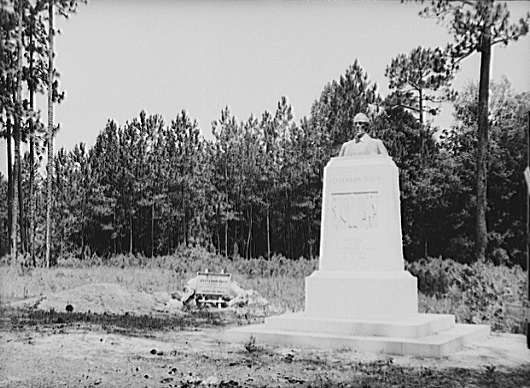
On May 10, 1865, federal troops captured him at Irwinville, Georgia. From 1865 to 1867 he was imprisoned at Fortress Monroe, Virginia. Davis was indicted for treason in 1866 but the next year was released on a bond of $100,000 signed by the American newspaper publisher Horace Greeley and other influential Northerners. In 1868 the federal government dropped the case against him.


This monument marks the spot where Jefferson Davis was captured in Irwinville, Georgia

From 1870 to 1878 he engaged in a number of unsuccessful business enterprises; and from 1878 until his death in New Orleans, on December 6, 1889, he lived near Biloxi, Mississippi. His grave is in Richmond, Virginia. He wrote The Rise and Fall of the Confederate Government (1881).


Slavery, Secession, and Civil War: Views from the UK and Europe, 1856-1865


The Beginning and the End: The Civil War Story of Federal Surrenders Before Fort Sumter and Confederate Surrenders After Appomatox
Surrenders continued for months after Appomattox. The background of Johnston's surrender in North Carolina, Taylor's in Alabama , Jones's in Florida,  the same day that Davis was captured—and Kirby-Smith's, west of the Mississippi


Why Confederates Fought: Family and Nation in Civil War Virginia
The Southern view of slavery as essential to the Southern economy is reiterated. Slavery was the great Southern irony, viewed as a foundation of white liberty. From that perspective, the Confederate soldier's choice was simply victory or death


Political Culture and Secession in Mississippi: Masculinity, Honor, and the Antiparty Tradition, 1830-1860
A rich new perspective on the events leading up to the Civil War and will prove an invaluable tool for understanding the central crisis in American politics.

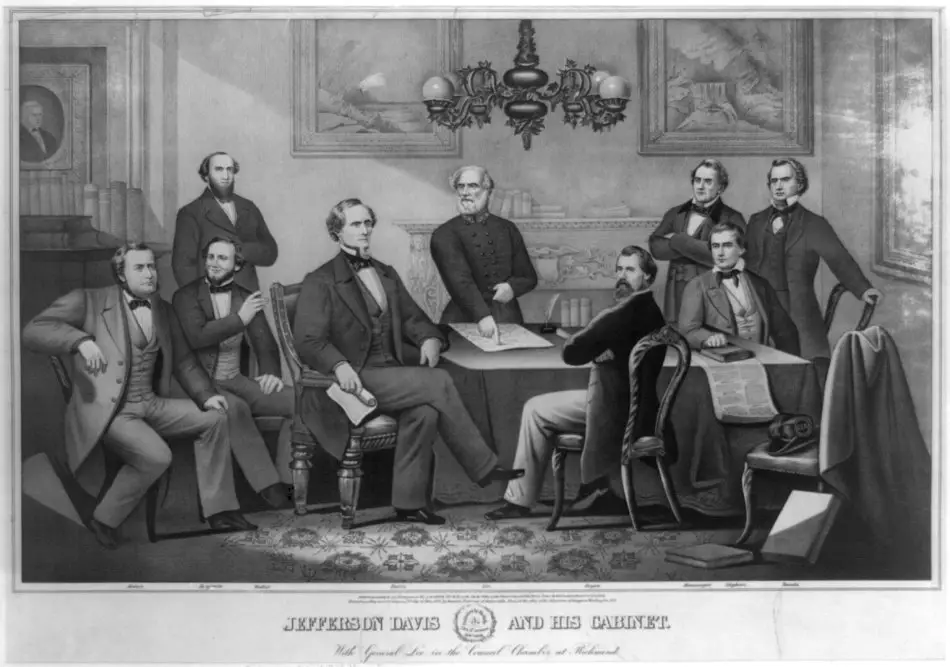
Jefferson Davis and his cabinet with General Lee in the Council Chamber at Richmond
Jefferson Davis and cabinet General Lee Council Chamber Richmond

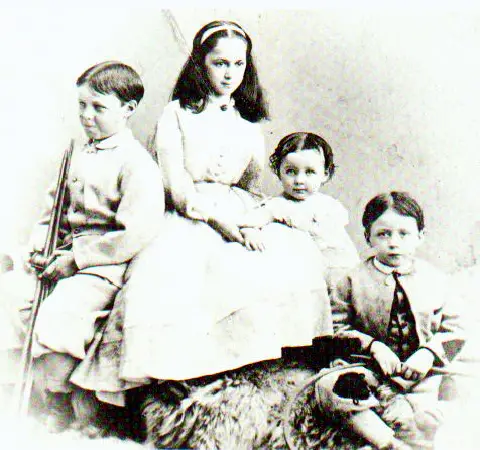
jefferson davis children
The Davis Children
Picture taken in Canada after the war
one son died after falling in the Executive Mansion in 1864
Jefferson Davis: Unconquerable Heart Shades of Blue and Gray
Jefferson Davis in a different light - as an American patriot and a human being. In the passions that colour anything dealing with the War of Northern Aggression, it is sometimes difficult to remember that everyone involved had a life before that tragic conflict. I can't help but be grateful for the way in which Mrs. Allen brought that point home in her book. While I will still take issue with many of his wartime decisions, I can't help but be proud that our nation produced a man like Jefferson Davis


No scholar can fail to appreciate Allen's exhaustive research,, nor any layman fail to be amazed at her mass of fact and significant detail

The Rise and Fall of the Confederate Government
A decade after his release from federal prison, the 67-year-old Jefferson Davis ex-president of the Confederacy, the Southern Lincoln, popularly regarded as a martyr to the Confederate cause began work on his monumental "Rise and Fall of the Confederate Government". Motivated partially by his deep-rooted antagonism toward his enemies (both the Northern victors and his Southern detractors), partially by his continuing obsession with the cause, and partially by his desperate pecuniary and physical condition, Davis devoted three years and extensive research to the writing of what he termed an historical sketch of the events which preceded and attended the struggle of the Southern states to maintain their existence and their rights as sovereign communities. The result was a perceptive two-volume chronicle, covering the birth, life, and death of the Confederacy, from the Missouri Compromise in 1820, through the tumultuous events of the Civil War, to the readmission of the Southern states to the U. S. Congress in the late 1860s.

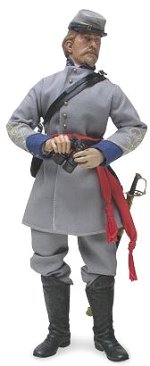
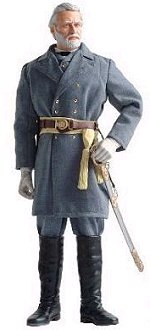
Confederate President Jefferson Davis in Uniform

Civil War Exhibits
Civil War Timeline
Civil War Women
State Battle Maps
Flags of the Confederacy
Civil War Submarines
Confederate Commanders
Civil War Summary
Civil War Store

American Civil War DVD Titles

Battle of Stones River
The Fight for Murfreesboro

At dawn on December 31, 1862 the two armies clashed in a deadly struggle along the banks of Stones River.
Chickamauga Civil War DVD
The Battle of Chickamauga
Special Widescreen Edition

Chickamauga one of the fiercest engagements of the American Civil War. Over a period of two days, more than 100,000 men struggled for control of the south's transportation hub, Chattanooga.

Struggle For Vicksburg
Photography of the park with authentic battlefield illustrations and life-like paintings. Vicksburg's wartime role in the bloody and brutal conflict.

Civil War: A Concise History
The best collection of Civil War visuals ever assembled in one 75-minute program. A breathtaking and first-hand account of the war. Great DVD Bonuses

History Channel Presents The Civil War
From Harper's Ferry, Fort Sumter, and First Bull Run to Shiloh, Antietam, and Gettysburg. The most legendary Civil War battles in brilliant detail. A selection of the soldiers and legendary leaders.

Horses of Gettysburg
Civil War Minutes

Filmed in high definition with charging horses, battlefield panoramas and no "talking heads," this cinematic documentary tells the story of the estimated 72,000 horses and mules that fought at the Battle of Gettysburg and uncovers the strategies employed to ensure that the millions of animals in service with the North and South remained healthy and well-trained for action.

The Last Days of the Civil War - April 1865: The Month That Saved America, Civil War Combat:
The Tragedy At Cold Harbor
The remarkable succession of events leading from the fall of Richmond to Appomattox.

Civil War Terror
Tales of hidden conspiracies of terror that specifically targeted the civilian populations. Engineers of chemical weapons, new-fangled explosives and biological warfare competed

Ricmond Virginia Views
London News 1861

Sources:
"Davis, Jefferson," Microsoft (R) Encarta. Copyright (c) 1994 Microsoft Corporation.
Copyright (c) 1994 Funk & Wagnall's Corporation.
"Davis, Jefferson," Comptons Encylopedia
Library of Congress
London Illustriated News