|
|
|
|
Native American Book Titles 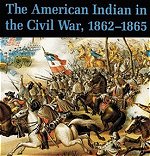 The American Indian in the Civil War, 1862-1865 The 1862 Battle of Pea Ridge, a bloody disaster for the confederates but a glorious moment for Colonel Stand Watie and his Cherokee Mounted Rifles. The Indians were soon enough swept by the war into a vortex of confusion and chaos. |
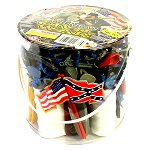 Civil War Soldier 102 Piece Playset
|
Minnesota State Battle Map State Battle Maps American Civil War Exhibits Civil War Timeline Women in the War |
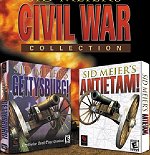 Sid Meier's Civil War Collection Take command of either Confederate or Union troops and command them to attack from the trees, rally around the general, or do any number of other realistic military actions. The AI reacts to your commands as if it was a real Civil War general, and offers infinite replayability. The random-scenario generator provides endless variations on the battles |
Kindle Available The Confederate War Bonnet: A Novel of the Civil War in Indian Territory An evocative historical novel that helps to answer how Indians became involved in the Civil War, why they joined Confederate forces, and how the experience shaped their future in America. |
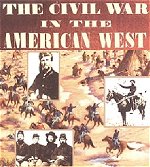 Civil War in the American West An accurate and detailed history of the Western Theater of the Civil War, which was largely forgotten by history. He was one of the first historians to fully understand the impact that California had on the war as he gives an accounting of the Federal raid on the Dan Showalter Ranch in San Bernadino on October 5, 1861. |
 Confederate Armies: Kentucky, Maryland, Missouri, the Confederate Units and the Indian Units This volume is arranged by state; units organized directly by the Confederate authorities from various state companies; and those units from the Indian nations allied with the Confederacy. Chapters are included for artillery, cavalry and infantry units that are broken down by size: battalions, batteries, companies and regiments |
 The Cherokee Nation in the Civil War The Cherokee people, who had only just begun to recover from the ordeal of removal, faced an equally devastating upheaval in the Civil War. The Cherokee Nation, with its sovereign status and distinct culture, had a wartime experience unlike that of any other group of people |
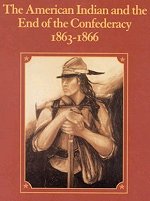 The American Indian and the End of the Confederacy, 1863-1866 The vulnerability of the Indians caught between two warring sides. The failure of the US government to afford to the southern Indians the protection solemnly guaranteed by treaty stipulations was the great cause of their entering into an alliance with The Confederacy |
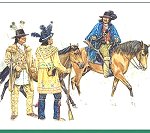 The American Civil War in Indian Territory Native Americans fought in both Union and Confederate units. The Indian Territory saw its share of battles and campaigns. If you are a reenactor or modeler this is the kind of detail that you need. The photos and artwork make this a must-have. |
 General Stand Watie's Confederate Indians The Confederacy pioneered the idea of giving blacks and women positions of authority [the Matron Law], placed Jews in positions of power, put General's stars on a Mexican and the first American Indian General. This book is his story |
 Sam Bell Maxey and the Confederate Indians Accompanying photos, clear maps. This book will leave you wanting to learn more about this rather neglected region of the war. No less important in many regards for the defining of the nation's future than the more well-known battlefields of Virginia, Maryland, and Pennsylvania. Highly recommended |
Kindle Available Civil War on the Western Border, 1854-1865 Fanatical politics of the western frontier, immigrant abolitionists with loaded Spencer rifles funded by mysterious personages back East, cut-throats, gin heads and horse thieves, colorful character descriptions |
 The Civil War in Arizona: The Story of the California Volunteers, 1861-1865 History of the California Column in wartime Arizona and a rare compilation of letters written by the volunteer soldiers who served in the U.S. Army from 1861 to 1866. These letters provide testimony of the grueling desert conditions the soldiers endured as they fought on many fronts |
 Black Flag: Guerrilla Warfare on the Western Border, 1861-1865: A Riveting Account of a Bloody Chapter in Civil War History The guerilla warfare along the Kansas-Missouri boarder brought forth some of the bloodiest incidents of the Civil War |
Kindle Available Child of the Fighting Tenth: On the Frontier with the Buffalo Soldiers The drama of growing up in the frontier army, the Indian wars on the plains, the Geronimo campaign in the Southwest and Mexico, her love for the regiment and the Buffalo Soldiers, their admiration for her, and even her lost love for a dashing young cavalry officer |
 Keepers of the Earth: Native American Stories and Environmental Activities for Children These are stories from the various First Nations. They are well told. Get this for your kids. In an age of instant media, the storyteller's art is one that is timeless, connecting us to our oral past. Make sure that it connects to our future, too. |
 Thirteen Moons on Turtle's Back The Turtle's shell stand for the 13 cycles of the moon, each with its own name and a story that relates to the changing seasons. Joseph Bruchac and Jonathan London collaborate to reveal the beauty of the natural world around us, while Thomas Locker's illustrations honor both Native American legends and the varied American landscape |
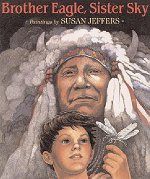 Brother Eagle Sister Sky The Earth does not belong to us. We belong to the Earth. The great American Indian Chief Seattle spoke these words over a hundred years ago. His remarkably relevant message of respect for the Earth and every creature on it has endured the test of time and is imbued with passion born of love of the land and the environment |
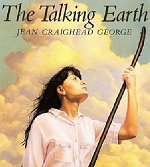 The Talking Earth Billie Wind lives with her Seminole tribe. She follows their customs, but the dangers of pollution and nuclear war she's learned about in school seem much more real to her. How can she believe the Seminole legends about talking animals and earth spirits? |
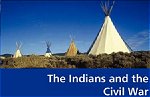 The Indians and the Civil War - Effects of the American Civil War on the Native American History Native American history has always been a study full of ambiguous points. Nowadays, when the outlived tribes still live on poor circumstances and try to keep step with our running world despairingly, their unique culture deserves more attention than used to. |
Kindle Available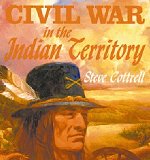 Civil War in the Indian Territory When the war broke out, both sides wanted the Five Civilized Tribes, led by the Cherokees, and each got around half. The Confederacy sent Brigadier General Albert Pike to recruit them, and he did a pretty good job. A strange, brilliant, man, Pike's career as a General is a minor footnote in his long life |
 The First Americans: Prehistory-1600 A History of US Tribes of hunters made their way from Asia across the Bering land bridge to North America. They didn't know it, but they had discovered a New World. The First Americans is a fascinating re-creation of pre-Columbian Native American life, and it's an adventure of a lifetime |
