Thompson's Station Tennessee

American Civil War
March 5, 1863

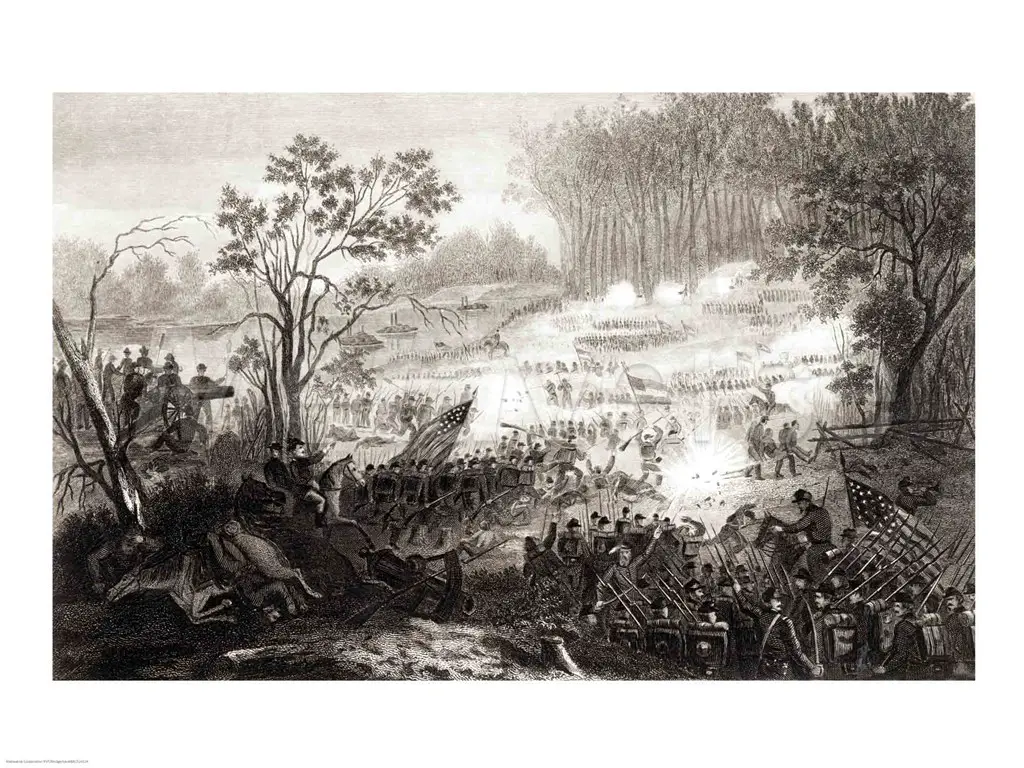
In a period of relative inactivity following the Battle of Stones River, a reinforced Union infantry brigade, under Col. John Coburn, left Franklin to reconnoiter south toward Columbia.

Four miles from Spring Hill, Coburn attacked with his right wing, a Confederate force composed of two regiments; he was repelled. Then, Major General Van Dorn seized the initiative. Brig. General W.H. "Red"  Jackson's dismounted 2nd Division made a frontal attack, while Brig. General Nathan Bedford Forrest's division swept around Coburn's left flank, and into his rear.

After three attempts, characterized by hard fighting, Jackson carried the Union hilltop position as Forrest captured Coburn's wagon train and blocked the road to Columbia in his rear.

Out of ammunition and surrounded, Coburn surrendered. Union influence in Middle Tennessee subsided for a while.

Result(s): Confederate victory

Location: Williamson County

Campaign: Middle Tennessee Operations (1863)

Date(s): March 5, 1863

Principal Commanders: Col. John Coburn [US]; Major General Earl Van Dorn [CS]

Forces Engaged: Infantry brigade [US]; I Cavalry Corps [CS]

Estimated Casualties: 2,206 total (US 1,906; CS 300)


Van Dorn: The Life and Times of a Confederate General
Biography of the flamboyant Earl Van Dorn, one of the most promising yet disappointing officers in the Confederate Army

Civil War Model 1851 Naval Pistol with Engraved Silver Tone / Gold Tone Finish and Wooden Grips - Replica of Revolver Used by Both USA / Union and CSA / Confederate Forces


Civil War Confederate Revolver
Tennessee State Battle Map
State Battle Maps
American Civil War Exhibits
Campaigns of the War
Civil War Summary
Documents of the Civil War
Confederate Commanders
Union Generals
Civil War Timeline
Women Civil War Soldiers
Ships and Naval Battles
Confederate Supplies
Civil War Store
Shelby Foot 3 Volume Civil War Set
The Civil War: A Narrative
3 Volume Set : Foote

This trilogy of books on the Civil War is not only a piece of first-rate history, but also a marvelous work of literature. Many know Foote for his prominent role as a commentator on Ken Burns's PBS series about the Civil War. These three books, however, are his legacy
American Civil War Book Titles

No Better Place to Die
The Battle of Stones River

The forces of Braxton Bragg came very close to victory. But the star-crossed Confederate general ended up withdrawing, leaving Rosecrans' Union forces to claim victory by holding the field of battle

Winter Lightning: A Guide to the Battle of Stones River
Lincoln thanked Rosecrans saying that the nation could not have taken another defeat. Additionally, Lincoln said he would remember this victory as long as he lived

The Partisan Rangers of the Confederate States Army: Memoirs of General Adam R. Johnson
The capture of Newburg, Indiana, with only twelve men and two joints of stovepipe mounted on the running gear of a wagon. This episode won him a nickname of "Stovepipe." He was promoted to Brigadier General in June 1864

Nathan Bedford Forrest's Escort And Staff
The CSA escort company and staff officers of Nathan Bedford Forrest were held in awe by men on both sides of the conflict during the war and long after, and they continue to be held in esteem as figures as legendary as Forrest himself. Not merely guards or couriers, these men were an elite force who rode harder and fought more fiercely than any others

Bloody Bill Anderson: The Short, Savage Life of a Civil War Guerrilla
For a brief but dramatic period, Bloody Bill played the leading role in the most violent arena of the entire war-and did so with a vicious abandon that spread fear throughout the land

Gray Ghosts of the Confederacy: Guerrilla Warfare in the West, 1861-1865
The establishment of a police state in Missouri and the subsequent backlash and ensuing war of sabotage by local guerrillas. Missouri and Kansas had shared much animosity in the years leading up to the Civil War

Autobiography of Samuel S. Hildebrand
Figures such as Quantrill and Anderson are better known today, Sam Hildebrand was an equally notorious Missouri bushwhacker in the southeast region of Missouri. Operating with a small group of followers, Hildebrand and his rifle "Kill-Devil" were a terror to local Unionist civilians

Where the South Lost the War: An Analysis of the Fort Henry-Fort Donelson Campaign
The war probably could have been over in 1862 had Lieutenant Phelps destroyed the bridge at Florence. Not doing so provided a retreat for A. S. Johnston to move his men to Corinth and then to Shiloh

War in Kentucky: From Shiloh to Perryville

by James Lee McDonough
By mid 1862, Union gains in the Mississippi Valley and in Tennessee and Kentucky had brought the Confederacy to a point of strategic crisis. This valuable addition to the growing literature on the Civil War in the West tells how the Union then failed to press home its advantage while the Confederacy failed to force Kentucky into the Confederacy. The climax of these events was the little-known Battle of Perryville, in which a greatly inferior Southern force under Braxton Bragg managed a draw against Don Carlos Buell's Union army but also effectively terminated the Confederate invasion of Kentucky. McDonough has researched thoroughly and written clearly, making this book informative and accessible to a wide range of Civil War students.
Cozzens follows up his magisterial account of the Battle of Chickamauga, This Terrible Sound (1992), with an equally authoritative study of the Chattanooga campaign that followed it. Braxton Bragg (who sometimes seems unfit to have been at large on the public streets, let alone commanding armies) failed to either destroy or starve out the Union Army of the Cumberland. In due course, superior Northern resources and strategy--not tactics; few generals on either side come out looking like good tacticians--progressively loosened the Confederate cordon around the city. Finally, the Union drove off Bragg's army entirely in the famous Battle of Missionary Ridge, which was a much more complex affair than previous, heroic accounts make it. Like its predecessor on Chickamauga, this is such a good book on Chattanooga that it's hard to believe any Civil War collection will need another book on the subject for at least a generation.
The Shipwreck of Their Hopes: The Battles for Chattanooga
Civil War History Documentary DVD Movie Titles

Civil War Combat: America's Bloodiest Battles
The violent mayhem of the hornet's nest at Shiloh, the valiant charge on the sunken road at Antietam, the carnage in the wheat field at Gettysburg, and the brutal fighting at Cold Harbor

Civil War Journal - The Conflict Begins
These four programs from the History Channel series Civil War Journal cover critical aspects of the early days of the war.

Long Road Back to Kentucky:
The 1862 Confederate Invasion

T he often-overlooked Western campaign of the war with a specific emphasis on Kentucky's involvement in the American Civil War. DVD

Gettysburg / Gods and Generals
The tide of the war changes during three fierce days of combat at Gettysburg [Disc 1] the gripping saga of the tactics command errors and sacrifices behind the bloodiest battle ever fought on U.S. soil. Gods and Generals [Disc 2] reveals the spirited allegiances and fierce combat of earlier Civil War struggles

History Channel Presents The Civil War
From Harper's Ferry, Fort Sumter, and First Bull Run to Shiloh, Antietam, and Gettysburg. The most legendary Civil War battles in brilliant detail. A selection of the soldiers and legendary leaders.

The Civil War - A Film by Ken Burns
Here is the saga of celebrated generals and ordinary soldiers, a heroic and transcendent president and a country that had to divide itself in two in order to become one

The Blue and the Gray
The Complete Miniseries

The Civil War proved a backdrop for this 1982 miniseries. Complete and uncut three disc set. Two families divided by the War Between the States. A Southerner caught when he becomes a war correspondent for the Northern newspaper. He finds himself  where history's in the making from the Battle of Bull Run to Abraham Lincoln's assassination

Blue Vs. Gray - Killing Fields
Relive the most vicious fighting of the Civil War, in which General Ulysses S. Grant forcibly reversed the tide of the conflict by paying with the blood of thousands. It was a desperate time for the Union

Women in the War
Civil War Cooking
Civil War Submarines
Kids Zone Causes of the War


Sources:
U.S. National Park Service
U.S. Library of Congress.