|
What is a Zouave?
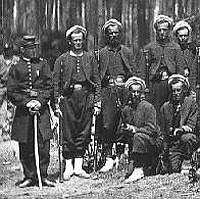
Zouaves of the 114th PA Volunteers
(Miller's Photographic History) |
ZOUAVE (zoo-ahh-vah) was the name given to
native North African troops employed by the French Army as fighters and
mercenaries. Their dash, spirit, and heroic style of warfare caught the
fancy of many military observers worldwide in the 1800's, including a
young American named Elmer Ellsworth. Ellsworth organized the "US
Zouave Cadets", the first zouave organization in this country, and
toured the north where they participated in parades and drill
competitions. The popularity of the cadets caught on in other areas of
the nation and it was this idea that gave birth to "zouave regiments"
during the American Civil War. A number of zouave regiments were
organized in the North and South in 1861, modeled after the zouave
regiments of North Africa and Ellsworth's Cadets. The uniforms of these
regiments were very distinctive and made them stand out in camp and on
the drill field. Regrettably, their bright red trousers and sashes also
made them good targets on the battlefield. Never the less, a number of
zouave regiments were raised, uniformed, and marched off to war to
serve both sides.
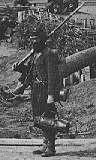
A Zouave of the 95th PA Infantry.
(Miller's Photographic History) |
Zouave uniforms were difficult to obtain in America, so
manufacturers of specialty clothing were employed to make the uniforms.
There were many distinct styles and colors, depending on the design
submitted by the benefactor of the regiment. Friends of the organizer
provided money to pay for the uniforms along with donations from the
town where the regiment was organized. John M. Gosline, a prominent
citizen of Philadelphia who raised the 95th Pennsylvania Volunteer
Infantry ("Gosline's Zouaves"), secured sufficient funds to purchase a
full set of clothing for 1,000 men with enough cash left over to insure
that the uniforms could be replenished as they were worn out. When the
uniforms of the 114th Pennsylvania Infantry began to wear out, Colonel
Charles Collis used his influence with political friends in the state
legislature to secure state money to supply new uniforms to those men
who needed them. Despite these efforts, a zouave regiment only retained
its distinctive dress if the men repaired their clothing and the
distinctive zouave uniforms slowly disappeared from the army as time
passed. By the time of the Battle of Gettysburg, many of these
regiments had lost or worn out their original uniforms and adopted the
standard Union uniform. Still, there were a handful of regiments that
still had a portion of the zouave uniform- the jacket- such as the 23rd
Pennsylvania Infantry and the 95th Pennsylvania Infantry.
Even though many original zouave regiments had gone to standard
Union uniforms, there some Union regiments that became zouave
regiments. The 146th New York Infantry did not start the service in
zouave uniforms, but adopted them in June 1863 jus before the
Gettysburg Campaign began. Some of the other regiments in that brigade,
including the 140th New York and 155th Pennsylvania Infantry, adopted
zouave uniforms later in the war.
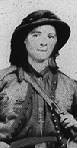
French Mary |
A unique presence in zouave regiments was the vivandiere
(vi-van-de-air). This was a special person in the regiment because they
were female and dressed in a uniform similar to the men. Many zouave
regiments had vivandieres who performed a variety of duties, most
notably nursing on the battlefield. Mary Tepee, or "French
Mary" as she was called, was the vivandiere of the 114th Pennsylvania
Infantry. Mary was present on almost every battlefield where the
regiment fought and acted as a battlefield nurse and aide. She carried
water and bandages into battle and was wounded during the war. Mary was
present with the regiment at Gettysburg and was one of the few women
with the army to ever experience combat. Her regiment, the 114th
Pennsylvania Infantry or "Collis' Zouaves", were one of the more well
known zouave regiments of the war, heralded for their precision on the
drill field dressed in flashy zouave-style uniforms featuring bright
red trousers, white leggings, blue jacket, and red fez. The 114th
fought in almost every major battle of the Army of the Potomac,
including Gettysburg. In 1864, the regiment was appointed headquarters
guard for General Meade. One of the original uniforms that belonged to
a solder of the 114th Pennsylvania is currently on display at the
Chancellorsville Battlefield Visitor Center at Fredericksburg &
Spotsylvania National Military Park.
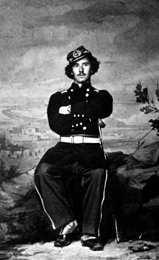
Ellsworth in his Zouave Cadet uniform, 1860
(www.zouave.org) |
The young man who started the zouave craze in America did not live long
enough to see the zouave regiments his example inspired, march to the
battlefield. In 1861, Ellsworth returned to New York (his home state)
and organized the 11th New York Infantry, "Ellsworth's Fire Zouaves".
The men in the regiment recruited from the many different fire
departments in New York City. The 11th New York moved to the defenses
of Washington that April where their commander, Colonel Ellsworth, paid
a courtesy call on the president. Ellsworth had become an acquaintance
of Abraham Lincoln while living in Illinois, and the president was very
fond of the dashing 24 year-old officer, viewing him as a symbol of
Union and patriotism. On May 24, 1861, the day after Virginia seceded
from the Union, the 11th New York Infantry was ordered to seize
Alexandria, Virginia, across the Potomac River from Washington. While
securing the city, Colonel Ellsworth personally removed a Confederate
flag from the front of an inn known as the Marshall House and was
gunned down by the furious innkeeper. A grief stricken President
Lincoln ordered Ellsworth's body be laid in state at the White House
before the body was taken home to New York for burial. Ellsworth's
tragic death became a symbol of the Union cause while northern
newspapers and politicians eulogized him as one of the North's greatest
patriots. Soon after his burial, his old regiment changed their
nickname to "Ellsworth's Avengers".
|