 Battle on the Bay: The Civil War Struggle for Galveston Civil War history of Galveston is one of the last untold stories from America's bloodiest war, despite the fact that Galveston was a focal point of hostilities throughout the conflict. Galveston emerged as one of the Confederacy's only lifelines to the outside world. |
Galveston Harbor
|
|
|
|
|
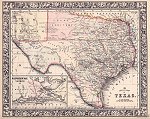 Pre-Civil War 1860 Texas map 24 x 36 The period just prior to the Civil War . In this period Texas was in rapid development, trying to get railroad lines to the major cities and shipping points Kindle Available  Horse Sweat and Powder Smoke: The First Texas Cavalry in the Civil War Regimental history from the time the regiment was raised by Colonel McCulloch to defend against indian warriors tor the time the regiment was part of the Confederate Army under the Colonels Buchel and Yager until the end of the Civil War |
Kindle Available  Standard Catalog of Civil War Firearms Over 700 photographs and a rarity scale for each gun, this comprehensive guide to the thousands of weapons used by Billy Yank and Johnny Reb will be indispensable for historians and collectors. |
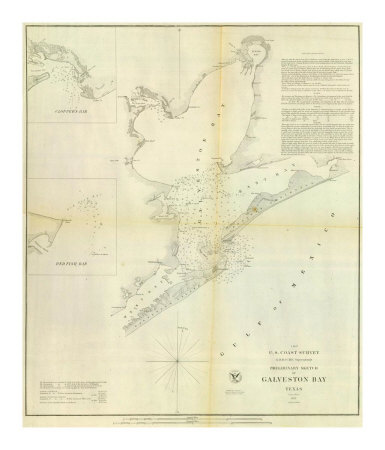
Galveston Bay, Texas, c.1852 34.25 in. x 40 in. Buy at AllPosters.com Framed |
 Civil War Musket Wood & Steel Frontier Rifle Designed After The Original Rifle, This Civil War Musket replica has been designed after the original rifle of its era. Measures approximately 37 inches long. Each is constructed with a solid one-piece wood stock, painted steel barrel and die-cast parts. |
Texas State Battle Map Civil War Submarines Ships and Naval Battles Confederate Johhny Cakes Recipe Civil War Picture Album Kids Zone Gettysburg State Battle Maps American Civil War Exhibits Civil War Summary Women in the War Reenactors Row Supplies |
 Only a Private: A Texan Remembers the Civil War : The Memoirs of William J. Oliphant A first-hand account of the common soldier's point of view. No colonel or general, William Oliphant was, "only a private." His perspective provides a window into Texas during the first days of the Civil War, and first-hand descriptions of battles |
Kindle Available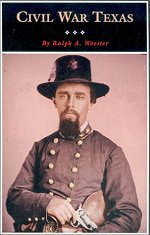 Civil War Texas Describes Texas's role in the civil war and notes the location of historical markers, statues, monuments, battle sites, buildings, and museums in Texas that may be visited by those interested in learning more about the war. |
 The Fate of Texas: The Civil War and the Lone Star State When Texas joined the Confederacy and fought in the war, its fate was uncertain. The war touched every portion of the population and all aspects of life in Texas. |
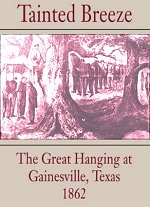 Tainted Breeze: The Great Hanging at Gainesville, Texas, 1862 October 1, 1862, state militia arrested more than two hundred Unionists from five northern counties . At least forty-four prisoners were hanged, others were lynched in neighboring communities |
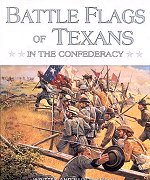 Battle Flags of Texans in the Confederacy Excellent Confederate Flag information resource |
 Jefferson Davis: Unconquerable Heart Shades of Blue and Gray No scholar can fail to appreciate Allen's exhaustive research,, nor any layman fail to be amazed at her mass of fact and significant detail |
Battle on the Bay: The Civil War Struggle for Galveston Civil War history of Galveston is one of the last untold stories from America's bloodiest war, despite the fact that Galveston was a focal point of hostilities throughout the conflict. Galveston emerged as one of the Confederacy's only lifelines to the outside world. |
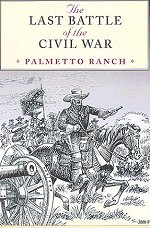 The Last Battle of the Civil War Palmetto Ranch May 12-13, the last battle of the Civil War had been fought at the southernmost tip of Texas—resulting in a Confederate victory. Although Palmetto Ranch did nothing to change the war's outcome, it added the final irony to a conflict replete with ironies |
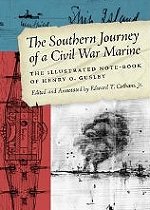 The Southern Journey of a Civil War Marine : The Illustrated Note-Book of Henry O. Gusley On September 28, 1863, the Galveston Tri-Weekly News caught its readers' attention with an item headlined "A Yankee Note-Book." It was the first installment of a diary confiscated from U.S. Marine Henry O. Gusley, who had been captured at the Battle of Sabine Pass. Gusley's diary proved so popular with readers that they clamored for more, causing the newspaper to run each excerpt twice until the whole diary was published. For many in Gusley's Confederate readership, his diary provided a rare glimpse into the opinions and feelings of an ordinary Yankee--an enemy whom, they quickly discovered, it would be easy to regard as a friend. This book contains the complete text of Henry Gusley's Civil War diary |
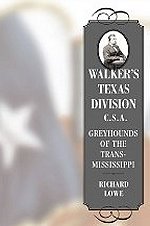 Walker's Texas Division, C.S.A: Greyhounds of the Trans-Mississippi (Conflicting Worlds: New Dimensions of the American Civil War) Colorfully known as the "Greyhound Division" for its lean and speedy marches across thousands of miles in three states, Major General John G. Walker's infantry division in the Confederate army was the largest body of Texans—about 12,000 men at its formation—to serve in the American Civil War. From its creation in 1862 until its disbandment at the war's end, Walker's unit remained, uniquely for either side in the conflict, a stable group of soldiers from a single state. Richard Lowe's compelling saga shows how this collection of farm boys, store clerks, carpenters, and lawyers became the trans-Mississippi's most potent Confederate fighting unit |
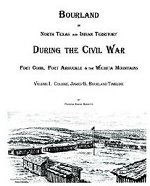 Bourland in North Texas and Indian Territory During the Civil War: Fort Cobb, Fort Arbuckle & the Wichita Mountains The Indian conflicts during the period 1861 through 1865 on the Southern frontier - the frontier of the Confederate States of America. When the United States military forces withdrew in the face of the establishment of the new fledgling Southern republic, a partial defense vacuum was created in the areas contiguous to the Indian lands. This book deals with the Texas-Oklahoma border area, the Red River area. Texas had to contribute its sons not only to the struggle to maintain the nascent Confederate army in the War for Southern Independence but additionally to fill the need for border security with the many Indian tribes |
| Search AmericanCivilWar.com |
| Enter the keywords you are looking for and the site will be searched and all occurrences of your request will be displayed. You can also enter a date format, April 19,1862 or September 1864. |