|
|
|
The origins of the National Woman's Party (NWP) date from 1912, when Alice Paul and Lucy Burns, young Americans schooled in the militant tactics of the British suffrage movement, were appointed to the National American Woman Suffrage Association's (NAWSA) Congressional Committee. They injected a renewed militancy into the American campaign and shifted attention away from state voting rights toward a federal suffrage amendment. At odds with NAWSA over tactics and goals, Paul and Burns founded the Congressional Union for Woman Suffrage (CU) in April 1913, but The CU continued its aggressive suffrage campaign. Its members held street meetings, distributed pamphlets, petitioned and lobbied legislators, and organized parades, pageants, and speaking tours. In June 1916 the CU formed the NWP, briefly known as the Woman's Party of Western Voters. The CU continued in states where women did not have the vote; the National Woman's Party existed in western states that had passed women's suffrage. In March 1917 the two groups reunited into a single organization–the NWP. In January 1917 the CU and NWP began to picket the White House. The government's initial tolerance gave way after the United States entered World War I. Beginning in June 1917, suffrage protestors were arrested, imprisoned, and often force-fed when they went on hunger strikes to protest being denied political prisoner status. The National Woman's Party militant tactics and steadfast lobbying, coupled with public support for imprisoned suffragists, forced President Woodrow Wilson to endorse a federal woman suffrage amendment in 1918. Congress passed the measure in 1919, and the NWP began campaigning for state ratification. Shortly after Tennessee became the 36th state to ratify women's suffrage, the 19th Amendment was signed into law on August 26, 1920. Once suffrage was achieved, the NWP focused on passing an Equal Rights Amendment. The party remained a leading advocate of women's political, social, and economic equality throughout the 20th century. |
 Century of Struggle The Womans Rights Movement Young suffragists who helped forge the last links in that chain were not born when it began. Old suffragists who forged the first links were dead when it ended. It is doubtful if any man, even among suffrage men, ever realized what the suffrage struggle came to mean to women |
"Silent sentinel" Alison Turnbull Hopkins at the White House on New Jersey Day"We ask not pardon for ourselves but justice for all American women". Alison Turnbull Hopkins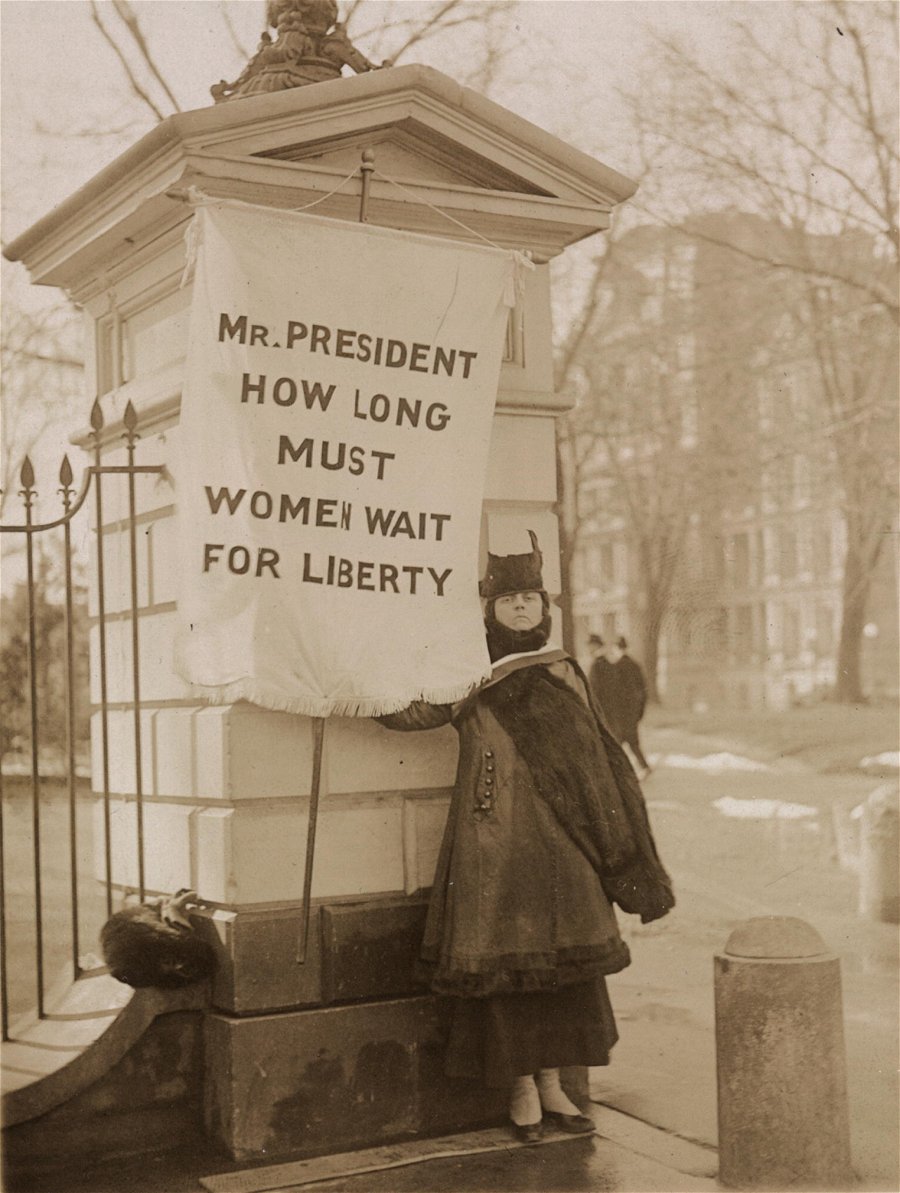 Photograph of Alison Turnbull Hopkins with banner, "Mr. President How long must women wait for liberty," picketing for suffrage outside White House gate. Photograph published in The Suffragist, 5, no. 56 (Feb. 7, 1917): 4. Caption reads: "New Jersey Day: Mrs. J.A.H. Hopkins heading the line". Photograph illustration in story "Fourth Week of the White House Guard." |
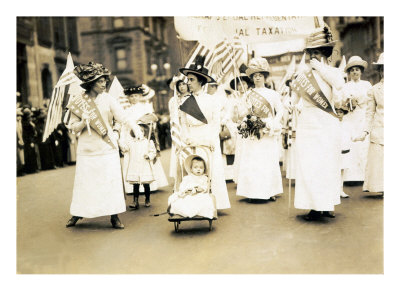 Women's Suffrage Parade New York City, May 6, 1912 12 in. x 9 in. Buy at AllPosters.com Framed Mounted |
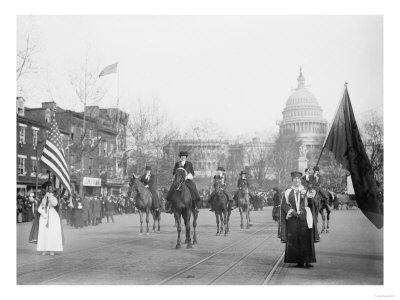 The Head of the Women's Suffrage Parade Photograph - Washington, DC 24 in. x 18 in. Buy at AllPosters.com Framed Mounted |
|
Alice Paul, ca. 1910-16.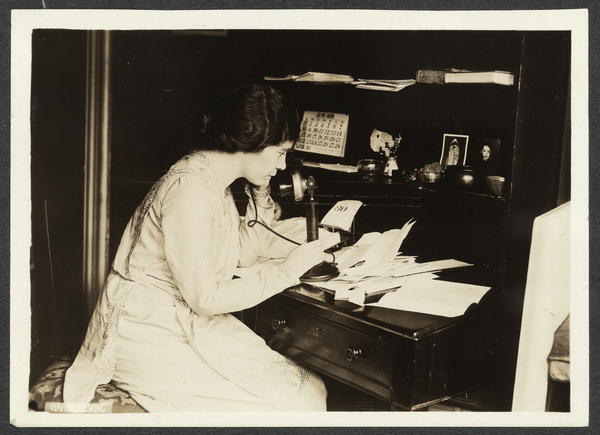 |
||
 Alice Paul, 1915 9 in. x 12 in. Buy at AllPosters.com Framed Mounted |
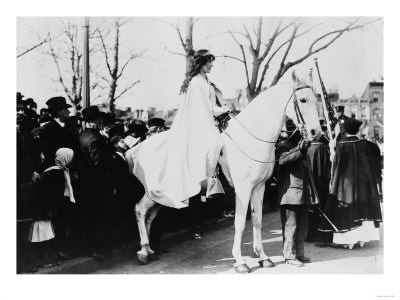 Woman on Horse Woman's Suffrage Parade Photograph - Washington, DC 24 in. x 18 in. Buy at AllPosters.com Framed Mounted |
|
Women of the Suffrage Movement
Woman's Suffrage Timeline
Women in the Civil War
Women Soldiers
American Civil War Exhibits
Women Subject Books
Young Reader Books
Kindle Available The Grimke Sisters from South Carolina: Pioneers for Women's Rights and Abolition A landmark work of women's history originally published in 1967, Gerda Lerner's best-selling biography of Sarah and Angelina Grimke explores the lives and ideas of the only southern women to become antislavery agents in the North and pioneers for women's rights. This revised and expanded edition includes two new primary documents and an additional essay by Lerner. In a revised introduction Lerner reinterprets her own work nearly forty years later and gives new recognition to the major significance of Sarah Grimke's feminist writings |
Kindle Available You Want Women to Vote, Lizzie Stanton? Grade 3-6. Fritz applies her gift for creating engaging, thorough historical literature to a larger-than-life historical figure. Stanton was a radical among radicals, and this objective depiction of her life and times, as well as her work for women's rights, makes readers feel invested in her struggle. An appealing, full-page black-and-white drawing illustrates each chapter. For students who need a biography, this title should fly off the shelves with a minimum of booktalking. And it is so lively that it is equally suitable for leisure reading.? |
 Recollections of 92 Years, 1824-1916 When the indomitable Meriwether was banned from her home by Union soldiers because her husband was a Confederate officer, she spent the next two years bartering for food and shelter for herself and her three young sons. After the war, Meriwether embarked on a decades-long career as an author and advocate for the equality of women, keeping up the crusade until her death in 1916--the year congressional support for women's suffrage emerged. |
 We Are Your Sisters: Black Women in the Nineteenth Century A remarkable documentary and the first in-depth record of many black women, slave and free."--Dorothy B. Porter, curator emeritus, Moorland-Spingarn Research Center, Howard University |
 Alice Paul and the American Suffrage Campaign An analysis of Paul's nonviolent and visual rhetorical strategies, Alice Paul and the American Suffrage Campaign narrates the remarkable story of the first person to picket the White House, the first to attempt a national political boycott, the first to burn the president in effigy, and the first to lead a successful campaign of nonviolence |
 A Colored Woman In A White World In this autobiography, originally published in 1940, Terrell describes the important events and people in her life. With a new introduction by Debra Newman Ham, professor of history at Morgan State University, this new edition of Mary Church Terrell's autobiography will be of interest to students and scholars of both women's studies and African American history. |
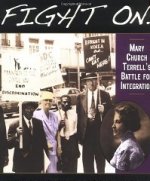 Fight On!: Mary Church Terrell's Battle for Integration The acclaimed civil rights leader Mary Church Terrell (1863–1954) is brought vividly to life in this well researched and compelling biography. The daughter of an ex-slave, Terrell was considered the best-educated black woman of her time. She was the first African American member of the Washington, D.C., Board of Education |
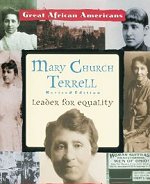 Mary Church Terrell Leader for Equality Grades 2-4 Mary Church Terrell lived in the 19th century, but was born free into a life of privilege and wealth. However, Terrell also faced the obstacles placed before African Americans and fought to overcome them. She was active in African-American women's groups and the newly formed NAACP. |
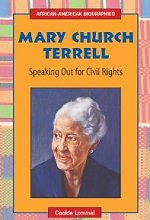 Mary Church Terrell Speaking Out for Civil Rights Grade 4-7-This biography of the civil rights activist tells of a strong woman who overcame great obstacles throughout her life in order to meet her goals. Although her father was the son of a white master, he was not able to gain his freedom until after the Emancipation Proclamation |
Kindle Available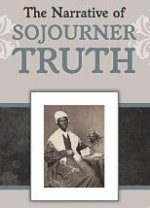 Narrative of Sojourner Truth The horror and evil of slavery is something that every American should confront. This is not to hang or condemn anyone. Its just to say that a book like The Narrative of Sojourner Truth is something that everyone should read. I was at times stunned by Sojourner Truths startling courage in the face of the evil she faced. |
Kindle Available Narrative of Sojourner Truth A symbol of the strength of African-American women, and a champion of the rights of all women, Sojourner Truth was an illiterate former slave in New York State who transformed herself into a vastly powerful orator. Dictating to a neighbor, she began her celebrated life story, in which she chronicles her youth |
| Kindle Available The Grimke Sisters from South Carolina: Pioneers for Women's Rights and Abolition A landmark work of women's history originally published in 1967, Gerda Lerner's best-selling biography of Sarah and Angelina Grimke explores the lives and ideas of the only southern women to become antislavery agents in the North and pioneers for women's rights. This revised and expanded edition includes two new primary documents and an additional essay by Lerner. In a revised introduction Lerner reinterprets her own work nearly forty years later and gives new recognition to the major significance of Sarah Grimke's feminist writings |
Kindle Available You Want Women to Vote, Lizzie Stanton? Grade 3-6. Fritz applies her gift for creating engaging, thorough historical literature to a larger-than-life historical figure. Stanton was a radical among radicals, and this objective depiction of her life and times, as well as her work for women's rights, makes readers feel invested in her struggle. An appealing, full-page black-and-white drawing illustrates each chapter. For students who need a biography, this title should fly off the shelves with a minimum of booktalking. And it is so lively that it is equally suitable for leisure reading.? |
Recollections of 92 Years, 1824-1916 When the indomitable Meriwether was banned from her home by Union soldiers because her husband was a Confederate officer, she spent the next two years bartering for food and shelter for herself and her three young sons. After the war, Meriwether embarked on a decades-long career as an author and advocate for the equality of women, keeping up the crusade until her death in 1916--the year congressional support for women's suffrage emerged. |
Source:
Library of Congress

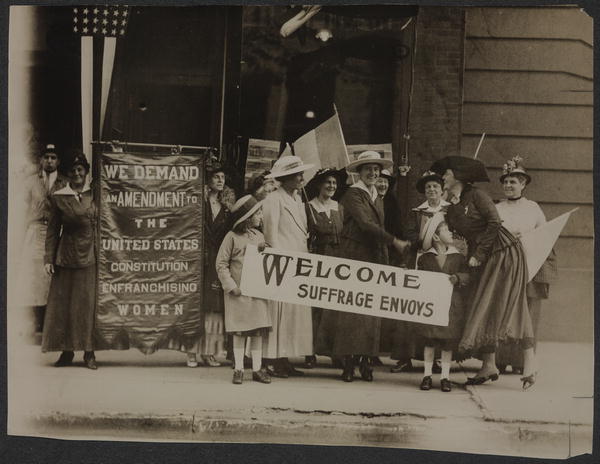 remained on NAWSA's Congressional Committee until December that year. Two months later, NAWSA severed all ties with the CU.