|
|
|
|
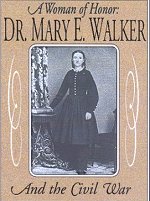 A Woman of Honor: Dr. Walker and the Civil War A picture of Mary Walker that allows us to see the furrows in her brow as she continued to stubbornly stick to her values. This book is eye-opening and brings to the forefront many women's rights issues that we may not even be aware of Kindle Available  Hit: Essays on Women's Rights by Mary Edwards, M.D. Walker The only woman to receive the Congressional Medal of Honor for her service during the Civil War, Dr. Mary E. Walker (1832-1919) was a surgeon, a public lecturer, and an outspoken champion of women's rights. One of the first women in the country to be awarded a medical degree, she served as an assistant surgeon for the Fifty-second Ohio Infantry  Divided Houses: Gender and the Civil War The new "manly" responsibilities both black and white men had thrust upon them as soldiers; the effect of the war on Southern women's daily actions on the homefront; the essential part Northern women played as nurses and spies; the war's impact on marriage and divorce; women's roles in the guerilla fighting; even the wartime dialogue on interracial sex. |
Dr. Mary Walker was an outspoken advocate for women's rights, and the first woman ever awarded the Congressional Medal of Honor. In a period of confusion about the rightful recipients of the award, the medal was revoked two years before her death. Dr. Walker remained proud of her service and her contributions to the campaign for women's rights, Mary Walker was born in Oswego, in upstate New York, in 1832. She was the fifth daughter of Alvah and Vesta Whitcomb Walker, and all children were encouraged to pursue their education. She and her sisters originally went into teaching after completing their studies, but Mary Walker enrolled in Syracuse Medical College at the end of her teenage years. She graduated with a doctor of medicine degree in 1855. Dr. Walker went into private practice and married Albert Miller, also a physician, and the couple moved to Rome, New York. At the outbreak of the Civil War, she volunteered in Washington to join the Union effort, and worked as a nurse in a temporary hospital set up in the capital. In 1862, Dr. Walker went to Virginia to provide medical care to the wounded, and in 1863 she was briefly appointed surgeon in an Ohio Regiment. The stories that surround this period of her life are undocumented, but in the summer of 1864, she was apparently a prisoner of war exchanged for a Confederate soldier. Some sources suggest she allowed herself to be captured in order to spy for the Union army, but there is little evidence to support this claim. In September of 1864, Dr. Walker was contracted as acting assistant surgeon with the Ohio 52nd Infantry. In 1865 Dr. Walker was awarded the Congressional Medal of Honor for her work during the Civil War. She was the first woman to receive the award, although her name was removed from the honor list of awardees in 1917, along with others, when the terms used to designate eligibility for the award were reappraised. She refused to surrender the medal, however, and continue to wear it for the rest of her life. In 1977, thanks to the efforts of her family and a Congressional reappraisal of her achievements, the honor was restored. In the mid-nineteenth century, as women were campaigning for a more public and professional role in society, clothing became a central issue in the struggle for women's rights. Feminists argued that tight corsets and long heavy skirts were bad for women's health and even designed to limit the possible activities that women could undertake. Amelia Bloomer, a campaigner for women's rights and a publisher, took to wearing a homemade dress and trouser combination that provided greater movement without compromising 'female modesty.' The Bloomer costume, as it came to be known, was quickly taken up by other feminists, and abandoned almost as quickly once it became obvious that the clothing was causing more of a stir than the politics. Many women experienced harassment when wearing the costume out in public, and the newspapers were filled with derogatory cartoons lampooning the outfit and its proponents. Twenty years later, as the suffragette movement's call for votes for women drew national attention, dress reform again became a topic of public debate, but this time, feminists were wary of the bloomer controversy and tended to disassociate themselves from women wearing any version of the costume. Dr. Mary Walker wore the bloomer dress until the late 1870s, when she began dressing in men's clothes. She was arrested for impersonating a man several times, although she argued that Congress had awarded her special permission to dress in this way. Despite the controversy surrounding her career and her politics, Dr. Mary Walker was proud of her accomplishments as a physician and an advocate for women's rights. As she concluded in 1897, "I am the original new woman...Why, before Lucy Stone, Mrs. Bloomer, Elizabeth Cady Stanton and Susan B. Anthony were—before they were, I am. In the early '40's, when they began their work in dress reform, I was already wearing pants...I have made it possible for the bicycle girl to wear the abbreviated skirt, and I have prepared the way for the girl in knickerbockers." National Library of Medicine |
 Doctors in Blue: The Medical History of the Union Army in the Civil War An excellent treatment of a rather specialized subject 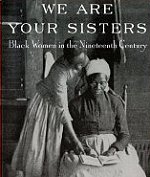 We Are Your Sisters: Black Women in the Nineteenth Century A remarkable documentary and the first in-depth record of many black women, slave and free."--Dorothy B. Porter, curator emeritus, Moorland-Spingarn Research Center, Howard University |
 The Stowe Debate: Rhetorical Strategies in Uncle Tom's Cabin This collection of essays addresses the continuing controversy surrounding "Uncle Tom's Cabin". The 13 contributors discuss questions of language and ideology, the tradition of the sentimental novel, biblical influences, and the rhetoric of anti-slavery discourse. |
Kindle Available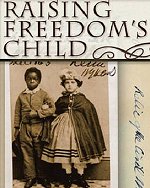 Raising Freedom's Child: Black Children and Visions of the Future After Slavery Previously untapped documents and period photographs casts a dazzling, fresh light on the way that abolitionists, educators, missionaries, planters, politicians, and free children of color envisioned the status of African Americans after emancipation |
Kindle Available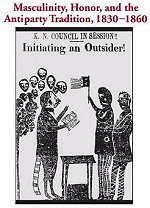 Political Culture and Secession in Mississippi: Masculinity, Honor, and the Antiparty Tradition, 1830-1860 A rich new perspective on the events leading up to the Civil War and will prove an invaluable tool for understanding the central crisis in American politics. |
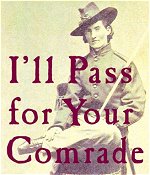 I'll Pass For Your Comrade: Women Soldiers in the Civil War Many people know about Clara Barton, the nurse who did so much to save soldiers' lives. But few have heard of Sarah Emma Edmonds, Rosetta Wakeman, or Mary Galloway. They were among the hundreds of women who assumed male identities, put on uniforms, enlisted in the Union or Confederate Army, and went into battle alongside their male comrades |
Kindle Available Dear America: When Will This Cruel War Be Over? The peaceful, traditional Southern life that Emma Simpson and her family know is shattered when the Civil War reaches their soil. Soon, Emma's father and brother are called to battle, but her family is confident the South will quickly win the War between the States. |
Kindle Available Lincoln's Ladies: The Women in the Life of the Sixteenth President The tumultuous experiences Abraham Lincoln had with women have long been chronicled. Lincoln's Ladies attempts to answer the questions of how he was affected by the women in his life and how he affected them. Abandoned through death by his mother, his sister, and his sweetheart, Ann Rutledge, Lincoln found it difficult to relate to women and developed an emotional barrier that often antagonized them. |
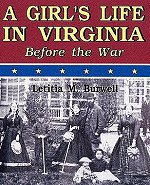 A Girl's Life in Virginia Before the War First published in 1895. An engrossing eyewitness account of antebellum plantation life as it really was |
Kindle Title Carolina Rain Open the page of Carolina Rain and step on the streets of an era gone by. Carolina Rain is not just a read, but an experience. You will smell the magnolia trees, feel the sun on your face and taste the bittersweet tears of a beautiful young girl coming of age at the dawning of the Civil War. |

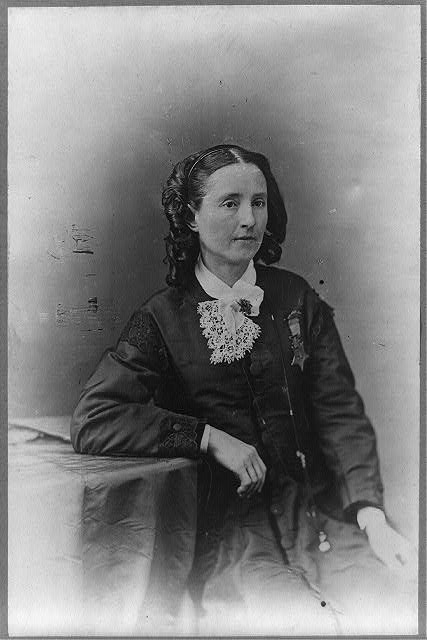 country doctor, was a free thinking participant in many of the reform movements that thrived in upstate New York in the mid 1800s. He believed strongly in education and equality for his five daughters Mary, Aurora, Luna, Vesta, and Cynthia (there was one son, Alvah). He also believed they were hampered by the tight-fitting women's clothing of the day.
 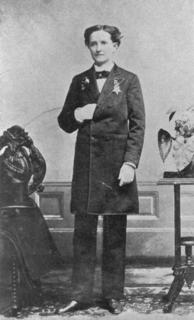 of $8.50, later raised to $20, but still less than some widows' pensions.
 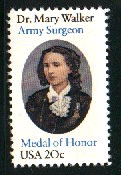 A 20¢ stamp honoring Dr. Mary Walker was issued in Oswego, NY on June 10, 1982. The stamp commemorates the first woman to have been awarded the Congressional Medal of Honor and the second woman to graduate from a medical school in the United States.
 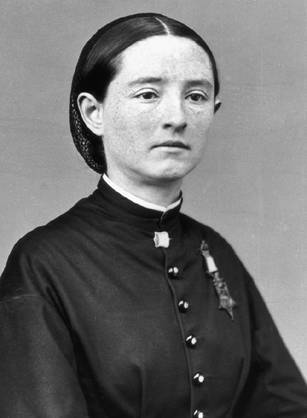 and 1977 Congressional reappraisal of her achievements led to the restoration of the honor.