Kindle Available Vicksburg: The Campaign That Opened the Mississippi Confederate troops surrendered Vicksburg on July 4, 1863 a crucial port and rail depot for the South was lost |
Vicksburg Mississippi Campaign Map
|
|
|
|
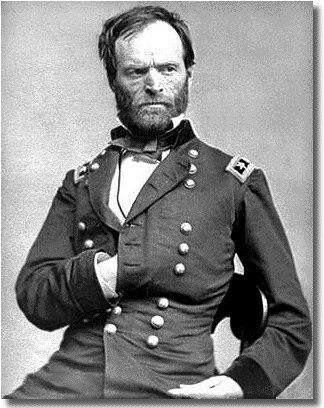
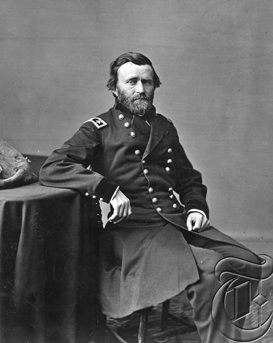
General Grant first tried a combined land and water expedition against Vicksburg in December 1862-January 1863. He sent Major General William T. Sherman down river from Memphis, but the Confederates under General Van Dorn and General Forrest raided and cut the 200-mile-long line of communications. Sherman himself bogged down before Vicksburg, and Grant, perhaps also wishing to keep close rein on McClernand, who ranked Sherman, then determined on a river Vicksburg had almost a perfect location for defense. At that point on the river, bluffs rose as high as 250 feet above the water and extended for about 100 miles from north to south. North of Vicksburg lay the Yazoo River and its delta, a gloomy stretch of watery, swampy bottom land extending 175 miles from north to south, 60 miles from east to west. The ground immediately south of Vicksburg was almost as swampy and impassable. The Confederates had fortified the bluffs from Haynes' Bluff on the Yazoo, some 10 miles above Vicksburg, to Grand Gulf at the mouth of the Big Black River about 40 miles below. Vicksburg could not be assaulted from the river, and sailing past it was extremely hazardous. The river formed a great U here, and Vicksburg's guns threatened any craft that tried to run by. For the Union troops to attack successfully, they would have to get to the high, dry ground east of town. This would put them in Confederate territory between two enemy forces. Lt. General John C. Pemberton commanded some 30,000 men in Vicksburg, while the Confederate area commander, General Joseph E. Johnston (now recovered from his wound at Fair Oaks), concentrated the other scattered Confederate forces in Mississippi at Jackson, the state capital, 40 miles east of Vicksburg. During late winter and early spring, with the rains falling, the streams high, and the On April 4 in a letter to Halleck, Grant divulged his latest plan to capture Vicksburg. Working closely with the local naval commander, Flag Officer David D. Porter, Grant evolved a stroke of great boldness. He decided to use part of his force above Vicksburg to divert the Confederates while the main body marched southward on the west side of the Mississippi, crossed to the east bank, and with only five days' rations struck inland to live off a hostile country without a line of supply or retreat. As he told Sherman, the Union troops would carry "what rations of hard bread, coffee, and salt we can and make the country furnish the balance." Porter's gunboats and other craft, which up to now were on the river north of Vicksburg, were to run past the batteries during darkness and then ferry the troops over the river. Sherman thought the campaign too risky, but the events of the next two months were to prove him wrong. While Sherman demonstrated near Vicksburg in March, McClernand's and McPherson's corps started their advance south. The rains let up in April, the waters receded slightly, and overland movement became somewhat easier. On the night of April 16 Porter led his river fleet past Vicksburg, whose guns, once the move was discovered, lit up the black night with an eerie bombardment. All but one transport made it safely, and starting on April 30, Porter's craft ferried the troops eastward over the river at Bruinsburg below Grand Gulf. The final march against Vicksburg was ready to begin. At this time the Confederates had more troops in the vicinity than Grant had but never could make proper use of them. Grant's swift move had bewildered Pemberton. Then too, just before marching downstream, Grant had ordered a brigade of cavalry to come down from the Tennessee border, riding between the parallel north-south railroad lines of the Mississippi Central and Mobile and Ohio. Led by Col. Benjamin H. Grierson, this force sliced the length of the state, cutting railroads, fighting detachments of Confederate cavalry, and finally reaching Union lines at Baton Rouge, Louisiana. Most important, for the few days that counted most, it drew Pemberton's attention away from Grant and kept the Confederate general from discerning the Union's objectives. Once more divided counsel hampered co-ordination of Confederate strategy. Johnston had been sent west by Davis to take over-all command, an imposing task, for Pemberton's army in Mississippi and Bragg's in Tennessee were widely separated. Things were further confused by Davis' directive to Pemberton to hold Vicksburg at all costs while Johnston recognized the potential trap and ordered him to move directly against Grant. In such a situation Pemberton could do little that was right. He tried to defend too wide an area; he had not concentrated but dispersed his forces at Vicksburg, the Big Black River, and along the railroad line to Jackson, where Johnston was gathering more troops. After Grant had captured Port Gibson on May 1, and Sherman's corps had rejoined the main force, the Union commander decided that he must defeat Johnston before turning on Vicksburg. He moved northeastward and fought his way into Raymond on May 12, a move which put him squarely between Johnston and Pemberton and in a position to cut the Confederate line of communications. Next day Sherman and McPherson marched against the city of Jackson, with McClernand following in reserve, ready to hold off Pemberton. The leading corps took Jackson on May 14 and drove its garrison eastward. While Sherman occupied the state capital to fend off Johnston, the other two corps turned west Grant assaulted the Vicksburg lines on May 15 and 22, but as Sherman noted of the attacks: "The heads of columns have been swept away as chaff from the hand on a windy day." The only recourse now was a siege. Grant settled down, and removed McClernand from command after the attack of May 22 during which the corps commander sent a misleading report, then later slighted the efforts of the other corps and publicly criticized the army commander. Grant replaced him with Maj. Gen. Edward O. C. Ord, and ordered the army to implant batteries and dig trenches around the city. The rest was now a matter of time, as Sherman easily kept Johnston away and the Federals advanced their siegeworks toward the Confederate fortifications. Food became scarce and the troops and civilians inside Vicksburg were soon reduced to eating mules and horses. Shells pounded the city, and the Federal lines were drawn so tight that one Confederate soldier admitted that "a cat could not have crept out of Vicksburg without being discovered." The front lines were so close that the Federals threw primitive hand grenades into the Confederate works. By July 1 the Union troops had completed their approaches and were ready for another assault. But Vicksburg was starving and Pemberton asked for terms. Grant offered to parole all prisoners, and the city surrendered on Independence Day. Since Grant was out of telegraphic contact with Washington, the news reached the President via naval channels on July 7, the day before General Banks' 15,000-man army, having advanced up river from New Orleans, captured Port Hudson. The whole river was now repossessed by the Union, the Confederacy sliced in two. Once more Grant had removed an entire Confederate army from the war—40,000 men—losing only one-tenth that number in the process. |
 The Beleaguered City: The Vicksburg Campaign, December 1862-July 1863 Shelby Foote explains all engagements in and around Vicksburg. Every event is descriptively written covering naval strategies along the Mississippi, Yazoo and other rivers which were of importance to naval affairs of each opposing side |
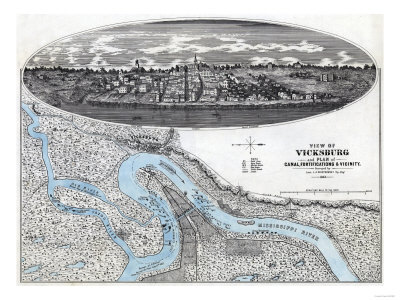 Siege of Vicksburg - Civil War Panoramic Map 12 in. x 9 in. Buy at AllPosters.com Framed Mounted |
 Guide to the Vicksburg Campaign U.S. Army War College Guides to Civil War Battles Army War College Examines an entire campaign, looking at many interlinked battles and joint Army-Navy operations as they played out over seven months and thousands of square miles |
Kindle Available Grant Wins the War Decision at Vicksburg A brilliantly constructed new account,A penetrating analysis of Grant's strategies and actions leading to the Union victory at Vicksburg. Approaching these epic events from a unique and well-rounded perspective, and based on careful research |
 Sherman's Mississippi Campaign Sherman set out from Vicksburg on February 3, 1864, with an army of some 25,000 infantry and a battalion of cavalry. An opportunity to observe how this large-scale raid presaged Shermans Atlanta and Carolina campaigns, revealing the transformation of Shermans strategic thinking |
|
 Professor Noggin's Civil War Trivia Game
|
Campaigns of the Civil War Civil War Exhibits Timeline of the War State Battle Maps Civil War Navy Ships Civil War Summary Civil War Picture Album Women of the Civil War Confederate Commanders Union Generals Civil War Submarines |
 Civil War Soldier 102 Piece Playset
|
 Civil War Campaigns: Vicksburg A chance to refight one of the American Civil War's most crucial battles. It's April of 1863, and General U.S. Grant has led his men to the banks of the Mississippi River. After disastrous Union campaigns at Chickasaw Bayou, Steele Bayou and Greenville, Grant elects to bypass the Confederate fortress city of Vicksburg |
 History Channel Civil War Secret Missions There are about a half-dozen different small arms types, but the Henry is the best for rapid repeating fire and least reloading. The shotgun they give you is useless: you must aim spot-on to affect an enemy, so why not just use the rifle? Grenades are useful at times. |
 History Channel Civil War A Nation Divided Rally the troops and organize a counterattack -- Your strategic decision and talent as a commander will decide if the Union is preserved or if Dixie wins its independence |
 Sid Meier's Civil War Collection Take command of either Confederate or Union troops and command them to attack from the trees, rally around the general, or do any number of other realistic military actions. The AI reacts to your commands as if it was a real Civil War general, and offers infinite replayability. The random-scenario generator provides endless variations on the battles |
Kindle Available The Passing of Armies: An Account Of The Final Campaign Of The Army Of The Potomac The beginning of the final campaign of the Army of the Potomac against Confederate General Robert E. Lee and the Army of Northern Virginia. It was the spring of 1864 and General Grant had Lee and his army backing up toward what finally became the siege of Petersburg, Virginia. |
Kindle Available Through Blood and Fire at Gettysburg: General Joshua L. Chamberlain and the 20th Maine This book is based on the actual report written by Joshua Chamberlain after Gettysburg. It is full of photos and maps which helps to clarify positions and movements on the battlefield. Chamberlain's account are full of excellent insight and illustrations. |
Kindle Available Grant Wins the War Decision at Vicksburg A brilliantly constructed new account,A penetrating analysis of Grant's strategies and actions leading to the Union victory at Vicksburg. Approaching these epic events from a unique and well-rounded perspective, and based on careful research |
Kindle Available Meade: Victor At Gettysburg Meade took command only hours before his forces stumbled upon Robert E. Lee's Confederates at Gettysburg, Pennsylvania, in 1863. He led his men to victory in one of the most famous battles in history, but Meade was soon embroiled in political battles with fellow generals and Washington politicians |
 The Last Confederate The Story of Robert Adams Great historically correct movie of a noble confederate and his undying love of a Yankee girl. |
 Civil War Terror Tales of hidden conspiracies of terror that specifically targeted the civilian populations. Engineers of chemical weapons, new-fangled explosives and biological warfare competed |
 The Civil War: To the Finish: Sherman and the March to the Sea After 3 years of battles, a Union general captured Atlanta and decided to change the course of the war for good. That general was William Tecumseh Sherman |
 The Last Days of the Civil War - Biography: Abraham Lincoln & Robert E. Lee, Civil War Journal: Jefferson Davis In-depth profiles that series--illuminate the personalities at the heart of the conflict: Abraham Lincoln, Jefferson Davis, and Robert E. Lee |
Sources:
United States Military Academy
Library of Congress
National Park Service

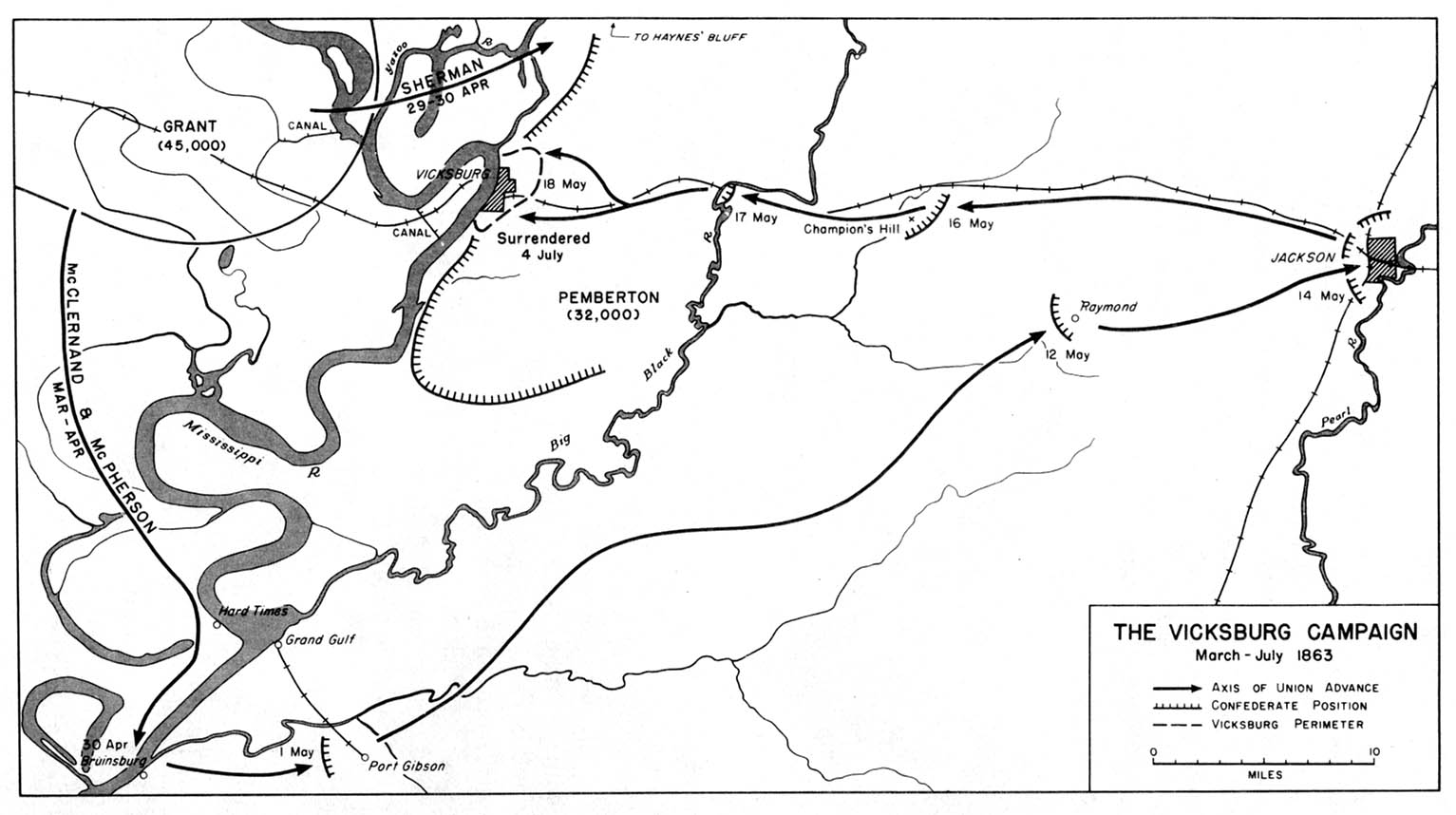
 roads at their wettest and muddiest, overland movement was impossible. Primarily to placate discontented politicians and a critical press, Grant made four attempts to reach high ground east of Vicksburg. All four were unsuccessful, foiled either by Confederate resistance or by natural obstacles. One of the more spectacular efforts was digging canals. These projects had as their objective the clearing of an approach by which troops could sail to a point near the high ground without being fired on by Vicksburg's guns, and all failed. That Grant kept on trying in the face of such discouragement is a tribute to his dogged persistence, and that Lincoln supported him is a tribute to his confidence in the general. The trouble was that Grant had been on the river for two months, and by early spring, Vicksburg was no nearer falling than when he came.
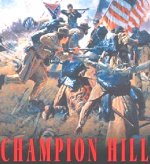
  against Pemberton and Vicksburg. Pemberton tried too late to catch Grant in open country. He suffered severe defeats at Champion's Hill (May 16) and Black River Bridge (May 17) and was shut up in Vicksburg. In eighteen days' Grant's army had marched 200 miles, had won four victories, and had finally secured the high ground along the Yazoo River that had been the goal of all the winter's fruitless campaigning.