|
|
|
|
 The Battle of Olustee 1864: The Final Union Attempt to Seize Florida When the Civil War began in 1861, Florida although the third state to secede from the Union was of little strategic importance to North or South. By the end of 1863, this position had changed dramatically. For the struggling Confederacy, Florida had become a crucial source of supplies, most especially for the troops in Savannah and Charleston |
|
Kindle Available  Standard Catalog of Civil War Firearms Over 700 photographs and a rarity scale for each gun, this comprehensive guide to the thousands of weapons used by Billy Yank and Johnny Reb will be indispensable for historians and collectors. |
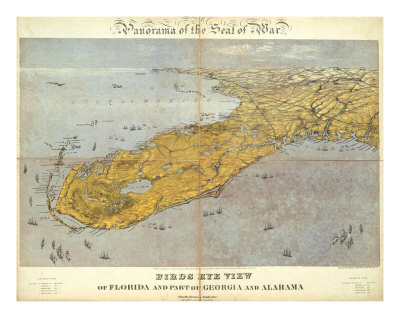
Florida and Part of Georgia and Alabama, c.1861 48 in. x 38 in. $169.99 Buy at AllPosters.com Framed |
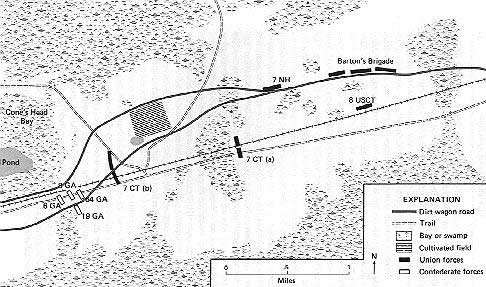
The Union campaign that climaxed in the Battle of Olustee began in February, 1864, when troops commanded by General Truman A. Seymour embarked at Hilton Head, S.C. Their immediate objective was a fourth occupation of Jacksonville . The force could then disrupt transportation links and deprive the Confederacy of food supplies from central Florida; capture cotton, turpentine and timber; gain black recruits for the Union army; and induce Unionists in east Florida to organize a loyal state government. Seymour's expeditionary force landed at Jacksonville on February 7, 1864. Scouts and raiders moved west and met little opposition. Meanwhile, during the month of January, movement of the Federal fleet had been noted by the Confederate forces, and they began to prepare for an offensive. The defense of Florida was placed in the hands of Brigadier General Joseph Finegan and Brigadier General Alfred Colquitt . Once it was apparent the Union forces were moving westward in Florida, Finegan began searching for the Confederate army's best defendable position. Finegan found that position at Olustee. With a lake called Ocean Pond on his left, a nearly impassable swamp on his right and only a narrow passage between, he called for troops to help defend Florida. Colquitt answered that call, bringing veteran troops from Savannah, Georgia. On February 20, 1864 the Union force of 5,500 men and 16 cannon marched westward from Macclenny. By this time, the Confederate forces almost equaled the Union opposing army in number. Finegan sent skirmishers to draw the Union forces to Olustee, and they made contact that afternoon. The Confederate line was formed. The infantry in the center was supported by cavalry on each flank. The battle was joined on the floor of a forest of virgin pines, free of underbrush. Men fought in the open forest with neither force constructing earthworks. The battle raged until dark, when the Union forces began a hasty retreat. In proportion to the number of troops involved, it was one of the bloodiest battles of the Civil War. Union forces remained in Jacksonville until the end of the war and occupied several coastal towns and various places along the St. Johns River. They carried out frequent operations against Confederate forces defending east Florida but did not venture out in significant force again.
|
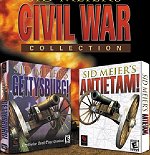 Sid Meier's Civil War Collection Take command of either Confederate or Union troops and command them to attack from the trees, rally around the general, or do any number of other realistic military actions. The AI reacts to your commands as if it was a real Civil War general, and offers infinite replayability. The random-scenario generator provides endless variations on the battles |
Florida State Battle Map State Battle Maps American Civil War Exhibits Civil War Timeline Confederate Commanders Union Generals Civil War Music History Women in the War Ships and Naval Battles Kids Zone Exhibits Civil War Cooking Civil War Summary |
 1860 Enfield Civil War Musketoon This piece is a full-size non-firing reproduction of the rifle used in the Civil War. The body is made of European hardwood |
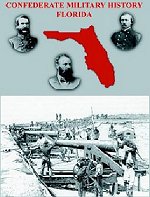 Confederate Military History of Florida The political and military events in the Confederacy's least-populated state during the American Civil War. It begins with the secession of the Florida in January 1861 and continues through the actions at Santa Rosa Island, the Battle of Olustee, and the engagement at Natural Bridge. |
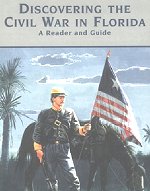 Discovering the Civil War in Florida A Reader and Guide While Confederates fought to preserve their sovereignty and way of life, Union troops descended on Florida with a mission to cripple the Confederacy: to destroy seashore salt works, to prevent the transfer of supplies and raw materials into, and to seize slaves and cattle |
 Confederate Florida The Road to Olustee A campaign study and a quick history of Confederate Florida. The political and social undercurrents of the time, and sheds light on the complex circumstances of the fateful Union campaign. Particularly of interest are the great chapters on the blockade and raid strategy of the Federal forces |
Kindle Available A South Divided: Portraits of Dissent in the Confederacy An account of Southern dissidents in the Civil War, at times labeled as traitors, Tories, deserters, or mossbacks during the war and loyalists, Lincoln loyalists, and Unionists by historians of the war |
 The New York City Draft Riots: Their Significance for American Society and Politics in the Age of the Civil War For five days in July 1863, at the height of the Civil War, New York City was under siege. Angry rioters burned draft offices, closed factories, destroyed railroad tracks and telegraph lines, and hunted policemen and soldiers. Before long, the rioters also turned their murderous wrath against the black community |
 A Battlefield Atlas of the Civil War Informative text enhanced 24 three-color maps and 30 black/white historical photographs. |
 The Official Virginia Civil War Battlefield Guide Virginia was host to nearly 1/3rd of all Civil War engagements. This guide covers them all like a mini-history of the war. This guide organizes battles chronologically. Each campaign has a detailed overview, followed by concise descriptions of the individual engagements |
Kindle Available The Maps of First Bull Run: An Atlas of the First Bull Run (Manassas) Campaign, including the Battle of Ball's Bluff, June-October 1861 |