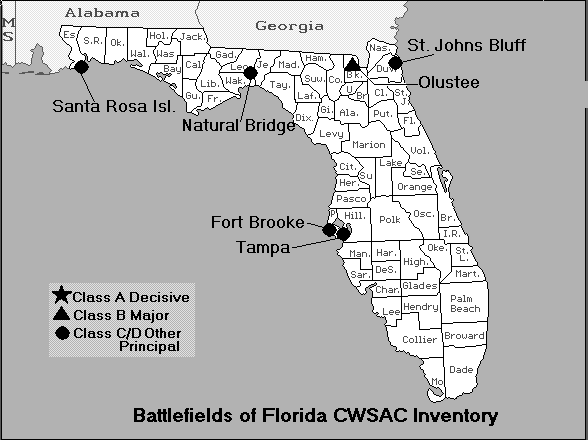
Florida Civil War Map of Battles
|
 |
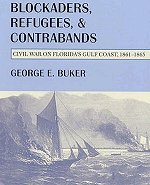 Blockaders, Refugees, and Contrabands: Civil War on Florida'S Gulf Coast, 1861-1865 Coastal Florida had a refugee crisis as the war progressed. Escaped slaves ("contrabands") sought out the blockaders. Some joined the U.S. Navy. White men and their families sought to avoid conscription or vengeful neighbors/regulators and eventually sought refuge with the blockaders |
|
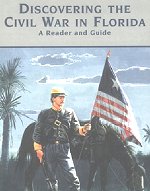 Discovering the Civil War in Florida A Reader and Guide While Confederates fought to preserve their sovereignty and way of life, Union troops descended on Florida with a mission to cripple the Confederacy: to destroy seashore salt works, to prevent the transfer of supplies and raw materials into, and to seize slaves and cattle |
Kindle Available Standard Catalog of Civil War Firearms Over 700 photographs and a rarity scale for each gun, this comprehensive guide to the thousands of weapons used by Billy Yank and Johnny Reb will be indispensable for historians and collectors. |
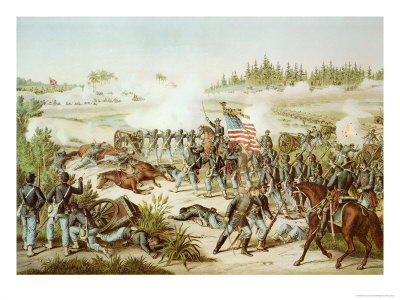 Black Troops of the 54th Massachusetts Regiment at the Battle of Olustee, Florida, 1864 24 in. x 18 in. Buy at AllPosters.com |
 Sid Meier's Civil War Collection Take command of either Confederate or Union troops and command them to attack from the trees, rally around the general, or do any number of other realistic military actions. The AI reacts to your commands as if it was a real Civil War general, and offers infinite replayability. The random-scenario generator provides endless variations on the battles |
Civil War State Battle Maps American Civil War Exhibits American Civil War Timeline Ships and Naval Battles Women in the War Civil War Picture Album Civil War Timeline Summary of the War |
 History Channel Civil War Secret Missions There are about a half-dozen different small arms types, but the Henry is the best for rapid repeating fire and least reloading. The shotgun they give you is useless: you must aim spot-on to affect an enemy, so why not just use the rifle? Grenades are useful at times. |
 Confederate Military History of Florida The political and military events in the Confederacy's least-populated state during the American Civil War. It begins with the secession of the Florida in January 1861 and continues through the actions at Santa Rosa Island, the Battle of Olustee, and the engagement at Natural Bridge. |
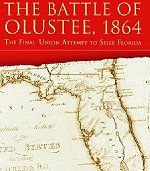 The Battle of Olustee 1864: The Final Union Attempt to Seize Florida When the Civil War began in 1861, Florida although the third state to secede from the Union was of little strategic importance to North or South. By the end of 1863, this position had changed dramatically. For the struggling Confederacy, Florida had become a crucial source of supplies, most especially for the troops in Savannah and Charleston |
 Confederate Florida The Road to Olustee A campaign study and a quick history of Confederate Florida. The political and social undercurrents of the time, and sheds light on the complex circumstances of the fateful Union campaign. Particularly of interest are the great chapters on the blockade and raid strategy of the Federal forces |
Kindle Available A South Divided: Portraits of Dissent in the Confederacy An account of Southern dissidents in the Civil War, at times labeled as traitors, Tories, deserters, or mossbacks during the war and loyalists, Lincoln loyalists, and Unionists by historians of the war |
|
Kindle Available Staff Officers in Gray: A Biographical Register of the Staff Officers in the Army of Northern Virginia Profiles some 2,300 staff officers in Robert E. Lee's famous Army of Northern Virginia. A typical entry includes the officer's full name, the date and place of his birth and death, details of his education and occupation, and a synopsis of his military record. Two appendixes provide a list of more than 3,000 staff officers who served in other armies of the Confederacy and complete rosters of known staff officers of each general |
 Apostles of Disunion: Southern Secession Commissioners and the Causes of the Civil War In late 1860 and early 1861, state-appointed commissioners traveled the length and breadth of the slave South carrying a fervent message in pursuit of a clear goal: to persuade the political leadership and the citizenry of the uncommitted slave states to join in the effort to destroy the Union and forge a new Southern nation |
Kindle Available Naval Strategies of the Civil War: Confederate Innovations and Federal Opportunism Compare and contrast the strategies of the Southern Secretary of the Navy, Mallory, against his rival in the North, Welles. Mallory used technological innovation and the skill of individuals to bolster the South's seapower against the Union Navy's superior numbers |
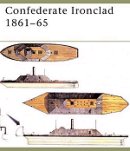 Confederate Ironclad 1861-65 Every aspect of Confederate ironclads is covered: design, construction, armor, armament, life on board, strategy, tactics, and actual combat actions. |
|
Kindle Available Civil War Curiosities: Strange Stories, Oddities, Events, and Coincidences |
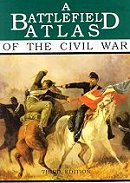 A Battlefield Atlas of the Civil War Informative text enhanced 24 three-color maps and 30 black/white historical photographs. |
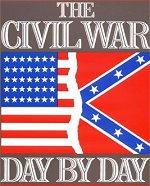 The Civil War Day By Day An Almanac, 1861-1865 The most exhaustively detailed and fascinating book on the American Civil War of its kind. Not only does it provide a day-by-day look at the major events of the war, but lists so many of the small skirmishes and actions as well. Accurate and enjoyable |
Kindle Available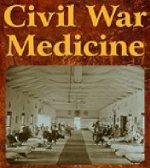 Civil War Medicine The staggering challenge of treating wounds and disease on both sides of the conflict. Written for general readers and scholars alike, this first-of-its kind encyclopedia will help all Civil War enthusiasts to better understand this amazing medical saga. Clearly organized, authoritative, and readable |
|
Kindle Available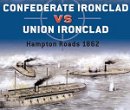 Confederate Ironclad vs Union Ironclad: Hampton Roads 1862 The Ironclad was a revolutionary weapon of war. Although iron was used for protection in the Far East during the 16th century, it was the 19th century and the American Civil War that heralded the first modern armored self-propelled warships. |
Kindle Available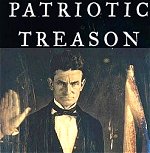 Patriotic Treason John Brown and the Soul of America The life of the first citizen committed to absolute racial equality. His friendships in defiance of the culture around him, He turned his twenty children into a dedicated militia. He collaborated with black leaders such as Frederick Douglass, Martin Delany, and Harriet Tubman to overthrow slavery. |
 Encyclopedia of the American Civil War: A Political, Social, and Military History Definitive Reference Work, this volume, rich with over 500 illustrations, 75 maps, and 250 primary source documents, offers more than 1,600 entries that chart the war's strategic aims, analyze diplomatic and political maneuvering, describe key military actions, sketch important participants, assess developments in military science, and discuss the social and financial impact of the conflict. |
Kindle Available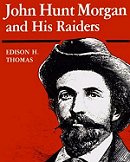 John Hunt Morgan and His Raiders The "Thunderbolt of the Confederacy" John Hunt Morgan from Tompkinsville, Kentucky to Greeneville, Tennessee. |
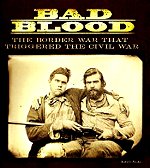 Bad Blood: The Border War That Triggered the Civil War In the years leading up to the Civil War, a bloody conflict between slaveholders and abolitionists focused the nation's eyes on the state of Missouri and the territory of Kansas. Told through the actual words of slave owners, free-staters, border ruffians, and politicians, Bad Blood presents the complex morality, differing values, and life-and-death decisions faced by those who lived on the Missouri-Kansas border |
 Blue Vs. Gray - Killing Fields Relive the most vicious fighting of the Civil War, in which General Ulysses S. Grant forcibly reversed the tide of the conflict by paying with the blood of thousands. It was a desperate time for the Union |
 Civil War Combat: America's Bloodiest Battles The violent mayhem of the hornet's nest at Shiloh, the valiant charge on the sunken road at Antietam, the carnage in the wheat field at Gettysburg, and the brutal fighting at Cold Harbor |
 Jefferson Davis An American President One of the most outstanding statesmen of the United States during the first 60 years of the 19th century, he sacrificed everything to defend the South's position regarding the rights of the states and conservative constitutional interpretation. Against staggering odds he led the South and held it together in the bloody Civil War or War Between the States |
 The Blue and the Gray The Complete Miniseries The Civil War proved a backdrop for this 1982 miniseries. Complete and uncut three disc set. Two families divided by the War Between the States. A Southerner caught when he becomes a war correspondent for the Northern newspaper. He finds himself where history's in the making from the Battle of Bull Run to Abraham Lincoln's assassination |
 Battle of Stones River The Fight for Murfreesboro At dawn on December 31, 1862 the two armies clashed in a deadly struggle along the banks of Stones River. |
 The Battle of Chickamauga Special Widescreen Edition Chickamauga one of the fiercest engagements of the American Civil War. Over a period of two days, more than 100,000 men struggled for control of the south's transportation hub, Chattanooga. |
 Struggle For Vicksburg Photography of the park with authentic battlefield illustrations and life-like paintings. Vicksburg's wartime role in the bloody and brutal conflict. |

1st Official Flag of Florida (1861) 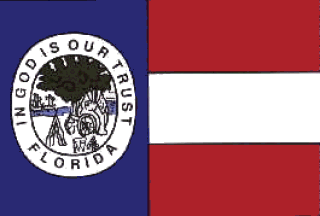 |
After Florida seceded from the Union in January 1861, a number of unofficial flags flew over the state. The general assembly passed an act directing Governor Madison S. Perry to adopt "an appropriate device for a State flag which shall be distinctive in character." Six months later the Governor had the Secretary of State record the description of Florida's first official flag. Whether it was ever raised over the Capitol or in the field is unknown. The flag shown here is reconstructed from a written description.
|
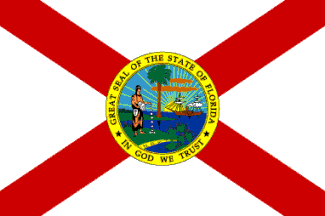 Florida - State Flag |
Many flags have flown over Florida since European explorers first landed here in the early sixteenth century. Among these have been the flags of five nations: Spain, France, Great Britain, the United States, and the Confederate States of America. Numerous other unofficial flags also have been flown on the penninsula at one time or another. Only a written description remains of some of these banners.
A joint resolution of the legislature in 1899, approved by state voters in 1900, made our current State Flag the official banner of Florida. The official specifications for the flag can be found in Chapter 15.012 of the Florida Statutes. "The State Flag shall conform with standard commercial sizes and be of the following portions and descriptions: The seal of the state, in diameter one-half the hoist, shall occupy the center of a white ground. Red bars, in width one-fifth the hoist, shall extend from each corner towards the center, to the outer rim of the seal." The Department of State is the custodian of the State Flag. Between 1868 and 1900, Florida's state flag consisted of a white field with the state seal in the center. During the late 1890s, Governor Francis P. Fleming suggested that a red cross be added, so that the banner did not appear to be a white flag of truce or surrender when hanging still on a flagpole. |
 Civil War Historic 1000-piece Puzzle The famous faces and fearsome facts of the Civil War are captured in this 1,000-piece cardboard puzzle for Civil War buffs and serious puzzle fans. |
 Civil War Cannon Collectible Models and childrens playsets Miniature Collectible Civil War Cannon12 pound Civil War field cannon replica weapon collectible is a detailed 1/12th scale military caisson replica weapon collectible as used throughout the Civil War Childrens Cannon Set. Includes 6 gray cannon with black wheels that measure 4.5 inches long |
 Professor Noggin's Civil War Trivia Game
|
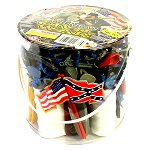 Civil War Soldier 102 Piece Playset
|
||||||
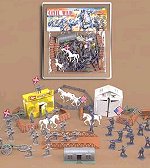 72 Piece Civil War Army Men Play Set 52mm Union and Confederate Figures, Bridge, Horses, Canon
|
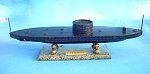 Monitor 21" Civil War Ship Wood Model Fully Assembled
|
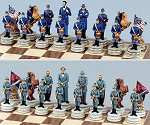 Civil War Chess Set Painted civil war chess set. Dimensions: Chess set pieces: 3-1/4" King's; 1-1/8" bases |
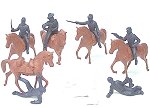 Civil War Union Cavalry: 25 Piece Set
|
||||||
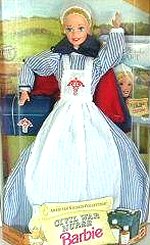 Civil War Nurse Barbie Part of the American Stories Collection. |
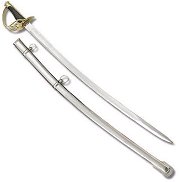 Cavalry Saber This fine replica is 39 inches overall and features a highly polished 33 inch carbon steel blade. Its leather wrapped handle fits the hand perfectly and sports decorative brass accents and a shiny brass pommel. |
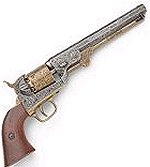 Civil War Model 1851 Naval Pistol Engraved Silver Tone / Gold Tone Finish and Wooden Grips - Replica of Revolver Used by Both USA / Union and CSA / Confederate Forces |
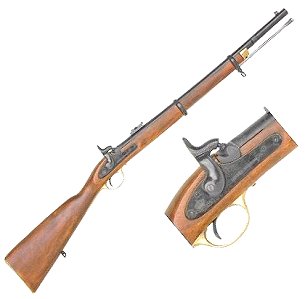 1860 Enfield Civil War Musketoon This piece is a full-size non-firing reproduction of the rifle used in the Civil War. The body is made of European hardwood |