 Forts Henry and Donelson The Key to the Confederate Heartland The front in Virginia was relatively narrow (Chesapeake Bay to Blue Ridge Mountains) while in Tennessee the front stretched hundreds of miles from the Mississippi River to the Appalachian Mountains. To cover this extensive area the Confederates had a much smaller force than in Virginia |
Fort Henry
|
|
|
|

|
Kindle Available Civil War Curiosities: Strange Stories, Oddities, Events, and Coincidences |
 |
Kindle Available Men of Fire: Grant, Forrest, and the Campaign That Decided the Civil War In the winter of 1862, on the border between Kentucky and Tennessee, two extraordinary military leaders faced each other in an epic clash that would transform them both and change the course of American history forever |
Kindle Available Tennessee in the Civil War Selected Contemporary Accounts of Military and Other Events, Month by Month |
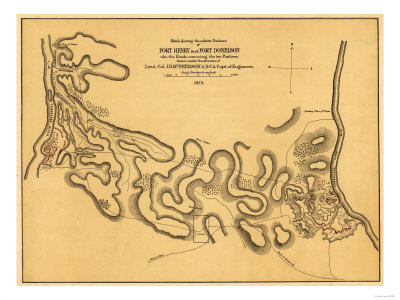
Battle of Fort Henry Civil War Panoramic Map 24 in. x 18 in. Buy at AllPosters.com Framed Mounted |
 Ironclads and Big Guns of the Confederacy : The Journal and Letters of John M. Brooke Information about the Confederate Navy's effort to supply its fledgling forces, the wartime diaries and letters of John M. Brooke tell the neglected story of the Confederate naval ordnance office, its innovations, and its strategic vision. Kindle Available Civil War Curiosities: Strange Stories, Oddities, Events, and Coincidences |
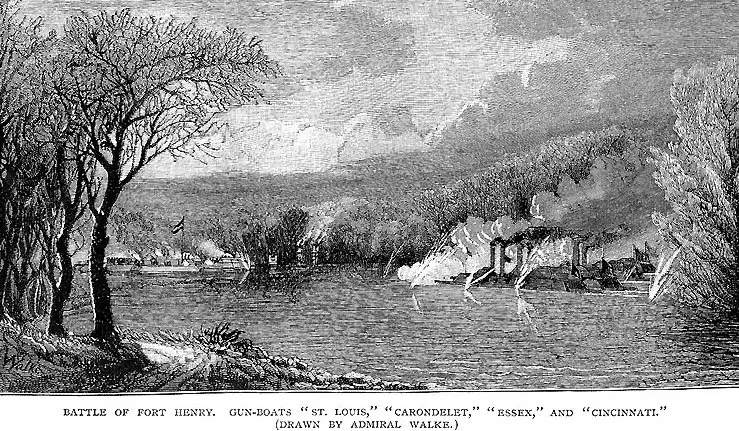
Line engraving after a drawing by Rear Admiral Henry Walke, published in the "History of the Great Rebellion", by Harper.
The print depicts the Federal gunboats Saint Louis, Carondelet, Essex and Cincinnati bombarding Fort Henry 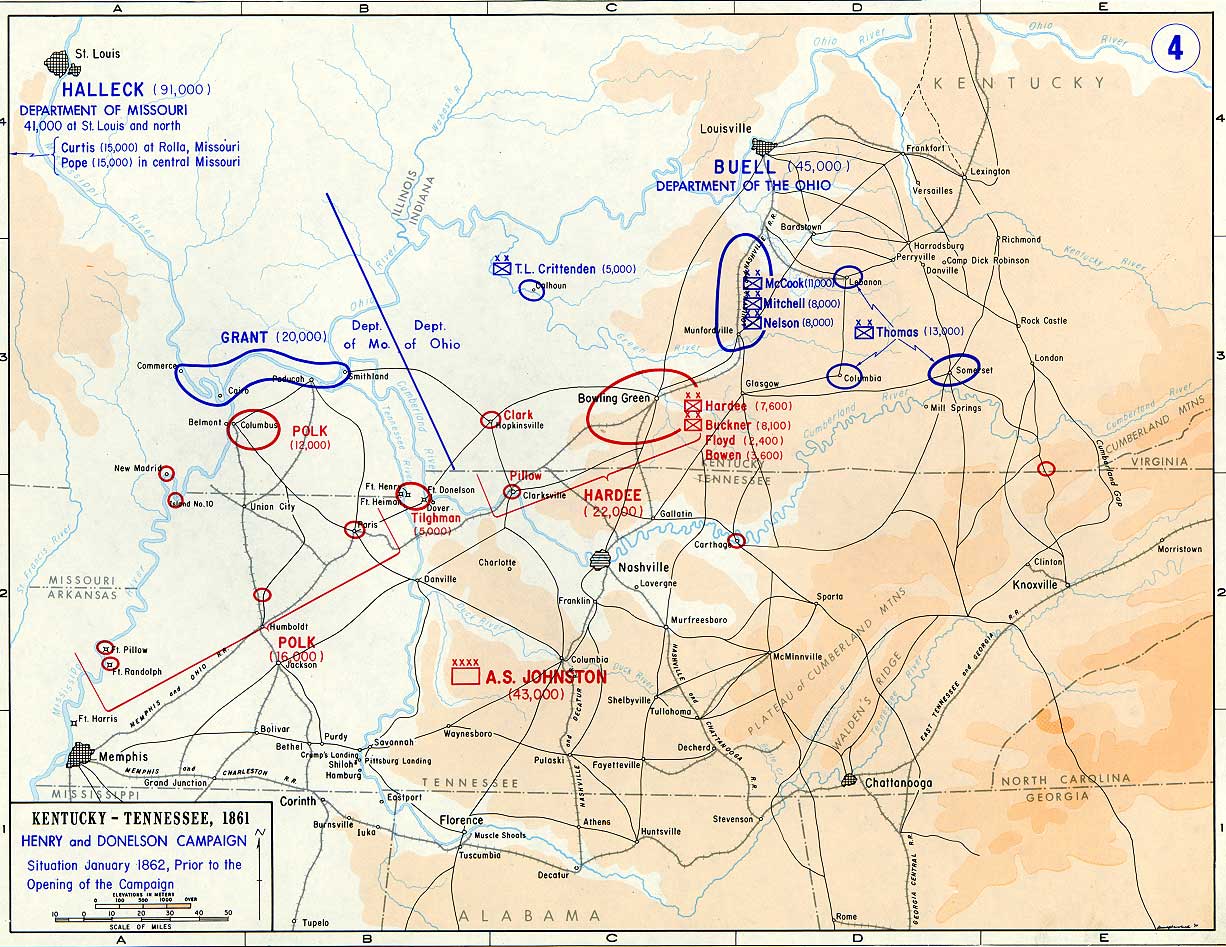 |
 Civil War Model 1851 Naval Pistol Engraved Silver Tone / Gold Tone Finish and Wooden Grips - Replica of Revolver Used by Both USA / Union and CSA / Confederate Forces |
Tennessee State Battle Map State Battle Maps American Civil War Exhibits Civil War Timeline Women in the War Civil War Summary Documents of the Civil War Civil War Cooking Civil War Submarines Kids Zone Causes of the War |
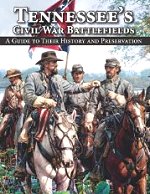 Tennessee's Civil War Battlefields: A Guide to Their History and Preservation Well researched, with detailed maps and photographs, this book allows you to follow General Forrest over his many engagements and march alongside the Army of Tennessee. |
Kindle Available John Hunt Morgan and His Raiders The "Thunderbolt of the Confederacy" John Hunt Morgan from Tompkinsville, Kentucky to Greeneville, Tennessee. |
 The Partisan Rangers of the Confederate States Army: Memoirs of General Adam R. Johnson The capture of Newburg, Indiana, with only twelve men and two joints of stovepipe mounted on the running gear of a wagon. This episode won him a nickname of "Stovepipe." He was promoted to Brigadier General in June 1864 |
Tennessee's Civil War Battlefields: A Guide to Their History and Preservation Well researched, with detailed maps and photographs, this book allows you to follow General Forrest over his many engagements and march alongside the Army of Tennessee. |
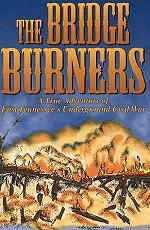 The Bridge Burners: A True Adventure of East Tennessee's Underground Civil War The railroad that proved such a peacetime boon would become a point of conflict only three years later |
 The Confederacy's Last Hurrah: Spring Hill, Franklin, and Nashville John Bell Hood rallied his demoralized troops and marched them off the Tennessee, desperately hoping to draw Sherman after him and forestall the Confederacy's defeat |
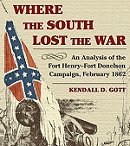 Where the South Lost the War: An Analysis of the Fort Henry-Fort Donelson Campaign The war probably could have been over in 1862 had Lieutenant Phelps destroyed the bridge at Florence. Not doing so provided a retreat for A. S. Johnston to move his men to Corinth and then to Shiloh |
 A Very Violent Rebel: The Civil War Diary of Ellen Renshaw House The Siege of Knoxville (November 1863) is covered and Sutherland's footnotes make for good historyl |
 The Untold Story of Shiloh: The Battle and the Battlefield Fought in south central Tennessee, north of Corinth, Mississippi, the battle showed the nation that the Civil War would be long and difficult. The Battle of Shiloh opened up the western Confederacy to the Union invasion that would ultimately prove its undoing |
|
Books Civil War Womens Subjects Young Readers Military History DVDs Confederate Store Civil War Games Music CDs Reenactors |