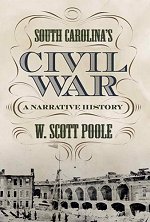
 South Carolina's Civil War A Narrative History Exploring South Carolina as the state where the war began - a state where the white leadership chose to defy the Union rather than release their grip on slavery - South Carolina's Civil War is as gripping and involving as it is acute in its attention to detail. An excellent contribution to school, library, and personal history shelves. |
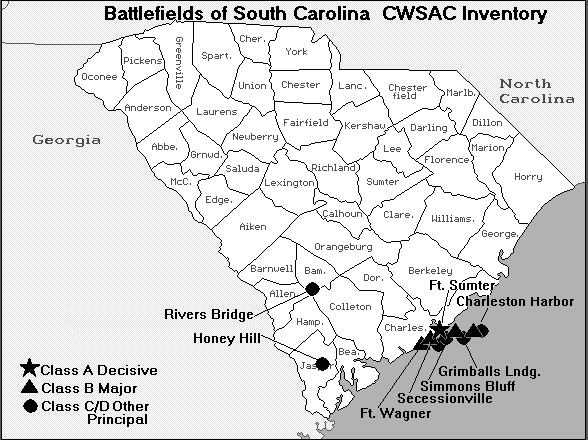
South Carolina Civil War Map of Battles
 |
 The History Of The Fall Of Fort Sumter: Being An Inside History Of The Affairs In South Carolina And Washington, 1860-61 The Conditions And Events In The South Which Brought On The Rebellion. The Genesis Of The Civil War and the Fall of Fort Sumter |
| April 12-14, 1861 Fort Sumter June 16, 1862 Secessionville / Ft. Lamar / James Island June 21, 1862 Simmon's Bluff April 7, 1863 Charleston Harbor / Fort Sumter July 10-11, 1863 Fort Wagner / Morris Island July 16, 1863 Grimball's Landing / Secessionville / James Island July 18-September 7, 1863 Fort Wagner / Morris Island Aug 17-Aug 23, 1863 Fort Sumter / Charleston Harbor / Morris Island September 7-8, 1863 Charleston Harbor / Battery Gregg November 30, 1864 Honey Hill February 3, 1865 Rivers' Bridge / Owens' Crossroads |
|
 The Perfect Steel Trap Harpers Ferry 1859 Eye-witness accounts of the John Brown insurrection from people like Lee, Brown's family, and ordinary citizens. The information has been gathered by two of the raiders who escaped and live to tell about it Owen Brown and Osborne Anderson. The preparations, the raid, the trials, the executions and the aftermath of the event |
 Confederate Charleston: An Illustrated History of the City and the People During the Civil War This book has so many facts that I had never read and pictures I'd never seen. The author really went into detail about the city and pictures that I haven't found in any other book. |
 Siege Train: The Journal of a Confederate Artilleryman in the Defense of Charleston Major Edward Manigault, one of the commanding officers ordered by General P. G. T. Beauregard to document his unit's daily operations, began a diary in July 1863 that would become one of the most informative records to survive the Civil War. |
Kindle Available Charlestonians in War The Charleston Battalion The history of a Confederate unit that was central to the defense of Charleston: the 1st South Carolina Volunteer Infantry Battalion, usually known simply as the Charleston Battalion |
Kindle Available A Yankee Girl at Fort Sumter Tale of a girl and her family from Boston living in Charleston, SC during the months leading up to the beginning of the Civil War by the attack on Fort Sumter. The reader senses the inhunanity of slavery through Sylvia's experiences. |
 Secessionville: Assault On Charleston 1862 The Union forces led by General David Hunter attempted to capture the city of Charleston, by landing troops on James Island. All the movements on both sides focusing on the high commands of both armies the common soldiers who bore the brunt of the fighting |
 Gate of Hell: Campaign for Charleston Harbor, 1863 Study of the Union's Campaign for Charleston. The many attacks the Union attempted that summer to capture the cradle of the Confederacy. Overview of the campaign, focusing on the relationships between the Army and the Navy of the United States |
 The Battle of Fort Sumter A discourse preached on the day of national fasting thanksgiving & prayer in the First Presbyterian Church Charleston SC June 13 1861 Gale Archival Editions: On Demand are digital copies of rare and out-of-print historical content |
Kindle Available Wolf of the Deep: Raphael Semmes and the Notorious Confederate Raider CSS Alabama In July 1862, the Confederate captain Raphael Semmes received orders to report to Liverpool, where he would take command of a secret new British-built steam warship. His mission: to prey on Union commercial vessels and undermine the North's ability to continue the war |
Kindle Available Naval Strategies of the Civil War: Confederate Innovations and Federal Opportunism Compare and contrast the strategies of the Southern Secretary of the Navy, Mallory, against his rival in the North, Welles. Mallory used technological innovation and the skill of individuals to bolster the South's seapower against the Union Navy's superior numbers |
Kindle Available The Politically Incorrect Guide to the Civil War As a graduate history instructor, I found this book to be a refreshing view of history. It's nice to read some critical reasoning that goes against the popular biases by presenting facts that are conveniently over-looked by many others. I highly recommend this book to high school seniors and college undergraduates as an excellent basis to their understanding of the war. Amazon Reviewer |
Kindle Available Reign of Iron: The Story of the First Battling Ironclads, the Monitor and the Merrimack The first ironclad ships to fight each other, the Monitor and the Virginia (Merrimack), were the unique products of American design genius |
Kindle Available On Gunnery: The Art and Science of Field Artillery from the American Civil War to the Dawn of the 21st Century The fascinating evolution of artillery from the battlefields of the American Civil War to the desert sands of the middle east at the dawn of the 21st Century. Chronicling the evolution of fire direction and control from the muzzle loaded cannons of the Union and Confederacy |
 Cannons: An Introduction to Civil War Artillery The concise guide to the weapons, ammunition and equipment of Civil War artillery. More than 150 photos and drawings. |
 Cannon Blasts: Civil War Artillery in the Eastern Armies Field artillery has had a great tradition in American military history. Based on the records, artillery did not inflict the casualties that one might expect; however, all serious Civil War buffs can recall instances when the field guns played a major role in the action. |
 Field Artillery Weapons of the Civil War A detailed survey, replete with photographs and diagrams, of the field artillery used by both sides in the Civil War. In paperback for the first time, the book provides technical descriptions of the artillery (bore, weight, range, etc.), ordnance purchases, and inspection reports. |
 Standing Soldiers, Kneeling Slaves The United States of America originated as a slave society, holding millions of Africans and their descendants in bondage, and remained so until a civil war took the lives of a half million soldiers, some once slaves themselves. |
 Desperate Engagement: How a Little-Known Civil War Battle Saved Washington, D.C., and Changed American History A full-field engagement between 12,000 battle-hardened Confederate troops led by Early, and some 5,800 Union troops, many of them untested in battle |
 A Very Violent Rebel: The Civil War Diary of Ellen Renshaw House The Siege of Knoxville (November 1863) is covered and Sutherland's footnotes make for good history |
 A Battlefield Atlas of the Civil War Informative text enhanced 24 three-color maps and 30 black/white historical photographs. Compact, comprehensive, "user friendly", and providing a narrative history along with a complete cartographic display of the famed American Civil War battle of Gettysburg |
 Ironclads and Big Guns of the Confederacy : The Journal and Letters of John M. Brooke Information about the Confederate Navy's effort to supply its fledgling forces, the wartime diaries and letters of John M. Brooke tell the neglected story of the Confederate naval ordnance office, its innovations, and its strategic vision. |
Kindle Available Six Years of Hell Harpers Ferry During the Civil War While Harpers Ferry was an important location during the Civil War, in most Civil War books it's a sideshow of something larger. John Brown's raid, Lee's invasions of 1862 & 1863 as well as Early's 1864 raid are all covered in depth |
 Struggle for the Heartland: The Campaigns from Fort Henry to Corinth The military campaign that began in early 1862 with the advance to Fort Henry and culminated in late May with the capture of Corinth, Mississippi. The first significant Northern penetration into the Confederate west |
Kindle Available John Hunt Morgan and His Raiders The "Thunderbolt of the Confederacy" John Hunt Morgan from Tompkinsville, Kentucky to Greeneville, Tennessee. |
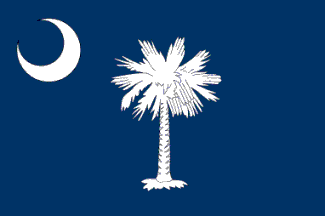 South Carolina State Flag |
Though the South Carolina State Flagharkens back to the crescent worn by her troops in the American Revolution, and the palmetto tree is a reminder of the palmetto logs that stopped British cannon balls in the bombardment of Ft. Moultrie during the same war, it is still very much a Confederate flag for its current incarnation.
While the flag in some variation was adopted under the South Carolina Militia Act of 1838, the flag as shown today was not officially adopted as the state flag until January, 1861. Then it was the flag of the seceded Republic of South Carolina - the first of the states to leave the Union. As such, it is indeed every bit as much a Confederate flag as any other pattern of Confederate flag (and there were many). In fact, the palmetto flag, as it became called at the time, was far more the symbol of secession for the South than the more famous Bonnie Blue flag - that gets far more publicity than it deserves based on an examination of the newspapers of the time (but it did have the song). I have found FAR more mentions of palmetto flags being hoisted all over the South (as well as out West and in the North) as symbols of secession than the lone star/Bonnie Blue flags. South Carolina troops also fought under their state flag -the state providing flags to the first ten regiments raised for its defense. Other palmetto flags were issued to local military companies as well which saw early combat use. The palmetto flag of South Carolina is, therefore, a Confederate battle flag, just like those that were created to be as such during the war by the various CSA commanders |
| This is a version of an early flag raised over South Carolina shortly after its secession from the Union in 1860 (it was also supposed to have been raised over Yale University by sympathizers). It was called the South Carolina Sovereignty Flag and was supposed to have been an inspiration for the Confederate flag in its later form. | 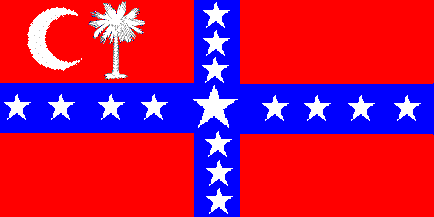 |
27th South Carolina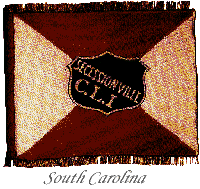 |
Bonnie Blue Flag Bonnie Blue The Confederate government did not adopt this flag but the people did and the lone star flags were adopted in some form in five of the southern States that adopted new flags in 1861. |
Southern Cross Flag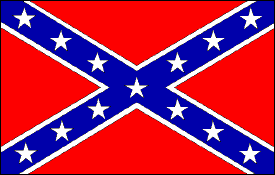 Used as a navy jack at sea from 1863 onward. This flag has become the generally recognized symbol of the South. |
Second Confederate Flag 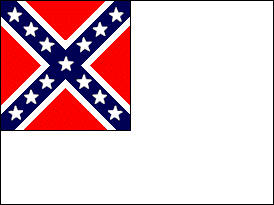 On May 1st,1863, a second design was adopted, placing the Battle Flag (also known as the "Southern Cross") as the canton on a white field. This flag was easily mistaken for a white flag of surrender especially when the air was calm and the flag hung limply. More on Confederate Flags |

Sources:
U.S. National Park Service
U.S. Library of Congress.
Charleston Harbor South Carolina City History and current weather