Battle of Stones River: The Fight for Murfreesboro
At dawn on December 31, 1862 the two armies clashed in a deadly struggle along the banks of Stones River.
DVD

Stones River
Murfreesboro
Civil War Tennessee

American Civil War

Stones River Campaign 1862 - 1863


Behind the Blue and Gray: The Soldier's Life in the Civil War
A soldiers journey beginning with enlistment and ending with a soldiers life after the war

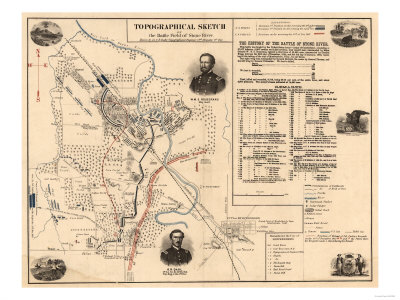
After General Braxton Bragg's defeat at Perryville, Kentucky, October 8, 1862, he and his Confederate Army of the Mississippi retreated, reorganized, and were redesignated as the Army of Tennessee. They then advanced to Murfreesboro, Tennessee, and prepared to go into winter quarters. 

Major General William S. Rosecrans's Union Army of the Cumberland followed Bragg from Kentucky to Nashville. Rosecrans left Nashville on December 26, with about 44,000 men, to defeat Bragg's army of more than 37,000.  He found Bragg's army on December 29 and went into camp that night, within hearing distance of the Rebels.

At dawn on the 31st, Bragg's men attacked the Union right flank. The Confederates had driven the Union line back to the Nashville Pike by 10:00 am but there it held. Union reinforcements arrived from Rosecrans's left in the late forenoon to bolster the stand, and before fighting stopped that day the Federals had established a new, strong line.

On New Years Day, both armies marked time. Bragg surmised that Rosecrans would now withdraw, but the next morning he was still in position. In late afternoon, Bragg hurled a division at a Union division that, on January 1, had crossed Stones River and had taken up a strong position on the bluff east of the river. The Confederates drove most of the Federals back across McFadden's Ford, but with the assistance of artillery, the Federals repulsed the attack, compelling the Rebels to retire to their original position.

Action on January 2, 1863

Bragg left the field on the January 4-5, retreating to Shelbyville and Tullahoma, Tennessee. Rosecrans did not pursue, but as the Confederates retired, he claimed the victory. Stones River boosted Union morale. 

The Confederates had been thrown back in the east, west, and in the Trans-Mississippi.

Result(s): Union victory

Location: Rutherford County

Campaign: Stones River Campaign (1862-63)

Date(s): December 31, 1862-January 2, 1863

Principal Commanders: Major General William S. Rosecrans [US]; General Braxton Bragg [CS]

Forces Engaged: Army of the Cumberland [US]; Army of Tennessee [CS]

Estimated Casualties: 23,515 total (US 13,249; CS 10,266)


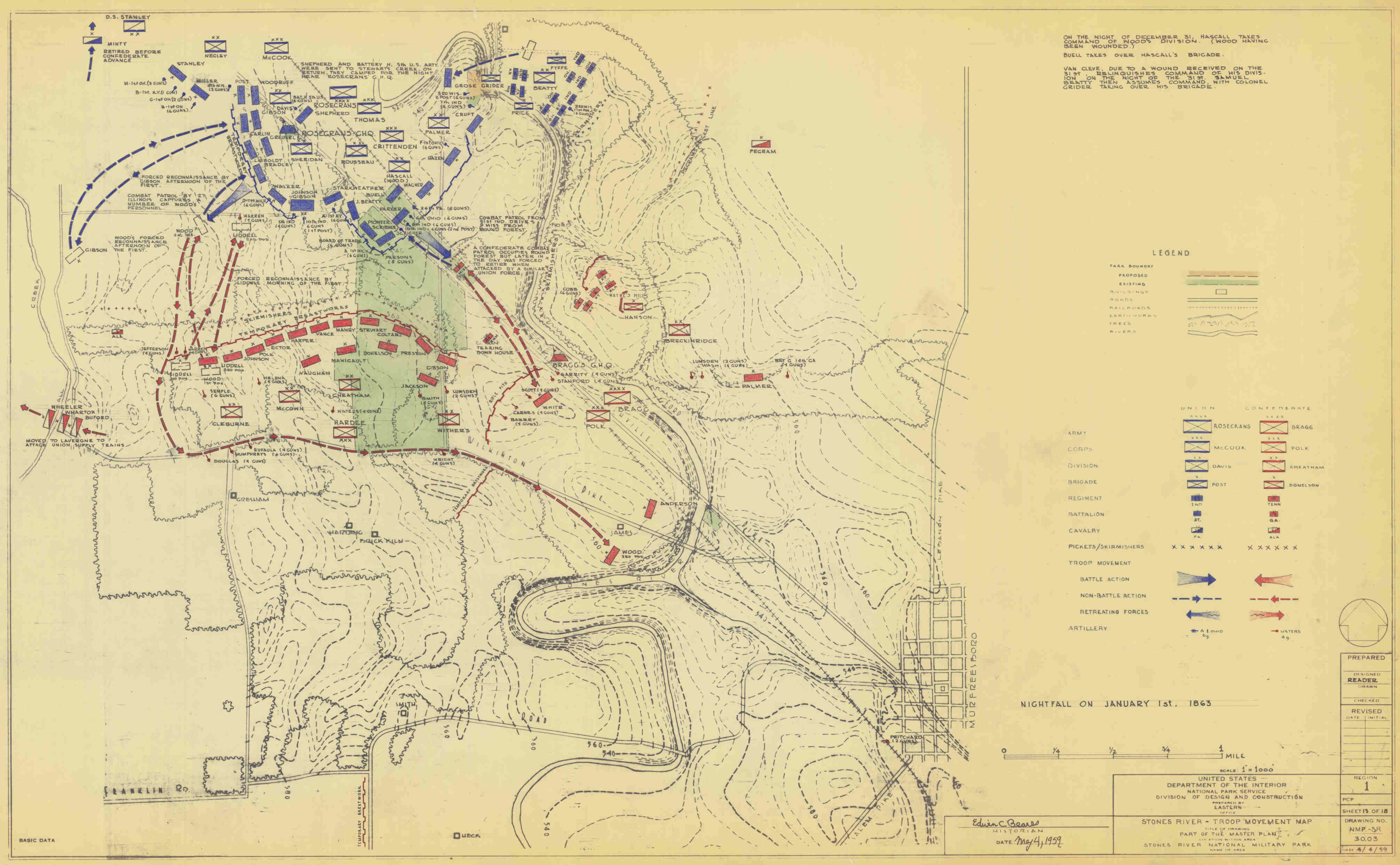
Battle Positions January 2 Afternoon


Click to Enlarge Map

Tennessee State Battle Map
State Battle Maps
American Civil War Exhibits
Civil War Timeline
Women in the War
Civil War Summary
Documents of the Civil War
Civil War Cooking
Civil War Submarines
Kids Zone Causes of the War


Chattanooga Tennessee City History Current Weather Hotel Motel camping and attractions
 
Web AmericanCivilWar.com
Volcano-Pictures.INFO

Additional Reading


No Better Place to Die
by Peter Cozzens
The Battle of Stones River
Cozzens's chronicle of the Battle of Stones River is a superb, engaging work. His careful work and skillful writing does justice to the memories of the 24,988 men who were injured or killed those cold days in Tennessee.

Civil War History Book Club Reading Titles


The bloodbath at Shiloh, Tenn. (April 6-7, 1862), brought an end to any remaining innocence in the Civil War. The combined 23,000 casualties that the two armies inflicted on each other in two days shocked North and South alike. Ulysses S. Grant kept his head and managed, with reinforcements, to win a hard-fought victory. Confederate general Albert Sidney Johnston was wounded and bled to death, leaving P.G.T. Beauregard to disengage and retreat with a dispirited gray-clad army. Daniel (Soldiering in the Army of Tennessee) has crafted a superbly researched volume that will appeal to both the beginning Civil War reader as well as those already familiar with the course of fighting in the wooded terrain bordering the Tennessee River. His impressive research includes the judicious use of contemporary newspapers and extensive collections of unpublished letters and diaries.

An act of love but also of careful scholarship, This Great Battlefield of Shiloh tells the story of the construction of a National Military Park there and of the people who made it. Everyone interested in the battle will want to read what happened there after the fighting stopped, and anyone interested in the process of reunion after the Civil War will learn that a field of such carnage became a site of reconciliation and nationalism

The first major battle in the Western theatre of the American Civil War, Shiloh came as a horrifying shock to both the American public and those in arms. For the first time they had some idea of the terrible price that would be paid for the preservation of the Union. On 6 April 1862 General Albert Sidney Johnston caught Grant and Sherman by surprise and very nearly drove them into the River Tennessee, but was mortally wounded in the process. Somehow Grant and Sherman hung on and the next day managed to drive back the hordes of grey-clad rebels.
By mid 1862, Union gains in the Mississippi Valley and in Tennessee and Kentucky had brought the Confederacy to a point of strategic crisis. This valuable addition to the growing literature on the Civil War in the West tells how the Union then failed to press home its advantage while the Confederacy failed to force Kentucky into the Confederacy. The climax of these events was the little-known Battle of Perryville, in which a greatly inferior Southern force under Braxton Bragg managed a draw against Don Carlos Buell's Union army but also effectively terminated the Confederate invasion of Kentucky. McDonough has researched thoroughly and written clearly, making this book informative and accessible to a wide range of Civil War students.

Cozzens follows up his magisterial account of the Battle of Chickamauga, This Terrible Sound (1992), with an equally authoritative study of the Chattanooga campaign that followed it. Braxton Bragg (who sometimes seems unfit to have been at large on the public streets, let alone commanding armies) failed to either destroy or starve out the Union Army of the Cumberland. In due course, superior Northern resources and strategy--not tactics; few generals on either side come out looking like good tacticians--progressively loosened the Confederate cordon around the city. Finally, the Union drove off Bragg's army entirely in the famous Battle of Missionary Ridge, which was a much more complex affair than previous, heroic accounts make it. Like its predecessor on Chickamauga, this is such a good book on Chattanooga that it's hard to believe any Civil War collection will need another book on the subject for at least a generation.

Sources:
U.S. National Park Service
U.S. Library of Congress.