Major General George B. McClellan affected a smile as he read the fateful orders from Washington. Turning toward his late night visitor, General McClellan spoke without revealing his bitter disappointment. "Well Burnside, I turn the command over to you." With these words, the charismatic, overcautious leader of the Union's most famous fighting force exited the military stage, yielding to a new man with a different vision of war.
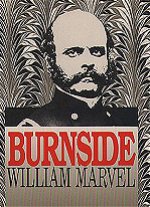
US General Ambrose E. Burnside inherited the Army of the Potomac on November 7, 1862. Its 120,000 men occupied camps near Warrenton,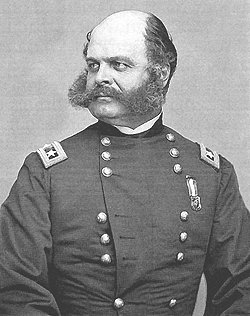 Virginia. Within two days, the 38 year-old Indiana native proposed abandoning McClellan's sluggish southwesterly advance in favor of a 40-mile dash across country to Fredericksburg. Such a maneuver would position the Federal army on the direct road to Richmond, the Confederate capital, as well as ensure a secure supply line to Washington. Virginia. Within two days, the 38 year-old Indiana native proposed abandoning McClellan's sluggish southwesterly advance in favor of a 40-mile dash across country to Fredericksburg. Such a maneuver would position the Federal army on the direct road to Richmond, the Confederate capital, as well as ensure a secure supply line to Washington.
President Lincoln approved General Burnside's initiative but advised him to march quickly. Burnside took the President at his word and launched his army toward Fredericksburg on November 15. The bewhiskered commander (whose facial hair inspired the term "sideburns") also streamlined the army's organization by partitioning it into thirds that he styled "grand divisions." The blueclad veterans covered the miles at a brisk pace and on November 17 the lead units arrived opposite Fredericksburg on Stafford Heights.
Burnside's swift March placed General Robert E. Lee and his Army of Northern Virginia at a perilous disadvantage. After the Maryland Campaign, Lee had boldly divided his 78,000 men, leaving Lt. General Thomas J. Stonewall Jackson in the Shenandoah Valley while sending Lt. General James Longstreet to face the Federals at Culpeper. Lee had not anticipated Burnside's shift to Fredericksburg and now neither of his wings was in position to defend the old city.
The Federals could not move South, however, without first crossing the Rappahannock River, the largest of several river barriers that flowed across his path to Richmond. Because the civilian bridges had been destroyed earlier in the war, Burnside directed that pontoon equipment meet him at Stafford Heights. A combination Of miscommunication, inefficient army bureaucracy, and poor weather delayed the arrival of the floating bridges. When the pontoons finally appeared on November 25, so had the Army of Northern Virginia.
Burnside's strategy depended upon an unopposed crossing of the Rappahannock. Consequently, his plan had failed before a gun had been fired. Nevertheless, the country demanded action. Winter weather would soon render Virginia's highways impassable and end serious campaigning until spring. The Union commander had no choice but to search for a new way to outwit Lee and satisfy the public's desire for victory. This would not be an easy task.
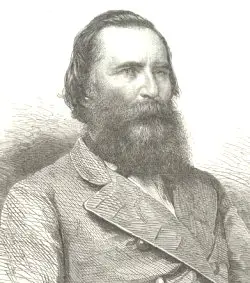 General Longstreet's corps appeared at Fredericksburg on November 19. Lee ordered it to occupy a range of hills behind the town, reaching from the Rappahannock on its left to marshy Massaponax Creek on its right. When Jackson's men arrived more than a week later, Lee dispatched them as far as 20 miles down river from Fredericksburg. The Confederate army thus guarded a long stretch of the Rappahannock, unsure of where the Federals might attempt a crossing. Burnside harbored the same uncertainties. After agonizing deliberation, he finally decided to build bridges at three places - two opposite the city and the other one a mile downstream. The Union commander knew that Jackson's corps could not assist Longstreet in resisting a river passage near town. Thus, Burnside's superior numbers would encounter only half of Lee's legions. Once across the river, the Federals would strike Longstreet's overmatched defenders, outflank Jackson, and send the whole Confederate army reeling toward Richmond. General Longstreet's corps appeared at Fredericksburg on November 19. Lee ordered it to occupy a range of hills behind the town, reaching from the Rappahannock on its left to marshy Massaponax Creek on its right. When Jackson's men arrived more than a week later, Lee dispatched them as far as 20 miles down river from Fredericksburg. The Confederate army thus guarded a long stretch of the Rappahannock, unsure of where the Federals might attempt a crossing. Burnside harbored the same uncertainties. After agonizing deliberation, he finally decided to build bridges at three places - two opposite the city and the other one a mile downstream. The Union commander knew that Jackson's corps could not assist Longstreet in resisting a river passage near town. Thus, Burnside's superior numbers would encounter only half of Lee's legions. Once across the river, the Federals would strike Longstreet's overmatched defenders, outflank Jackson, and send the whole Confederate army reeling toward Richmond.
Burnside's lieutenants, however, doubted the practicality of their chiefs plan. "There were not two opinions among the subordinate officers as to the rashness of the undertaking, "wrote one corps commander. Nevertheless, in the foggy pre-dawn hours of December 11, Union engineers crept to the riverbank and began laying their pontoons. Skilled workmen from two New York regiments completed a pair of bridges at the lower crossing and pushed the upstream spans more than halfway to the fight bank; then the sharp crack of musketry erupted from the river-front houses and yards of Fredericksburg.
These shots came from a brigade of Mississippians under William Barksdale. Their job was to delay any Federal attempt to negotiate the Rappahannock at Fredericksburg. Nine distinct and desperate attempts were made to complete the bridge[s] reported a Confederate officer, "but every one was attended by such heavy loss that the efforts were abandoned..."
Burnside now turned to his artillery chief, Brig. Gen. Henry J. Hunt, and ordered him to blast Fredericksburg into submission with some 150 guns trained on the city from Stafford Heights. Such a barrage would surely dislodge the Confederate infantry and 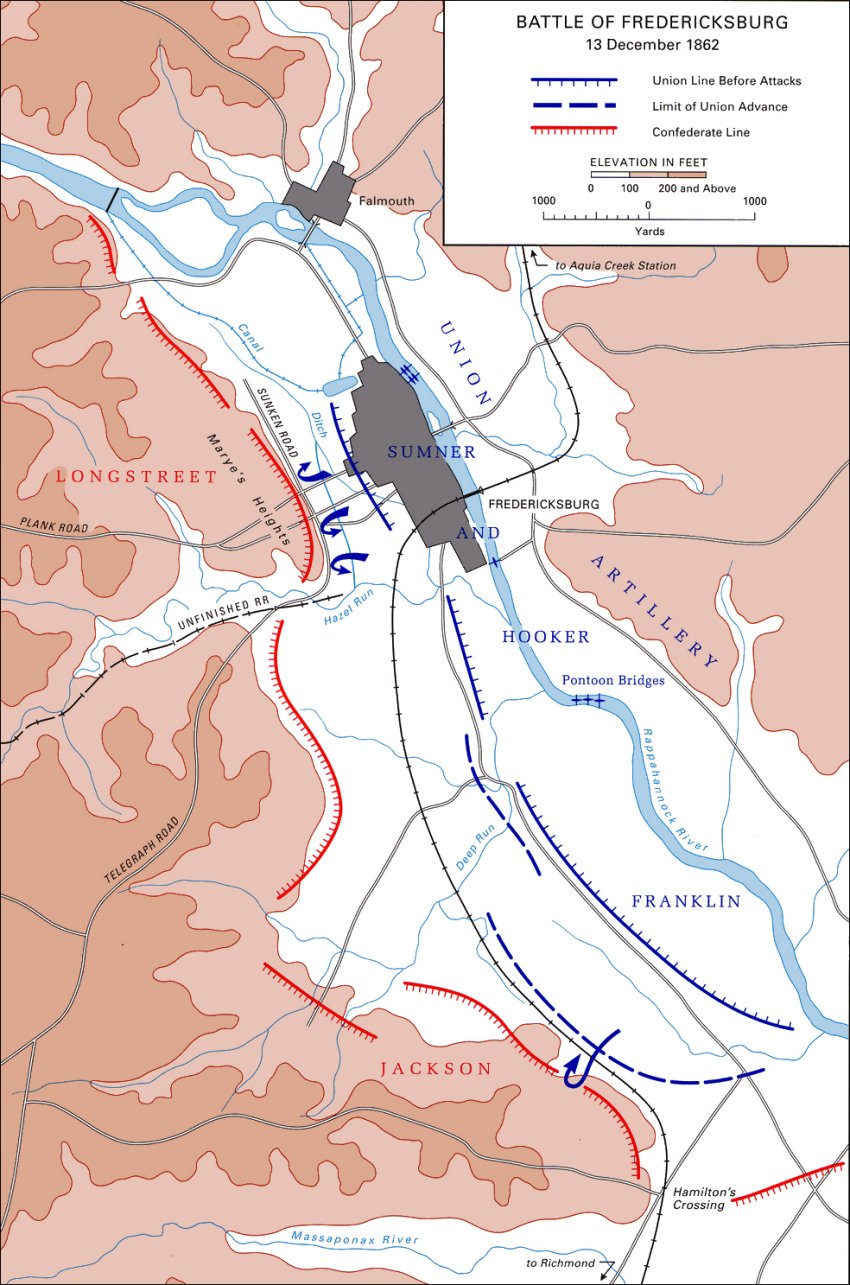 permit completion of the bridges. Shortly after noon, Hunt gave the signal to commence fire. "Rapidly the huge guns vomited forth their terrible shot and shell into every corner and thoroughfare of [Fredericksburg]," remembered an eyewitness. permit completion of the bridges. Shortly after noon, Hunt gave the signal to commence fire. "Rapidly the huge guns vomited forth their terrible shot and shell into every corner and thoroughfare of [Fredericksburg]," remembered an eyewitness.
The bombardment continued for nearly two hours, during which 8,000 projectiles rained destruction on Fredericksburg. Then the grand cannonade ceased and the engineers ventured warily to the ends of their unfinished bridges. Suddenly -impossibly - muzzles flashed again from the cobble-strewn streets and more pontoniers tumbled into the cold waters of the Rappahannock.
Burnside now authorized volunteers to ferry themselves across the river in the clumsy pontoon boats. Men from Michigan, Massachusetts, and New York scrambled aboard the scows, frantically pulling at oar's to navigate the hazardous 400 feet to the Confederates' side. Once on shore, the Federals charged Barksdale's marksmen who, despite orders to fall back, fiercely contested each block in a rare example of street fighting during the Civil War. After dusk the brave Mississippians finally withdrew to their main line, the bridgebuilders completed their work, and the Army of the Potomac entered Fredericksburg.
December 12 dawned cold and foggy. Burnside began pouring reinforcements into the city but made no effort to organize an attack. Instead, the Northerners squandered the day looting and vandalizing homes and shops. A Connecticut chaplain left a graphic account of some of this shameful behavior:
I saw men break down the doors to rooms of fine houses, enter, shatter the lookingglasses with the blow of the ax, [and] knock the vases and lamps off the mantelpiece with a careless swing ... A cavalry man sat down at a fine rosewood Piano ... drove his saber through the polished keys, then knocked off the top [and] tore out the strings ...
Lee, on the other hand, utilized the time by recalling half of Jackson's corps from its isolated posts downstream. Following a personal reconnaissance during the afternoon, "Stonewall" sent word to the rest of his troops to march that night to the point of danger. Forced by political considerations to bring on a battle, Burnside's own needless delay on December 12 lengthened the odds against the Unionists' success.
The Battle of Fredericksburg would unfold in a natural amphitheater bounded on the east by the Rappahannock River and on the west by the line of hills fortified by Lee. When Jackson's men arrived from downstream, Longstreet sidled his corps to the north, defending roughly five miles of Lee's front. He mounted guns at Strong points such as Taylor's Hill, Marye's Heights, Howison Hill, and Telegraph (later Lee's) Hill, the Confederate command post. "Old Pete's" five divisions of infantry supported his artillery at the base of the slopes.
Below Marye's Heights a Georgia brigade under Brig. Gen. Thomas R. R. Cobb poised along a 600-yard portion of the Telegraph Road, the main thoroughfare to Richmond. Years of wagon traffic had worn down the surface of the roadway lending it a sunken appearance. Stone retaining walks paralleling the shoulders transformed this peaceful stretch of country highway into a ready-made trench. Jackson's end of the line possessed less inherent strength. His command post at Prospect Hill rose only 65 feet above the surrounding plain. Jackson compensated for the weak terrain by stacking his four divisions one behind the other to a depth of nearly a mile. Any Union offensive against Lee's seven-mile line would, by necessity, traverse a virtually naked expanse in the teeth of a deadly artillery crossfire before reaching the Confederate infantry.
Burnside issued his attack orders early on the morning of December 13. They called for an assault against Jackson's corps by Maj.. General William B. Franklin's Left Grand Division to be followed by an advance against Marye's Heights by Major General Edwin V. Sumner's Right Grand Division. Burnside used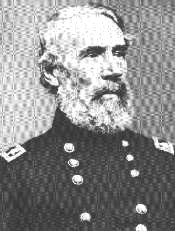 tentative, ambiguous language in his directives, reflecting either a lack of confidence in his plan or a misunderstanding of his opponent's posture -- perhaps both. tentative, ambiguous language in his directives, reflecting either a lack of confidence in his plan or a misunderstanding of his opponent's posture -- perhaps both.
Burnside had reinforced Franklin's sector on the morning of battle to a strenght of some 60,000 men. Franklin, a brilliant engineer but cautious combatant, placed the most literal and conservative interpretation on Burnside's ill-phrased instructions. He designated Maj. General George G. Meade's division -- just 4,500 troops -- to spearhead his attack.
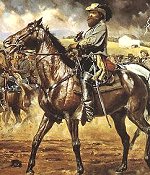
Meade's men, Pennsylvanians all, moved out in the misty half-light about 8:30 a.m. and headed straight for Jackson's line, not quite one mile distant. Suddenly, artillery fire exploded to the left and rear of Meade's lines. Major John Pelham had valiantly moved two small guns into position along the Richmond Stage Road perpendicular to Meade's axis of march. The 24 year-old Alabamian ignored orders from Maj. General J.E.B. Stuart to disengage and continued to disrupt the Federal formations for almost an hour. General Lee, watching the action from Prospect Hill, remarked, "it is glorious to see such courage in one so young."
When Pelham exhausted his ammunition and retired, Meade resumed his approach, Jackson patiently allowed the Federals to Close to within 500 yards Of the wooded elevation where a 14-gun battalion lay hidden in the trees. As the Pennsylvanians drew near to the Richmond, Fredericksburg, and Potomac Railroad north of Hamilton's Crossing, "Stonewall" unleashed his masked artillery. Confederate shells ripped gaping holes in Meade's ranks and the beleaguered Unionists sought protection behind wrinkles of ground in the open fields.
Union guns responded to Jackson's cannoneers. A fullthroated artillery duel raged for an hour, killing so many draft animals that the Southerners called their position "Dead Horse Hill." When one Union shot spectacularly exploded a Confederate ammunition wagon, the crouching Federal infantry let loose a spontaneous Yankee cheer. Meade, seizing the moment, ordered his men to fix bayonets and charge.
Meade's soldiers focused on a triangular point of woods that jutted toward them across the railroad as the point of reference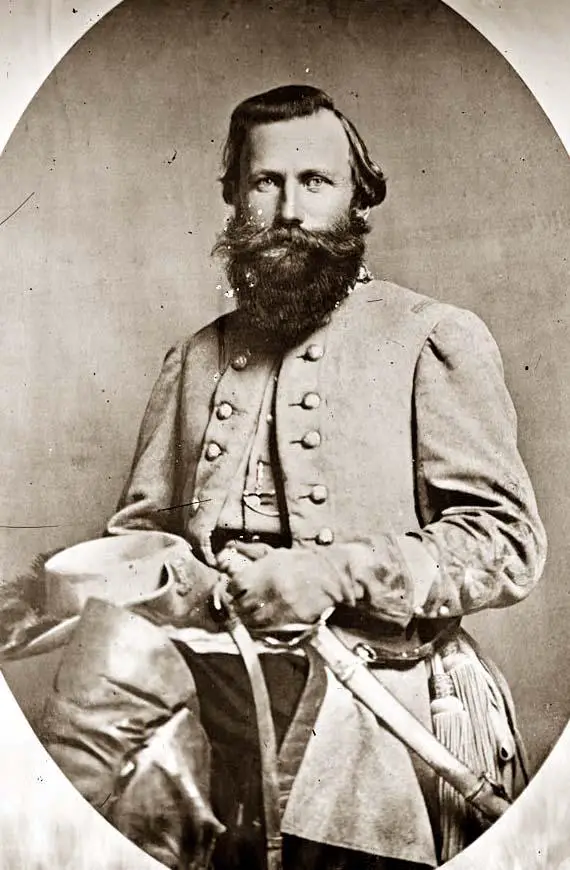 for their assault. When they reached these trees they learned, to their delight, that no Southerners defended them. In fact, Jackson had allowed a 600-yard gap to exist along his front and Meade's troops accidentally discovered it. for their assault. When they reached these trees they learned, to their delight, that no Southerners defended them. In fact, Jackson had allowed a 600-yard gap to exist along his front and Meade's troops accidentally discovered it.
The Unionists pushed through the boggy forest and hit a brigade of South Carolinians, who at first mistook the attackers for retreating Confederates. Their commander, Brig. General Maxcy Gregg, paid for this error with a fatal bullet through his spine. Meade's men rolled forward and gained the crest of the heights deep within Jackson's defenses.
Jackson, who had learned of the crisis in his front from an officer in Gregg's brigade, calmly directed his vast reserves to move forward and restore the line. The Southerners raised the "Rebel Yell" and slammed into the exhausted and outnumbered Pennsylvanians. "The action was close-handed and men fell like leaves in autumn," remembered one Federal. "It seems miraculous that any of us escaped at all."
Jackson's counterattack drove Meade out of the forest, across the railroad, and through the fields to the Richmond Stage Road. Union artillery eventually arrested the Confederate momentum. Except for a minor probe by a New Jersey brigade along the Lansdowne Road in the late afternoon and an aborted Confederate offensive at dusk, the fighting on the south end of the field was over.
Burnside waited anxiously at his headquarters on Stafford Heights for news of Franklin's offensive. According to the Union plan, the advance through Fredericksburg toward Marye's Heights would not commence until the Left Grand Division began rolling up Jackson's corps. By late morning, however, the despairing Federal commander discarded his already-suspect strategy and ordered Sumner's grand division to move to the attack.
In several ways, Marye's Heights offered the Federals their most promising target. Not only did this sector of Lee's defenses lie closest to the shelter of Fredericksburg, but the ground rose less steeply here than on the surrounding hills.
Nevertheless, Union soldiers had to leave the city, descend into a valley bisected by a water-filled canal ditch, and ascend an open slope of 400 yards to reach the base of the heights. Artillery atop Marye's Heights and nearby elevations would thoroughly blanket the Federal approach. "A chicken could not live on that field when we open on it," boasted on Confederate cannoneer.
Sumner's first assault began at noon and set the pattern for a ghastly series of attacks that continued, one after another, until dark. As soon as the Northerners marched out of Fredericksburg, Longstreet's artillery wreaked havoc on the crisp blue formations. The Unionists then encountered a deadly bottleneck at the canal ditch which was spanned by partially-destroyed bridges at only three places. Once across this obstacle, the attackers established shallow battle lines under cover of a slight bluff that shielded them from Reel eyes.
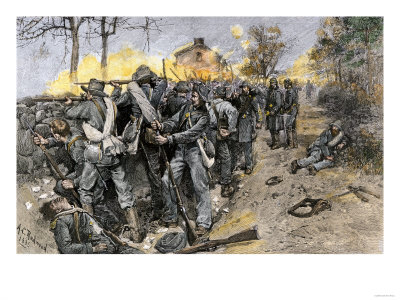
Orders then rang out for the final advance. The landscape beyond the canal ditch contained a few buildings and fences, but from the military perspective it provided virtually no protection. Dozens of Southern cannon immediately reopened on the easy targets and when the Federals traversed about half the remaining distance, as sheet of flame spewed forth from the Sunken Road. This rifle fire decimated the Northerners. Survivors found refuge behind a small swale in the ground or retreated back to the canal ditch valley. 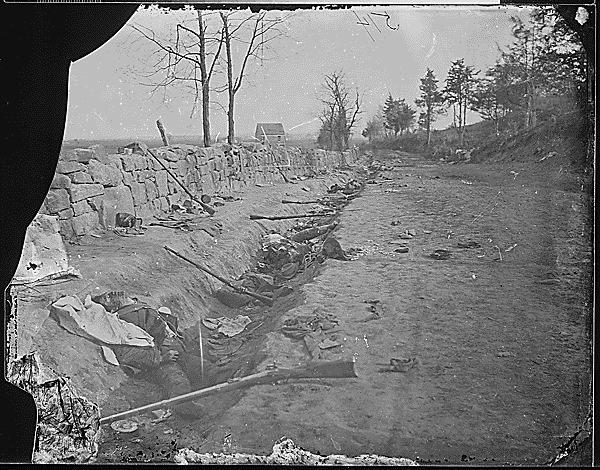
Quickly a new Federal brigade burst toward Marye's Heights and the "terrible stone wall," then another, and another, until three entire divisions had hurled themselves at the Confederate bastion. In one hour, the Army of the Potomac lost nearly 3,000 men; but the madness continued.
Although General Cobb suffered a mortal wound early in the action, the Southern line remained firm. Kershaw's Brigade joined North Carolinians in reinforcing Cobb's men in the Sunken Road. The Confederates stood four ranks deep, maintaining a ceaseless musketry while the gray artillerists fired over their heads.
More Union units tested the impossible. "We came forward as though breasting a storm of rain and sleet, our faces and bodies being only half- turned to the storm, our shoulders shrugged," remembered one Federal. "Everybody from the smallest drummer boy on up seemed to be shouting to the full extent of his capacity," recalled another. But each blue wave crested short of the goal. Not a single Union soldier laid his hand on the stone wan.
Lee, from his lofty perch on Telegraph Hill, watched Longstreet's almost casual destruction of Burnside's divisions as Jackson's counterattack repulsed Meade. Turning toward Longstreet, Lee confessed, "It is well that war is so terrible. We should grow too fond of it."
Burnside ordered Maj. General Joseph Hooker's Center Grand Division to join the attack in the afternoon, and late in the day, troops from the Fifth Corps moved for-ward. Brig. General Andrew A. Humphreys led his division through the human debris of the previous assaults. Some of Humphreys' soldiers shook off well-meaning hands that 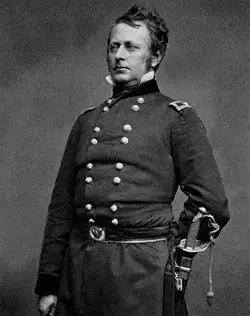 clutched at them to prevent their advance. Part of one brigade sustained its momentum until it drew within 25 yards of the stone wall. There, it too melted away. clutched at them to prevent their advance. Part of one brigade sustained its momentum until it drew within 25 yards of the stone wall. There, it too melted away.
The final Union effort began after sunset. Colonel Rush C. Hawkins' brigade, the fifteenth such Federal unit to charge the Sunken Road that day, enjoyed no more success than its predecessors. Darkness shrouded the battlefield and at last the guns fell silent.
The hideous cries of the wounded, "weird, unearthly, terrible to hear and bear," echoed through the night. Burnside wrote orders to renew the assaults on December 14, wishing to lead them personally, but his subordinates dissuaded him from this suicidal scheme. On the evening of December 15-16, Burnside skillfully withdrew his army to Stafford Heights, dismantling his bridges behind him. The Fredericksburg Campaign had ended.
Estimated Casualties: 17,929 total (US 13,353; CS 4,576)
Grim arithmetic tells only a part of the Fredericksburg story. Lee suffered 5,300 casualties but inflicted more than twice that many losses on his opponent. Of the 12,600 Federal soldiers killed, wounded, or missing, almost two-thirds fell in front of the stone wall.
Despite winning in the most overwhelming tactical sense, however, the Battle of Fredericksburg proved to be a hollow victory for the Confederates. The limitless resources of the North soon rectified Burnside's losses in manpower and materiel. Lee, on the other hand, found it difficult to replenish either missing soldiers or needed supplies. The Battle of Fredericksburg, although profoundly discouraging to Union soldiers and the Northern populace, made no decisive impact on the war. Instead, it merely postponed the next "On to Richmond" campaign until the spring.
The text for this section was written by A. Wilson Green, former staff historian for Fredericksburg and Spotsylvania National Military Park. It is derived from a National Park Service training booklet. |





 tentative, ambiguous language in his directives, reflecting either a lack of confidence in his plan or a misunderstanding of his opponent's posture -- perhaps both.
 for their assault. When they reached these trees they learned, to their delight, that no Southerners defended them. In fact, Jackson had allowed a 600-yard gap to exist along his front and Meade's troops accidentally discovered it.

