|
|
|
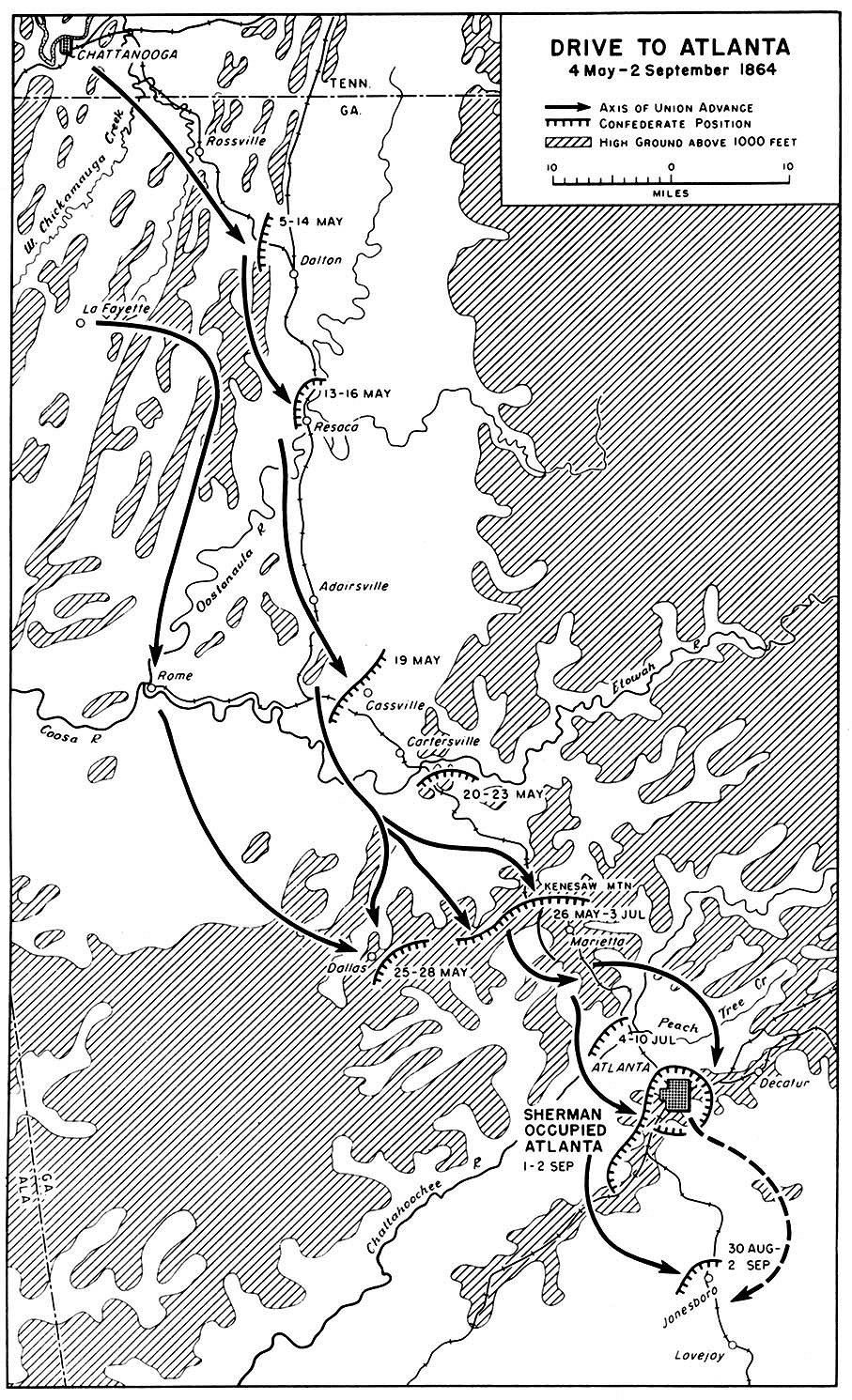
On March 17, 1864, General Grant had met with General Sherman at Nashville and told him his role in the grand strategy. Sherman, like Grant, held two commands. As Division of the Mississippi commander, he was responsible for the operation and defense of a vast logistical system that reached from a communications zone at St. Louis, Louisville, and Cincinnati to center on a large base depot at Nashville. Strategically, Nashville on the Cumberland River rivaled Washington, D.C., in importance. A 90-mile military railroad, built and operated by Union troops, gave Nashville access to steamboats plying the Tennessee River. Connected with Louisville by rail, Nashville became one vast storehouse and corral. If the city was destroyed, the Federal forces would have to fall back to the Ohio River line. Wearing his other hat, Sherman was a field commander, with three armies under his direction. With the promise of the return of his two crack divisions from the Red River expedition by May 1864 and with a splendid administrative system working behind him, Sherman was ready to leave Chattanooga March to the Sea through Atlanta. His mission was to destroy CSA General Joseph Johnston's armies and capture Atlanta, which after Richmond was the most important industrial center in the Confederacy. With 254 guns, Sherman matched his three small armies, and a separate cavalry command a total force of more than 100,000 men against General Johnston's Army of Tennessee and the Army of Mississippi including General Wheeler's cavalry, consisting of 65,000 men. Sherman moved out on May 4, 1864, the same day the Army of the Potomac crossed the Rapidan. Johnston, realizing how seriously he was outnumbered, decided to go on the defensive, preserve his forces intact, Johnston had done his part well. He had accomplished his missions and had so slowed Sherman that Sherman covered only 100 miles in 74 days. Johnston, his forces intact, was holding strong positions in front of Atlanta, his main base; but by this time Jefferson Davis had grown impatient with Johnston and his tactics of cautious delay. In July he replaced him with General John B. Hood, a much more impetuous commander. On July 20, while Sherman was executing a wide turning movement around the northeast side of Atlanta, Hood left his fortifications and attacked at Peach Tree Creek. When Sherman beat him off, Hood pulled back into the city. The fall of Atlanta gave President Lincoln's campaign for reselection in 1864 a tremendous boost. In addition, the psychological lift given the Union by Admiral Farragut's personal heroism in the battle of Mobile Bay greatly added to Lincoln's prestige. Atlanta was only a halfway point in Sherman's vast wheel from the western theater toward the rear of Lee's Army of Northern Virginia. Abandoning the idea of catching up with Hood, Sherman by telegraph outlined his next strategic move to Lincoln and Grant in early September 1864. Sherman's two proposals proved him an able strategist as well as a consummately bold and aggressive commander. To defend Nashville, he suggested that he send two corps, 30,000 men, back to Thomas, where that commander would raise and train more men and be in position to hold Tennessee if Hood came north. To carry the offensive against the economic heart of the Confederacy, Sherman recommended that he himself take four corps�62,000 men�cut his own communications, live off the country, and march to the seacoast through Georgia, devastating and laying waste all farms, railways, and storehouses in his path. Whether he arrived at Pensacola, Charleston, or Savannah, Sherman reasoned he could hold a port, make contact with the U.S. Navy, and be refitted by Stanton and Meigs. Meigs promised to do the logistical job, and Lincoln and Grant, though their reaction to the plan was less than enthusiastic, accepted it in a show of confidence in Sherman. Before marching out of Atlanta, Sherman's engineers put selected buildings to the torch and destroyed all railroads in the vicinity. On November 12, moving away from the Nashville depots toward Savannah, the Division of the Mississippi troops broke telegraphic contact with Grant. They had twenty days' emergency rations in their wagons, but planned to replenish them by living off the country. Operating on a 60-mile-wide front, unimpeded by any Confederate force, Sherman's army systematically burned and destroyed what it did not need. The march became something of a rowdy excursion. Sherman's campaign, like Sheridan's in the Shenandoah, anticipated the economic warfare and strategic aerial bombardments of the twentieth century. Yet the victims of his methods could hardly be blamed if they regarded Sherman's strategy as an excuse for simple thievery. On December 10 Sherman, having broken the classic pattern by moving away from his logistical base, arrived in front of Savannah. Confederate forces evacuated the seaport on December 21 and Sherman offered it to the nation as a Christmas present. Awaiting him offshore was Meigs' floating seatrain, which enabled him to execute the last phase of Grant's strategy, a thrust north toward the line of the James River.
|
 Guide to the Atlanta Campaign: Rocky Face Ridge to Kennesaw Mountain Following the capture of Chattanooga, the Union initiated battles and operations that took it from the Tennessee border to the outskirts of Atlanta. Bloody confrontations at places such as Resaca and New Hope Church. Grant had ordered Sherman to penetrate the enemy's interior and inflict "all the damage you can against their War resources,"  Cracker Cavaliers: The 2nd Georgia Cavalry Under Wheeler and Forrest The Second Georgia fought in such famous campaigns as Perryville, Stones River, Chickamauga, Knoxville, Resaca, Atlanta, and Bentonville, they also participated in deadly encounters at Farmington, Mossy Creek, Noonday Creek, Sunshine Church, and Waynesboro  Sherman's Horsemen: Union Cavalry Operations in the Atlanta Campaign A comprehensive study of the role of the cavalry in Sherman's coordinated assault on Atlanta in 1864, involving three federal armies that swept in from the west through Alabama and Georgia |
Kindle Available Civil War Curiosities: Strange Stories, Oddities, Events, and Coincidences |
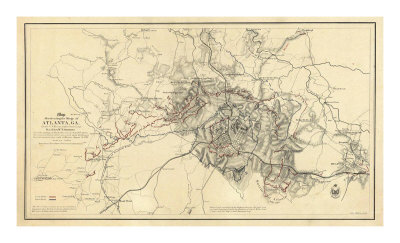
Civil War Map Illustrating the Siege of Atlanta, Georgia, c.1864 48 in. x 29. in. Buy at AllPosters.com Framed |
Comments by CSA General John B. Hood on the Confederate Defense of Atlanta |
Battles of the
|
Kindle Available Southern Storm Sherman's March to the Sea The destruction spanned more than sixty miles in width and virtually cut the South in two, disabling the flow of supplies to the Confederate army. He led more than 60,000 Union troops to blaze a path from Atlanta to Savannah, ordering his men to burn crops, kill livestock, and decimate everything that fed the Rebel war machine |
Campaigns of the Civil War Civil War Exhibits Timeline of the War State Battle Maps Civil War Navy Ships Civil War Summary Civil War Picture Album Women of the Civil War Confederate Commanders Union Generals Civil War Submarines |
Kindle Available Worthy Opponents: William T. Sherman and Joseph E. Johnston: Antagonists in War-Friends in Peace If Confederate President Jefferson Davis had left Gen. Joseph E. Johnston, one of its most effective generals, in command of Atlanta's defenses, the city might have been preserved. Edward Longacre offers a new perspective on Sherman's and Johnston's military histories, including their clashes at Vicksburg, Kennesaw Mountain, and Bentonville |
 The White Tecumseh: A Biography of General William T. Sherman Utilizing regimental histories, historian Hirshon offers a sympathetic yet excellent biography of one of the more noted Civil War generals, best remembered for burning Atlanta, cutting a swath of destruction across Georgia, then creating total destruction in South Carolina, including the burning of Columbia. Hirshon gives us an insight into how Sherman's own troops felt about him and his relationships with fellow generals, especially Grant. |
 Sherman Invades Georgia: Planning the North Georgia Campaign Using a Modern Perspective Sherman Invades Georgia takes advantage of modern planning techniques to fully examine what went into the Georgia campaign. Unlike other studies, though, this one puts the reader squarely into the mind of General Sherman on the eve of his most famous military undertaking—limiting the information to that possessed by Sherman at the time, as documented in his correspondence during the campaign and not in his after-the-fact reports and autobiography. |
 Joseph E. Johnston A Civil War Biography A biography of the public and private life of General Joseph E. Johnston, one of the most important Southern field commanders during the American Civil War |
 The Battle of Resaca: Atlanta Campaign, 1864 Ideal book for a Civil War buff. Take it with you if you visit the site. Written accounts from the soldiers that stormed across the hills put you in the moment. Several good maps and even pictures taken a few days after the battle help take you out of your living room and into the past |
 If You Lived at the Time of the Civil War All of the "If you Lived at the Time of..." books are great for kids, and also a nice, quick read for adults! What I like about them is their layout, which is easy for readers to follow. Each page begins with a question, "Would you have seen a battle in the South?" for example. Nicely drawn illustrations accompany each answer. |
 Day Of Tears Through flashbacks and flash-forwards, and shifting first-person points of view, readers will travel with Emma and others through time and place, and come to understand that every decision has its consequences, and final judgment is passed down not by man, but by his maker. |
Kindle Available The Civil War Introduces young readers to the harrowing true story of the American Civil War and its immediate aftermath. A surprisingly detailed battle-by-battle account of America's deadliest conflict ensues, culminating in the restoration of the Union followed by the tragic assassination of President Lincoln |
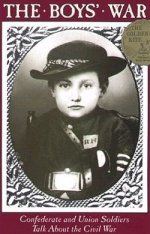 The Boys War With the many boys who fought in the civil war most of them lied about their age. A lot of them wrote letters or had a diary. Johnny Clem had run away from his home at 11. At age 12 he tried to enlist but they refused to let him join because he was clearly too young. The next day he came back to join as a drummer boy. |
 Wargame Construction Age of Rifles 1846 - 1905 Game lets you design and play turn-based strategic battles. You can create scenarios betwen years 1846 and 1905. You have complete control over all the units, and can customize their firepower, movement points, strength, aggressiveness, etc. Supports 1 or 2 players |
 History Channel Civil War A Nation Divided Rally the troops and organize a counterattack -- Your strategic decision and talent as a commander will decide if the Union is preserved or if Dixie wins its independence |
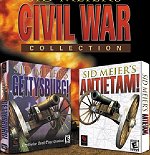 Sid Meier's Civil War Collection Take command of either Confederate or Union troops and command them to attack from the trees, rally around the general, or do any number of other realistic military actions. The AI reacts to your commands as if it was a real Civil War general, and offers infinite replayability. The random-scenario generator provides endless variations on the battles |
 History Channel Civil War Secret Missions There are about a half-dozen different small arms types, but the Henry is the best for rapid repeating fire and least reloading. The shotgun they give you is useless: you must aim spot-on to affect an enemy, so why not just use the rifle? Grenades are useful at times. |
 The Last Confederate The Story of Robert Adams Great historically correct movie of a noble confederate and his undying love of a Yankee girl. |
 Civil War Terror Tales of hidden conspiracies of terror that specifically targeted the civilian populations. Engineers of chemical weapons, new-fangled explosives and biological warfare competed |
 The Civil War: To the Finish: Sherman and the March to the Sea After 3 years of battles, a Union general captured Atlanta and decided to change the course of the war for good. That general was William Tecumseh Sherman |
 The Last Days of the Civil War - Biography: Abraham Lincoln & Robert E. Lee, Civil War Journal: Jefferson Davis In-depth profiles that series--illuminate the personalities at the heart of the conflict: Abraham Lincoln, Jefferson Davis, and Robert E. Lee |
 History Channel Presents The Civil War From Harper's Ferry, Fort Sumter, and First Bull Run to Shiloh, Antietam, and Gettysburg. The most legendary Civil War battles in brilliant detail. A selection of the soldiers and legendary leaders. |
 History Channel Presents Sherman's March In November 1864, Sherman and an army of 60,000 troops began their month-long march from Atlanta to Savannah. Burning crops, destroying bridges and railroads, and laying waste to virtually everything in his path |
 History's Mysteries - Human Bondage The story of Africans forcibly enslaved and shipped to America is a well-known tale; yet, it is just one tragic episode in the saga of world slavery. For nearly 6,000 years of recorded history, conquerors have imprisoned their enemies and forced them to act as laborers |
 Civil War Journal, West Point Classmates - Civil War Enemies, Robert E. Lee Beyond the pages of history and into the personal stories behind the Great Conflict |
 American Experience The Massachusetts 54th Colored Infantry After Lincoln signed the Emancipation Proclamation, the governor of Massachusetts was authorized to raise the first northern black regiment, the Massachusetts 54th colored infantry. |
 Long Road Back to Kentucky: The 1862 Confederate Invasion The often-overlooked Western campaign of the war with a specific emphasis on Kentucky's involvement in the American Civil War. |
History's Mysteries: Family Feud: The Hatfields And McCoys Millions of dollars worth of timber and coal rich land were at stake, the courts were involved and once the national press got wind of what was happening, the backwoods folk found that their fight was being followed nationwide |
 The Civil War - A Film by Ken Burns Here is the saga of celebrated generals and ordinary soldiers, a heroic and transcendent president and a country that had to divide itself in two in order to become one |
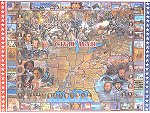 Civil War Historic 1000-piece Puzzle The famous faces and fearsome facts of the Civil War are captured in this 1,000-piece cardboard puzzle for Civil War buffs and serious puzzle fans. |
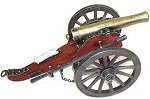 Civil War Cannon Collectible Models and childrens playsets Miniature Collectible Civil War Cannon12 pound Civil War field cannon replica weapon collectible is a detailed 1/12th scale military caisson replica weapon collectible as used throughout the Civil War Childrens Cannon Set. Includes 6 gray cannon with black wheels that measure 4.5 inches long |
 Professor Noggin's Civil War Trivia Game
|
 Civil War Soldier 102 Piece Playset
|
||||||
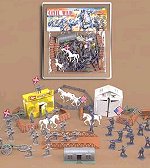 72 Piece Civil War Army Men Play Set 52mm Union and Confederate Figures, Bridge, Horses, Canon
|
 Monitor 21" Civil War Ship Wood Model Fully Assembled
|
 Civil War Chess Set Painted civil war chess set. Dimensions: Chess set pieces: 3-1/4" King's; 1-1/8" bases |
 Civil War Union Cavalry: 25 Piece Set
|
Sources:
U.S Army
Library of Congress
National Park Service
|
Books Civil War Womens Subjects Young Readers Military History DVDs Confederate Store Civil War Games Music CDs |

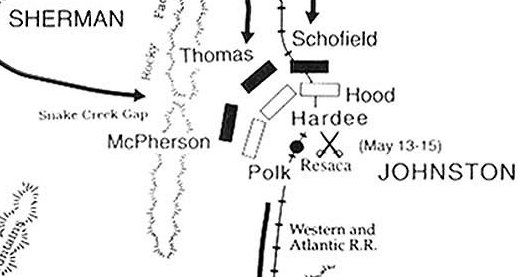 hold Atlanta, and delay Sherman as long as possible. There was always the hope that the North would grow weary of the costly struggle and that some advocate of peaceful settlement might defeat Abraham Lincoln in the election of 1864. From May 4 through mid-July, the two forces maneuvered against each other. There were daily fights but few large-scale actions. As Sherman pushed south, Johnston would take up a strong position and force Sherman to halt, deploy, and reconnoiter. Sherman would then outflank Johnston, who in turn would retire to a new line and start the process all over again. On June 27 Sherman, unable to maneuver because the roads were muddy and seriously concerned by the unrest in his armies brought about by constant and apparently fruitless marching, decided to assault Johnston at Kennesaw Mountain. This attack against prepared positions, like the costly failure at Cold Harbor, was beaten back. Sherman returned to maneuver and forced Johnston back to positions in front of Atlanta.
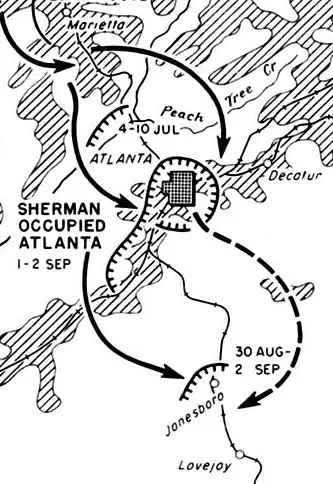 While Sherman made ready to invest, Hood attacked again and failed again. Sherman then tried cavalry raids to cut the railroads, just as Johnston had during the advance from Chattanooga, but Sherman's raids had as little success as Johnston's. Sherman then began extending fortifications on August 31. Hood, who had dissipated his striking power in his assaults, gave up and retired to northwest Alabama, and Sherman marched into Atlanta on the first two days of September. Sherman hoped that Mobile had fallen, and a shorter line for his supplies by way of Montgomery, Alabama, or still better by the lower Chattahoochee to Columbus, Georgia, was open. Admiral Farragut had entered Mobile Bay on August 5, 1864, but had no troops to take Mobile itself.